
Industrial Roof Maintenance Program in Bryan, Ohio: A Practical Checklist
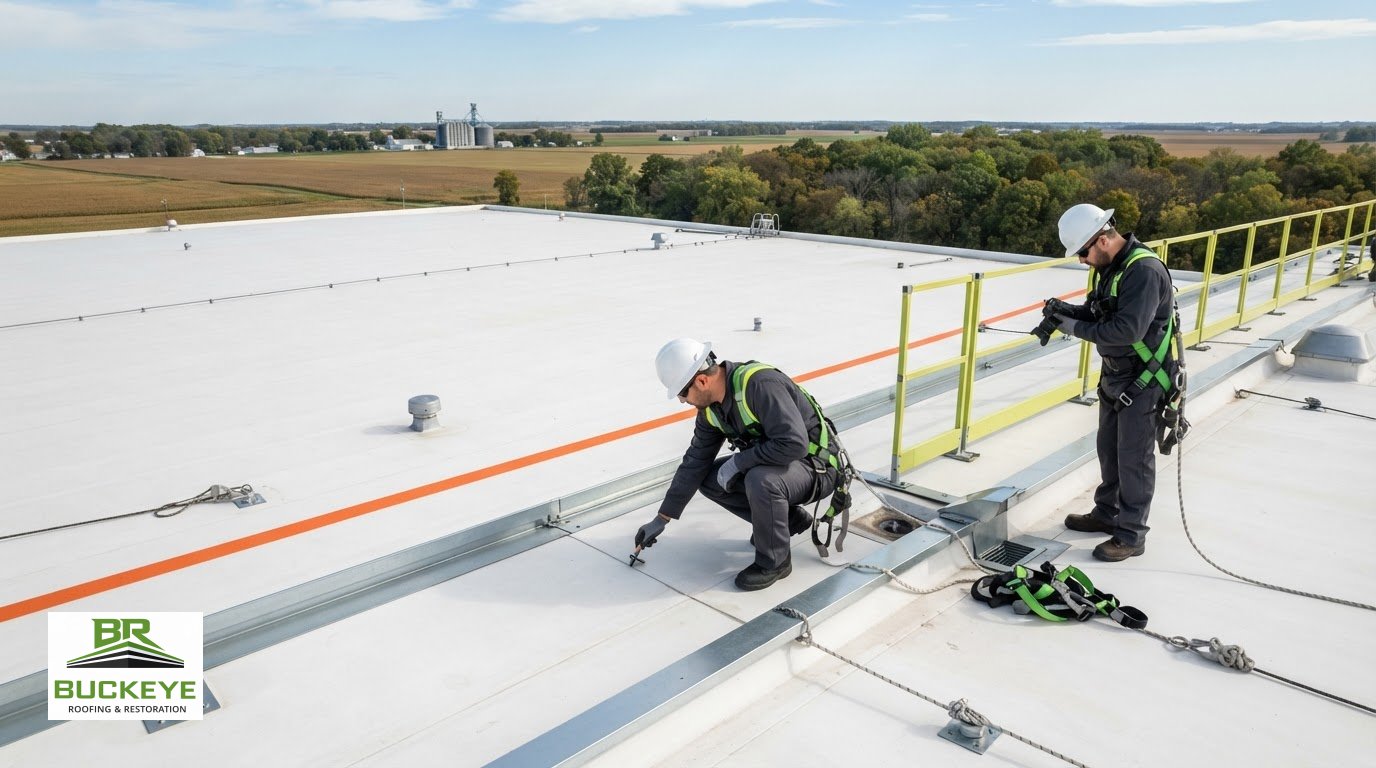
What if the first sign of a roof problem didn’t have to be a leak? For facility managers, roof conditions can change before damage is visible inside. An industrial roof maintenance program in Bryan Ohio gives your team a repeatable way to record observations, track follow-up, and make decisions based on the roof’s condition instead of scattered emails, work orders, or memory.
A maintenance routine doesn’t mean treating every concern as a major project. It starts with planned reviews, clear records, and a practical way to prioritize findings. In Bryan, seasonal shifts, freeze-thaw cycles, snow, and storms make it useful to consider changing weather and safe access when planning roof reviews.
This checklist covers what to document on a commercial or industrial low-slope roof, how to organize findings, and when to involve a roofing professional. Inspection results can help clarify whether a concern calls for repair, further evaluation for restoration or coating, or consideration of replacement. The goal is a consistent roof-care process, not a one-size-fits-all recommendation.
Key Takeaways
- Make roof care repeatable by assigning responsibility, keeping inspection records together, and tracking follow-up actions.
- Record each observation with its location, visible condition, date, and priority so maintenance decisions have a clear basis.
- Use pre-winter, post-winter, and post-storm reviews to focus attention on drainage, ice, and visible roof changes.
- An industrial roof maintenance program in Bryan Ohio turns observations into practical next steps instead of waiting for a leak to dictate priorities.
- Have a commercial roofing professional assess leaks, standing water, loose materials, or other concerns that need closer inspection.
What an Industrial Roof Maintenance Program Should Do for a Bryan, Ohio Facility
A maintenance program is more than a date on the calendar. It creates a repeatable cycle of condition reviews, written observations, and prioritized follow-up. For a facility manager in Bryan, organized roof information is useful when planning building upkeep, responding to a concern, or weighing future capital work.
An industrial roof maintenance program in Bryan Ohio also helps your team pay attention before a leak disrupts building operations. Planned reviews give staff a chance to record visible changes and arrange professional evaluation before deciding what work, if any, is appropriate. Routine reviews can’t prevent every leak or predict every problem, but they make it easier to identify and follow up on known concerns.
Who benefits from a planned roof-care routine?
Facility managers, manufacturers, warehouse operators, and commercial property owners benefit from a shared record of roof conditions. A Bryan-area facility may have production, storage, or tenant needs that make it important to know where an issue was observed and whether it has changed. Consistent records help teams coordinate maintenance priorities, plan access, and bring useful information into budget and capital discussions.
Connect roof observations to building operations. If staff report interior moisture, record where it appeared and when, then arrange a professional assessment rather than assuming the roof is the source. A qualified inspection can help investigate the concern and establish appropriate next steps.
What a maintenance program can and cannot tell you
Recurring observations can flag changes that deserve closer attention, such as a new visible defect, drainage concern, or altered condition around roof equipment. Records provide context over time, but they don’t guarantee that a roof will remain leak-free. Roof access and close inspection also involve hazards, so staff should not climb onto a roof or attempt repairs unless they’re trained and authorized to do so.
Roof maintenance is the planned review and documentation of roof conditions; repair addresses a specific defect, while replacement installs a new roofing system. A commercial “flat” roof is typically a low-slope system designed to drain. Reviews should note whether water appears to move toward drains and other drainage points. A professional inspection is needed to assess the roof’s actual condition.
When findings point to a specific defect, a professional evaluation may lead to commercial roof repair. Other findings may call for continued monitoring or a broader assessment. The right recommendation depends on the roof’s condition and inspection results, not on a maintenance schedule alone.
Industrial Roof Maintenance Checklist: What to Document During a Review
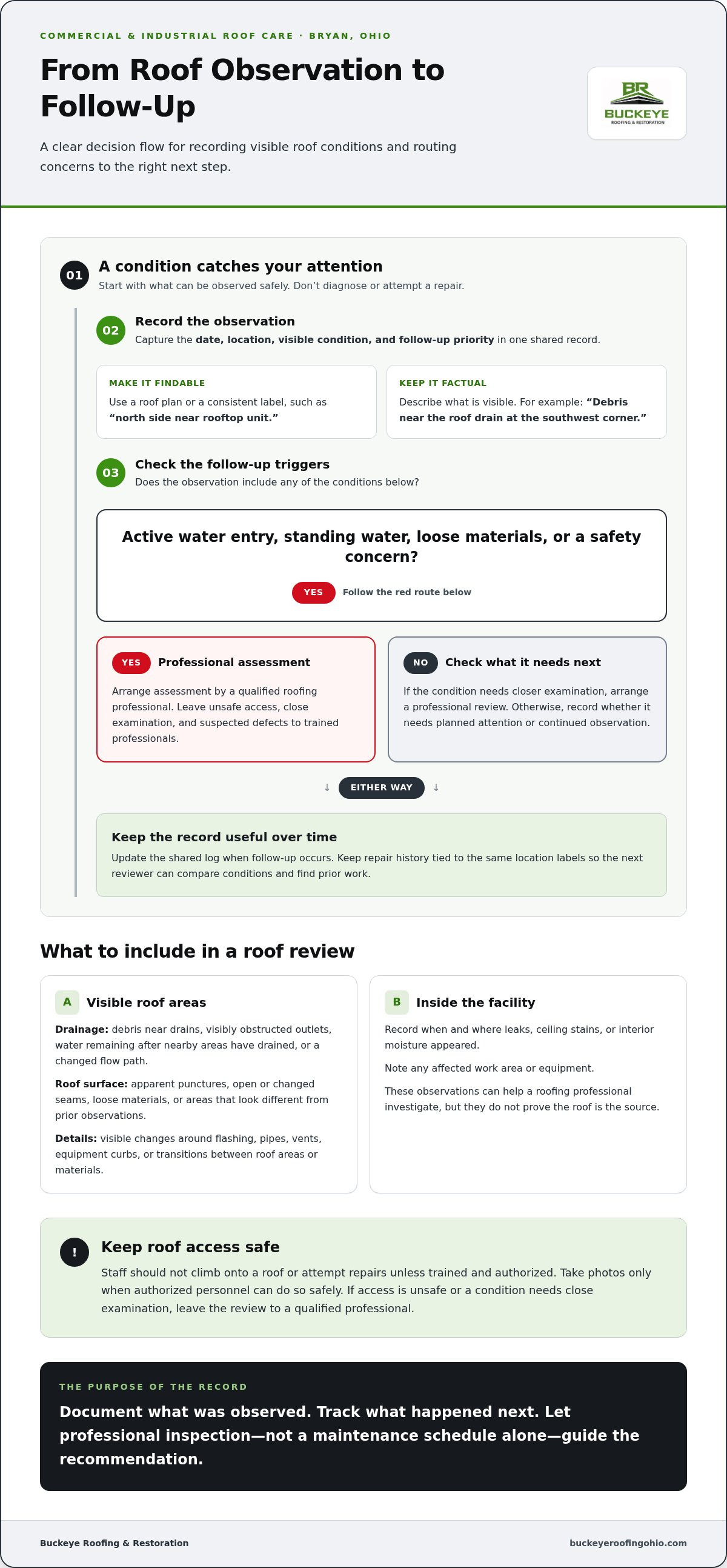
A useful roof record separates what someone observed from what they think it means. For each finding, note the date, location, visible condition, and follow-up priority. Use a roof plan or consistent area labels, such as “north side near rooftop unit,” so the next reviewer can find the same spot. Add a photograph only when authorized personnel can take it safely.
Visible roof areas and drainage conditions
Commercial low-slope roofs are designed to drain, so note visible conditions that may affect drainage or signal a change. Record what you can observe without attempting a diagnosis or repair. Don’t climb onto the roof, move materials, or investigate a suspected defect yourself. If access is unsafe or a condition needs close examination, leave the review to a qualified professional.
- Drainage: Note debris near roof drains, a visibly obstructed outlet, water that remains after nearby areas have drained, or a changed flow path.
- Roof surface: Record apparent punctures, open or changed seams, loose materials, or areas that look different from prior observations.
- Details and transitions: Note visible changes around flashing, pipes, vents, equipment curbs, and transitions between roof areas or materials.
- Follow-up: Mark whether the item needs professional review, planned attention, or continued observation. Active water entry, standing water, loose materials, or a safety concern warrants professional assessment.
Clear wording helps. “Debris near the roof drain at the southwest corner” is more useful than “drain problem.” The log should help the next reviewer locate and understand the observation, not imply that anyone has diagnosed its cause.
Building-side observations and maintenance records
Include reports from inside the facility. Staff can record when and where leaks, ceiling stains, or interior moisture appeared, along with any affected work area or equipment. These notes don’t prove the roof is the source, but they can help a roofing professional narrow the investigation.
Keep repair records tied to consistent location labels. If an issue returns near a previously repaired area, that history gives the professional useful context. Photos can help when taken safely from inside the building or another authorized location. Buckeye’s commercial roof repair services address specific defects identified during a professional evaluation.
For an industrial roof maintenance program in Bryan Ohio, keep observations and their status in one shared record. When a concern needs closer assessment, a commercial roof inspection can help clarify what to do next.
How Bryan’s Seasonal Conditions Shape Maintenance Priorities
In Bryan and Northwest Ohio, freeze-thaw cycles, snow, ice, and changing drainage conditions are useful reasons to plan roof reviews around the seasons. These conditions don’t create a fixed inspection schedule or mean every roof has the same vulnerabilities. Consider the roof’s age and condition, prior findings, building use, and whether recent weather or operational changes warrant another look.
Pre-winter and post-winter review priorities
Before winter, use a safe, authorized review or professional inspection to record visible drainage concerns and changes to membrane surfaces, seams, or flashing. This creates a reference point for later comparison. It’s also a good time to note recurring interior concerns so staff know what to watch for during colder months.
After winter, compare new observations with that record. Note changes in drainage, visible roof details, or interior moisture reports rather than assuming a cause. In Bryan, a warehouse with sensitive stored materials or a manufacturer with production areas below the roof may need to address reported water entry promptly because of the potential impact on operations.
When an additional professional review makes sense
A calendar review is a planning tool, not a reason to wait. Arrange professional assessment if staff observe apparent storm damage, loose materials, recurring leaks, or standing water. Prioritize concerns affecting occupied areas, manufacturing operations, stored goods, or equipment. Don’t send untrained staff onto the roof to investigate; ask them to report what they can observe safely from inside or at ground level.
Seasonal observations belong in a roof record because they show what changed, when it changed, and what may need attention next. That history helps facility teams distinguish a new concern from a previously documented condition and gives a roofing professional useful context. The National Roofing Contractors Association offers roofing resources that can inform maintenance planning, while a building-specific assessment remains essential for decisions about a particular roof.
There’s no single review interval that suits every commercial roof. A roof with prior concerns, changing conditions, or operational consequences from water intrusion may need closer attention than one with a stable record. An industrial roof maintenance program in Bryan Ohio should allow for planned seasonal reviews and additional professional evaluation when observations call for it.
If seasonal findings raise questions about a roof’s condition, Buckeye Roofing & Restoration can assess the documented concerns and identify practical next steps for your Bryan-area facility.
Turn Roof Observations into a Practical Maintenance Plan
A roof log is useful only if someone reviews it and moves findings toward a decision. For a Bryan facility, make the process clear so maintenance staff, operations managers, and building owners know where reports go and who follows up. Keep observations, inspection notes, repair history, and open actions in one shared record rather than relying on separate files or informal handoffs.
A repeatable review-and-record process
Assign one person to maintain the record and identify who receives reports of interior leaks or other changes. Follow a consistent sequence:
- Review the history. Check prior inspection notes, repair records, and unresolved items before evaluating new observations.
- Document current conditions. Record the location, visible condition, date, priority, and any available safe photo.
- Compare and prioritize. Note what appears new, unchanged, or recurring, and flag conditions that need professional assessment.
- Assign follow-up. Name the person responsible for the next step and set a review date that accounts for findings, safe access, and building operations.
- Close the loop. Update the log when a professional has assessed the condition or follow-up work is complete.
A simple status such as “open,” “scheduled for review,” or “completed” helps prevent an observation from disappearing after the initial report. For an industrial roof maintenance program in Bryan Ohio, a shared history also gives decision-makers a clearer basis for planning instead of treating every note as an isolated problem.
Prioritize findings without assuming replacement is necessary
Not every item belongs in the same queue. Active water entry, recurring leaks, standing water, loose roof materials, or a suspected structural concern call for professional assessment. Routine observations without an immediate sign of damage can be tracked and reviewed as part of planned maintenance. Staff should report concerns from safe locations, not attempt roof repairs or unsafe access.
The remedy depends on inspection findings. Repair addresses a specific defect. Restoration and coatings may be options only when the roof’s condition, substrate, moisture levels, drainage, and other findings support them. Replacement is a separate decision, considered when the existing system’s condition warrants it. Match the response to the roof rather than defaulting to the largest project. Buckeye’s commercial roof repair services address specific defects after professional evaluation.
If your log contains unresolved concerns or recurring issues, a commercial roof inspection can help clarify the findings and practical next steps.
How Buckeye Supports Commercial Roof Maintenance in Bryan, Ohio
Buckeye Roofing & Restoration is based in Edon, Ohio, and serves commercial and industrial properties in Bryan and surrounding markets. The company also serves businesses across Ohio, Northeast Indiana, and Southern Michigan, including Toledo, Fort Wayne, Findlay, Lima, Jackson, Battle Creek, Elkhart, Defiance, Bryan, Kalamazoo, Adrian, Bowling Green, Perrysburg, and Auburn. For facility managers, manufacturers, warehouse operators, and property owners, commercial roof inspections and preventative maintenance turn recorded concerns into a clearer plan for follow-up. The focus is to assess the roof’s condition and identify next steps suited to the building.
This matters for an industrial roof maintenance program in Bryan Ohio because a checklist can flag changes, but it can’t diagnose every cause or determine the right repair from notes alone. A professional inspection helps put observations in context, including the roof system, drainage, and facility use.
What Buckeye evaluates on commercial and industrial roofs
Buckeye works with commercial flat and low-slope roofs, including TPO and EPDM systems, as well as commercial metal roofing. These systems use different materials and details, so an assessment considers the roof type rather than treating them as interchangeable. The inspection can review visible conditions, drainage, seams, flashing, penetrations, and other areas relevant to the specific system.
Recommendations depend on inspection findings. Roof condition, substrate, moisture levels, drainage, and structural integrity all affect whether repair, restoration, coating, or replacement is appropriate. Restoration or coating isn’t right for every roof. Buckeye’s commercial roof restoration service is one option when the roof’s condition supports it.
A sensible next step for Bryan-area property managers
If maintenance records show recurring leaks, new visible changes, or unresolved drainage concerns, a commercial inspection can help clarify what needs attention. Share the roof’s service history, prior repair notes, and reports of interior moisture. That information can help connect observations to areas that need closer assessment without assuming that the entire roof needs replacement.
After reviewing the roof, Buckeye can explain practical options based on its condition. Repair addresses a specific defect. Restoration or coating may be considered when inspection findings support those approaches. Replacement is evaluated when the roof’s condition calls for a new system. The right next step comes from the roof itself, not a one-size-fits-all recommendation.
For commercial property managers in Bryan, a professional review can turn scattered concerns into a clearer maintenance decision.
Make Roof Care Part of Facility Planning
A roof record becomes more useful when it informs decisions your facility already makes. Bring open findings into maintenance and budget reviews so the team can consider roof work alongside operational needs instead of treating each issue as a surprise. That doesn’t mean committing to a major project whenever a condition changes. It means having clear information to decide what needs attention, what can be tracked, and when professional evaluation is warranted.
An industrial roof maintenance program in Bryan Ohio gives your team a steadier basis for those decisions while leaving room to adjust as the roof and facility needs change. To discuss your building’s condition and next steps, contact Buckeye Roofing & Restoration about a commercial roof inspection.
Frequently Asked Questions
How often should an industrial roof be inspected in Bryan, Ohio?
For an industrial roof maintenance program in Bryan Ohio, set inspection timing around the roof’s condition, system documentation, repair history, and facility operations. A major rooftop equipment change or roofing project can justify a review outside the regular schedule. So can a change in how the space below the roof is used, especially if sensitive inventory or production equipment is involved. A commercial roofing professional can help tailor the schedule to those factors.
What should an industrial roof maintenance checklist include?
Make the checklist useful to the people who will act on it. Include the roof system type if known, a roof-area map or consistent location key, relevant contacts, and open follow-up items. Keep the form consistent from review to review and store it alongside inspection and repair documents. That way, a new facility manager can understand the roof’s history without relying on verbal handoffs.
Can routine roof maintenance prevent every commercial roof leak?
No. Maintenance can support earlier attention, but it can’t rule out every leak or guarantee that one won’t occur. Interior moisture doesn’t always come from the roof, either. Plumbing, building equipment, or condensation may produce similar signs. If the source isn’t clear, don’t assume that a roof repair is the answer. A professional evaluation can help distinguish a roofing issue from another building-system concern before work is planned.
What happens if a commercial roof has standing water?
Standing water deserves attention, but its presence alone doesn’t identify the cause or establish the right fix. If you notice ceiling sagging or another apparent structural change below the area, keep people clear and arrange prompt professional assessment. Otherwise, note where the water is visible and whether the same area appears in later observations. A roofer can evaluate the drainage and roof condition without staff attempting to inspect the surface themselves.
Can a maintained TPO or EPDM roof be restored instead of replaced?
It may be possible, but a maintenance record alone doesn’t establish that restoration is suitable. TPO and EPDM are different roof systems, and an assessment needs to account for the existing assembly and its condition. A targeted repair, restoration or coating, and replacement are distinct approaches. Inspection findings help determine which, if any, fits the roof. The decision should be based on the building and system, not maintenance history alone.
Is it safe for facility staff to walk on an industrial roof?
Only personnel who are authorized, trained, and following the facility’s safety procedures should access a roof. Before any planned access, account for site-specific hazards such as rooftop equipment, changing weather, and areas that may not be safe to walk on. A roof walk isn’t a routine task for every maintenance employee. Staff who aren’t assigned and prepared for roof access should report concerns from a safe location and leave close review to a professional.
What should a facility manager do after discovering a roof leak?
Follow the facility’s water-intrusion and equipment-safety procedures first. If moisture is near electrical equipment or a production process, notify the appropriate onsite personnel and don’t touch affected equipment unless authorized. When arranging an assessment, share whether the leak is active or intermittent and note any recent building or rooftop work that could help with diagnosis. A roofing professional can determine whether commercial roof repair is appropriate after evaluating the condition.

Article by
Harry Stanley III
Harry Stanley III is a construction marketing strategist and fractional CMO at H&A Marketing. He has helped construction companies grow through website strategy, SEO, paid advertising, branding, lead generation, CRM systems, and professional content. His past work includes helping Meraki Solar generate an additional $3.7 million in revenue in his first year and supporting American Builders as a fractional CMO. Today, Harry works directly with custom home builders and construction companies to build marketing systems designed to generate qualified leads and measurable growth.
