
Industrial Flat Roof Replacement in Jackson, Michigan: What Building Owners Should Know
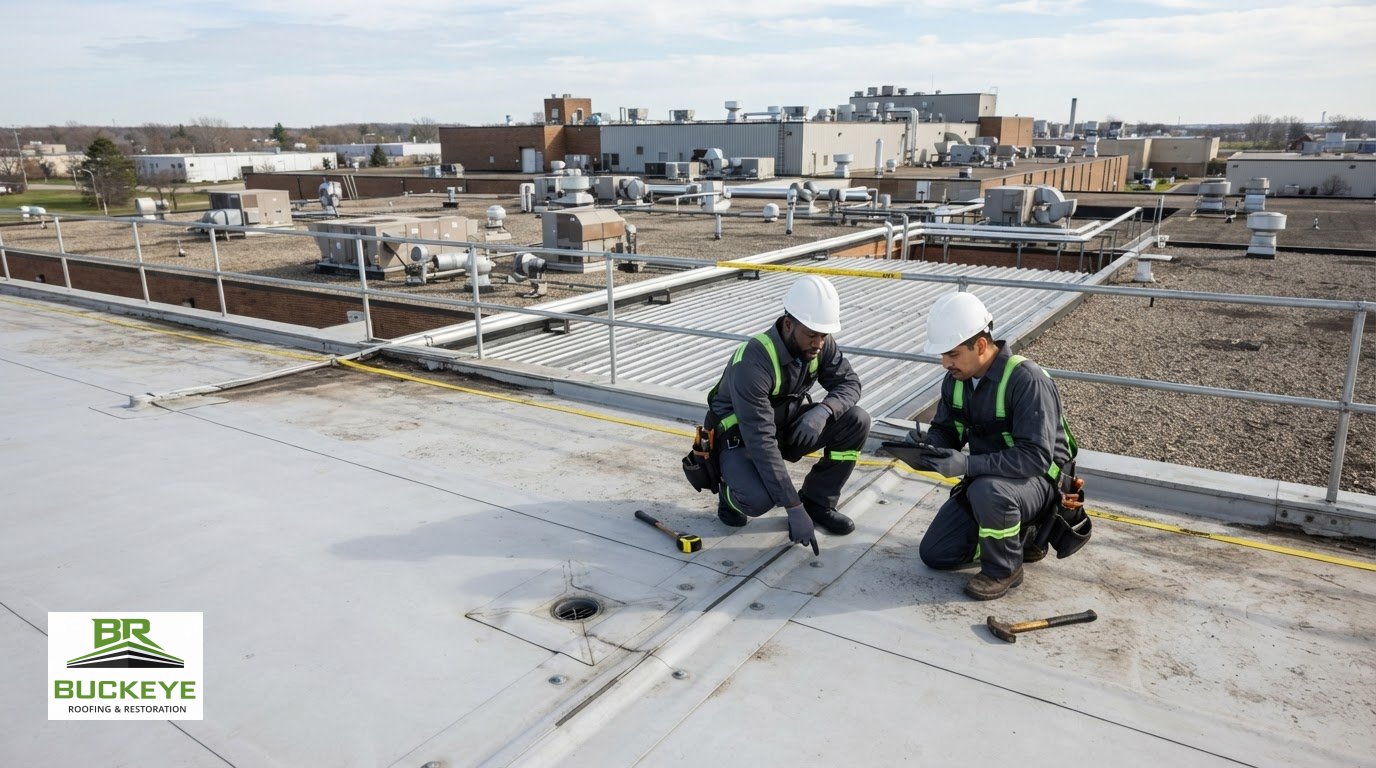
Could recurring leaks and repair bills mean it’s time to replace your roof, or is there a more proportionate fix? For building owners weighing industrial flat roof replacement in Jackson Michigan, the answer depends on more than the latest leak. The roof’s overall condition, moisture below the surface, drainage, and the demands of daily operations all matter.
It’s reasonable to be cautious. A full replacement can affect manufacturing, warehousing, and distribution schedules, while choosing between roofing systems can feel like comparing options without a clear basis. But recurring problems don’t automatically mean the entire roof has failed. A professional inspection can help establish whether repair, restoration, or replacement best fits what the roof actually needs.
This article explains which inspection findings can support a replacement decision, what to compare when evaluating roofing systems, and how to plan work around your building’s use. It also considers Jackson’s seasonal weather and the details to gather before planning next steps, so you can make a practical decision based on your roof and your operations.
Key Takeaways
- Learn which roof conditions may warrant evaluating industrial flat roof replacement in Jackson Michigan, rather than relying on recurring symptoms alone.
- See what a professional inspection examines, from seams and penetrations to drainage and visible deterioration.
- Compare TPO and EPDM based on your building’s conditions and needs, not a one-size-fits-all ranking.
- Prepare for project planning by identifying production, delivery, equipment, tenant, and roof-access constraints.
- Understand how inspection findings help determine whether repair, restoration, coating, or replacement is the proportionate next step.
Industrial Flat Roof Replacement in Jackson, Michigan: What Problems Make It Worth Evaluating?
An industrial “flat roof” is usually a low-slope roofing system, not a perfectly level surface. Its slope and drainage features are designed to move water toward drains or roof edges. Understanding that distinction helps facility teams assess recurring water concerns in context. The Flat Roof Overview provides background on common roof forms and coverings.
In Jackson, snow, ice, and seasonal freeze-thaw conditions make drainage and roof condition important inspection priorities. Water that doesn’t drain as intended, repeated leaks, or deterioration across multiple areas are reasons to arrange a professional assessment. They aren’t proof that the roof needs full replacement. A decision about industrial flat roof replacement in Jackson Michigan should follow an evaluation of the roof assembly and the building’s needs.
A roof symptom is a reason to investigate; replacement is a decision based on inspection findings. One leak may point to a limited repair, while recurring intrusion in several areas or widespread membrane wear may call for a broader review. The distinction matters: visible signs can help staff document a concern, but they can’t reveal the full condition of concealed layers.
Which roof warning signs can facility staff observe safely?
Start indoors and from ground level. Record where ceiling stains appear, when water intrusion occurs, and whether the same areas are affected again. From a safe location, note visible drainage concerns or exterior changes such as loose-looking material. Don’t climb onto the roof to investigate, especially if there’s standing water, ice, or another unsafe condition. Share observations with a roofing professional.
When does a recurring problem call for more than a repair?
An isolated problem may be suitable for a targeted repair. Repeated leaks, concerns across a broad area, or signs that membrane issues extend beyond one location warrant a closer assessment. A professional can investigate the membrane, seams, penetrations, drainage, and underlying substrate. Hidden moisture and substrate condition can’t be reliably determined from interior stains alone, so they need to be assessed as part of the inspection.
Keep a simple record of leak locations, dates, and any repair history. That information helps connect symptoms over time and gives the inspection a useful starting point. For more on weighing recurring patches against broader options, see When Is It Time to Stop Patching a Commercial Flat Roof? The goal isn’t to assume replacement is inevitable; it’s to understand whether a repair addresses the problem or whether the roof needs a more comprehensive plan.
How an Inspection Determines Whether a Jackson Industrial Roof Needs Replacement
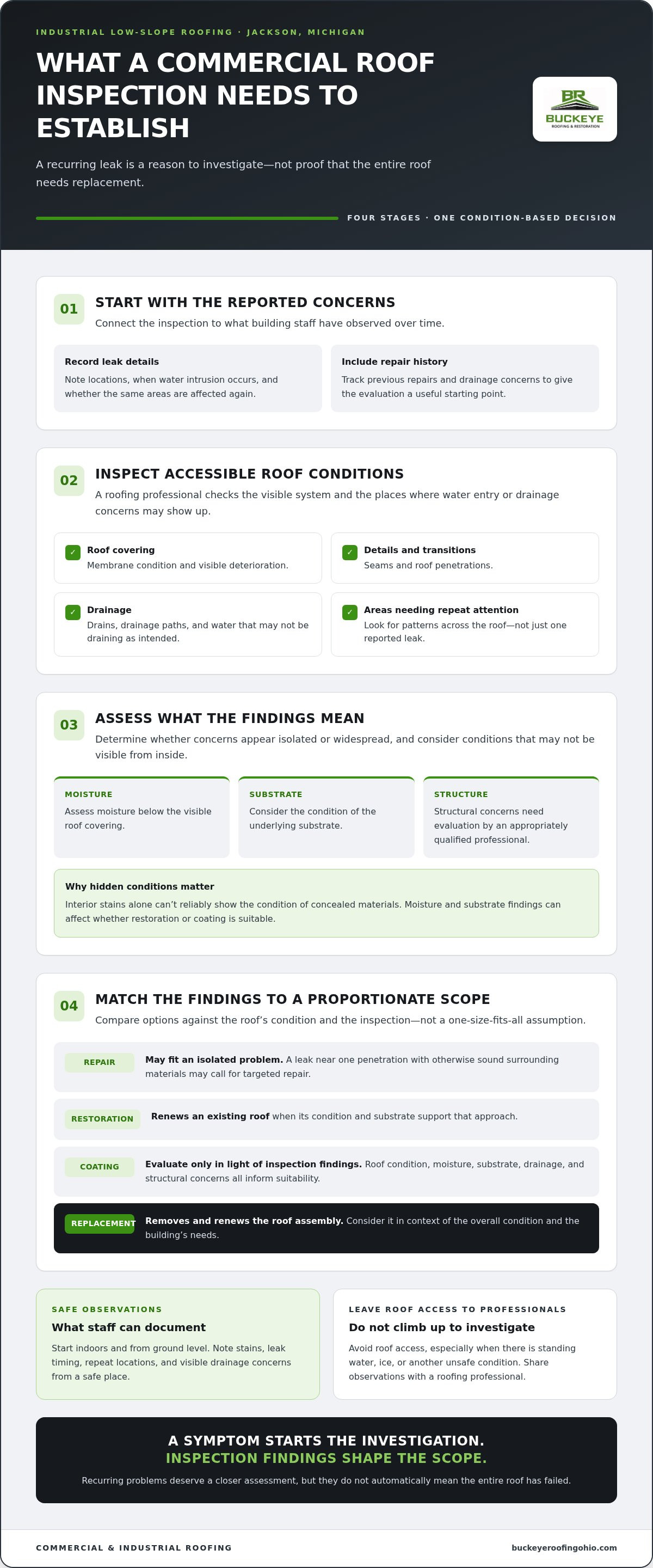
A sound recommendation comes from a sequence, not a single stain or leak report. For industrial flat roof replacement in Jackson Michigan, an inspection helps connect what staff have observed with the condition of the roof assembly, including areas that aren’t visible from inside the building. It can inform the next step, but it can’t guarantee future performance or reveal every concealed condition.
A practical evaluation moves through four stages:
- Review the concerns. Note leak locations, when they occur, repeated repairs, and any drainage issues staff have observed.
- Inspect accessible roof conditions. A roofing professional assesses the membrane, seams, penetrations, drainage paths, and visible deterioration.
- Assess what the findings mean. Consider whether concerns are isolated or widespread, and evaluate moisture, the condition of the underlying substrate, and any structural concerns.
- Compare appropriate options. Match the findings to a targeted repair, restoration, coating, or replacement scope rather than defaulting to one approach.
Moisture and substrate findings can change the recommended scope because a surface that looks repairable may conceal conditions that affect whether restoration or coating is suitable. That’s why an inspection should consider more than the visible membrane. If structural concerns arise, they require evaluation by an appropriately qualified professional rather than a roofing assumption.
What does a commercial roofer evaluate before recommending replacement?
The review includes the existing roof layers and the membrane’s condition, along with seams, penetrations, drains, and areas that have needed repeated attention. The roofer looks for patterns, such as deterioration across multiple sections or water that doesn’t appear to drain as intended. These observations help define the scope, but they don’t replace assessment of concealed moisture or the substrate beneath the roof covering.
Why can the same leak lead to different recommendations?
A leak near one penetration with otherwise sound surrounding materials may call for a targeted repair. Similar interior symptoms could have a different cause if inspection finds broader deterioration or wet underlying materials. Restoration renews an existing roof when its condition and substrate support that approach; replacement removes and renews the roof assembly. EPDM-specific background is available from the EPDM Roofing Association, though suitability still depends on the building and inspection findings.
For a broader comparison of the decision paths, see Should You Repair, Restore, or Replace Your Commercial Roof? If leaks or moisture concerns are ongoing, a professional commercial roof inspection can help clarify the condition and the scope worth considering. The useful outcome is a reasoned recommendation, not a predetermined tear-off.
TPO, EPDM, and Replacement Approaches: What Jackson Facility Managers Should Compare
Choosing a replacement system involves more than comparing membrane names. For industrial flat roof replacement in Jackson Michigan, the building’s existing roof, drainage, use, climate exposure, budget, and inspection findings all shape the decision. A warehouse, manufacturing facility, and distribution building may have different operational needs, even when their roofs look similar from the ground.
How do TPO and EPDM differ as commercial roofing systems?
TPO and EPDM are distinct single-ply membrane systems, not interchangeable labels. Their basic material characteristics can help frame a comparison, but they don’t determine which system is right for a particular building.
| System | What it is | What to consider |
|---|---|---|
| TPO | A thermoplastic single-ply roofing membrane. | Consider compatibility with the existing roof assembly, seams and details, drainage, building use, and project requirements. |
| EPDM | A synthetic-rubber single-ply roofing membrane. | Review how the system will suit the building, roof layout, attachment approach, drainage, and operating conditions. |
Neither row is a performance ranking. Compare proposed systems against the same project criteria, including how roof details will be handled and how the system fits the building’s use. A broader Commercial Flat Roof Systems: Selection Guide can help facility managers organize questions before reviewing project options.
When should a facility compare replacement with restoration or coating?
Replacement removes and renews the existing roof assembly, with the scope shaped by the roof’s layers and inspection findings. A recover installs a new roofing layer over an existing roof when conditions and applicable requirements allow. Restoration renews an existing roof system, while a coating is a protective layer applied to a suitable surface. These approaches aren’t substitutes for one another, and none is appropriate for every roof.
Coating or restoration suitability depends on the existing surface and substrate, moisture conditions, drainage, and structural findings. If the substrate is unsuitable or moisture is present where it shouldn’t be, applying a surface treatment may not address the underlying concern. The inspection helps determine whether preserving the existing assembly is reasonable or whether removal and replacement should be considered.
Jackson’s seasonal snow, ice, and freeze-thaw exposure also belongs in the project discussion, particularly when reviewing drainage and roof details. The right system still depends on the whole building and roof, not climate alone. Facility managers comparing options can also consult Commercial Flat Roof Restoration in Lima, Ohio: A Practical Buying Guide for restoration considerations.
For a condition-based review of restoration options, Buckeye Roofing & Restoration serves commercial properties in Jackson and provides commercial roof restoration. An inspection can help clarify whether restoration, coating, recover, or replacement fits the roof’s actual condition.
Planning Industrial Flat Roof Replacement Around Jackson Building Operations
Planning a roof project at an active facility starts with the building’s workday, not just the roof plan. For industrial flat roof replacement in Jackson Michigan, early coordination helps identify where roof access, deliveries, equipment, and production schedules may affect the work. It also gives the roofing team useful context before they recommend a scope.
What should facility managers prepare before a roof assessment?
Gather what’s readily available. A complete file isn’t necessary, but a clear history can help connect roof concerns with building operations.
- Record leak locations, dates, and whether intrusion recurs in the same area.
- Collect prior repair records, roof plans, and notes about drainage concerns if available.
- Identify sensitive production areas, occupied spaces, tenants, equipment, and delivery routes that may need coordination.
- Report visible concerns from safe locations. Keep staff off the roof, especially where access is unsafe or conditions include standing water, snow, or ice.
These details help focus the assessment and surface practical constraints early. For example, a warehouse may need clear access for loading activity, while a manufacturing floor may have equipment or processes that require advance coordination. The inspection can then inform a scope that considers both roof conditions and the facility’s layout.
How can replacement planning account for weather and building use?
Jackson’s winter snow and ice, along with freeze-thaw conditions during seasonal transitions, are relevant planning context. They don’t provide a reliable forecast for a particular project. Weather conditions, roof access, building use, and the agreed scope all influence how work can be coordinated, so a fixed schedule or uninterrupted operations shouldn’t be assumed without project-specific planning.
Once inspection findings clarify the proposed work, facility managers can review the scope and discuss practical arrangements such as:
- Where crews and materials can access the work area.
- How roof work relates to production schedules, tenant activity, and deliveries.
- Whether equipment, entrances, or specific work zones need coordination.
- How communication will flow between facility contacts and the roofing team as conditions or plans require attention.
Phasing may help organize work around building needs, but it depends on the roof, site conditions, and agreed scope. The useful first step is to share operational priorities before plans are finalized. That allows the proposed approach to reflect the actual facility rather than relying on assumptions about how the building runs.
If your Jackson facility has recurring roof concerns, schedule a commercial roof inspection to review the condition and discuss a scope that accounts for your building’s operations.
A Condition-Based Replacement Plan for Commercial Properties in Jackson
A useful roof plan starts with evidence, not a preset outcome. Inspection findings help determine whether a targeted repair can address a localized problem, whether restoration or a coating may suit the existing roof, or whether replacement is the more appropriate scope. Each option has a different purpose, and recurring leaks alone don’t settle the question.
For Jackson building owners considering industrial flat roof replacement in Jackson Michigan, the recommendation should connect the observed conditions to the work proposed. It should also explain relevant alternatives and what inspection findings make them suitable or unsuitable. Restoration and coating eligibility depends on factors such as substrate condition, moisture, drainage, and structural findings. A clear explanation lets facility managers weigh roof needs alongside building use and project priorities.
What should a useful replacement recommendation explain?
A practical recommendation describes the condition found, the areas affected, and why the proposed scope addresses those conditions. It should distinguish localized repair from work across a broader roof area and explain whether restoration or coating remains an option based on inspection findings. If replacement is recommended, the scope should identify what work is proposed without implying that every damaged roof needs a tear-off.
Building owners can use the recommendation to clarify key decisions:
- Which observed conditions drive the proposed scope?
- What alternatives were considered, and why do they fit or not fit the roof?
- How do the building’s use and operating constraints affect the plan?
This gives the decision a practical basis without relying on guarantees or assumptions about how the roof will perform in the future.
How can Jackson property managers take the next step?
Before requesting an assessment, gather a brief description of the building’s use, current roof concerns, and previous repair history if available. Note where leaks have appeared and any operating areas that may affect project coordination. Staff should report concerns from safe locations rather than accessing the roof themselves.
Buckeye Roofing & Restoration is based in Edon, Ohio, and serves commercial and industrial properties in Jackson. Its commercial roofing work includes inspections, replacement, and TPO and EPDM systems. A professional review can connect the building’s conditions to an appropriate scope, rather than treating replacement as the automatic answer.
For details about the replacement work Buckeye provides, visit the commercial roof replacement page. If your roof has recurring concerns, request a commercial roof inspection and share what you’ve observed. A grounded assessment is a sensible place to start.
Make the Next Roof Decision with a Clear Plan
A useful next step is to keep the decision tied to your facility’s longer-term plans. Consider how upcoming changes to building use, equipment, or space could affect roof access and future maintenance. Sharing those priorities during an inspection can help keep the discussion grounded in how the property needs to function.
For industrial flat roof replacement in Jackson Michigan, a clear record of the reasoning behind the decision can also help future facility teams understand what was evaluated and why a particular direction made sense. That context supports more informed planning as building needs evolve.
If you’re ready to discuss your facility’s roof conditions, request a commercial roof inspection for your Jackson facility. A practical conversation is a good place to start.
Frequently Asked Questions
When should an industrial flat roof be replaced instead of repaired?
Consider replacement when a repair proposal would leave substantial portions of the existing roof unresolved, or when repeated repair scopes keep addressing the same areas without resolving the broader concern. For industrial flat roof replacement in Jackson Michigan, compare the proposed repair boundaries with the areas that have needed attention over time. That side-by-side review can help clarify whether a limited scope still fits the facility’s needs.
Can an industrial flat roof in Jackson, Michigan, be restored instead of replaced?
Sometimes. Before comparing a restoration proposal with replacement, ask for a clear description of what the work would address and what existing conditions it would leave in place. Facility managers can also gather available roof plans, past maintenance notes, and information about how the building is used. These details make it easier to evaluate the proposed scope against the facility’s priorities and plan for future roof maintenance.
What is the difference between roof replacement, reroofing, and restoration?
Terminology can vary, so focus on the written scope. It should state which existing materials will remain, which will be removed, and what new work is proposed. “Replacement” generally means renewing the roof assembly; “reroofing” may describe different approaches depending on the project. Restoration works on an existing roof, while a coating is applied to a suitable surface. Clear definitions help owners compare proposals accurately.
How do I choose between TPO and EPDM for an industrial roof?
Ask that each option be described in comparable terms. Review the proposed assembly, how seams and penetrations will be treated, and what preparation the existing roof requires. Also consider whether the scope accounts for equipment, roof access, and the facility’s maintenance process. Comparing these project details is more useful than relying on a general claim that one membrane is always the better fit.
Can roof replacement work disrupt warehouse or manufacturing operations?
It can, depending on the work area and facility layout. A practical coordination plan can identify a facility contact, describe how access changes will be communicated, and note any periods when deliveries or production activities need special consideration. Managers can also identify interior areas where work above may require coordination. Discuss these items before work planning is finalized, rather than assuming the same arrangement will suit every building.
What should a commercial roof inspection check before replacement?
Beyond the roof itself, share records that can help establish context: available roof plans, repair documentation, maintenance notes, and a map of recurring interior leak areas. Tell the inspector about rooftop equipment or access restrictions that may affect the review. Afterward, keep the findings and proposed scope with the building’s maintenance records. That creates a useful reference for future facility staff without assuming every condition was visible during one inspection.
Does a leaking industrial roof always need full replacement?
No. A leak alone doesn’t determine the size of the project. The location of interior damage may not show exactly where water entered, so note when and where it appears and whether building activity changes around that time. This record can help focus follow-up investigation. If water is near electrical equipment or creates an immediate safety concern, keep people clear of the area and follow the facility’s safety procedures.

Article by
Harry Stanley III
Harry Stanley III is a construction marketing strategist and fractional CMO at H&A Marketing. He has helped construction companies grow through website strategy, SEO, paid advertising, branding, lead generation, CRM systems, and professional content. His past work includes helping Meraki Solar generate an additional $3.7 million in revenue in his first year and supporting American Builders as a fractional CMO. Today, Harry works directly with custom home builders and construction companies to build marketing systems designed to generate qualified leads and measurable growth.
