
How to Choose a Commercial Roofing Contractor for Your Facility in 2026
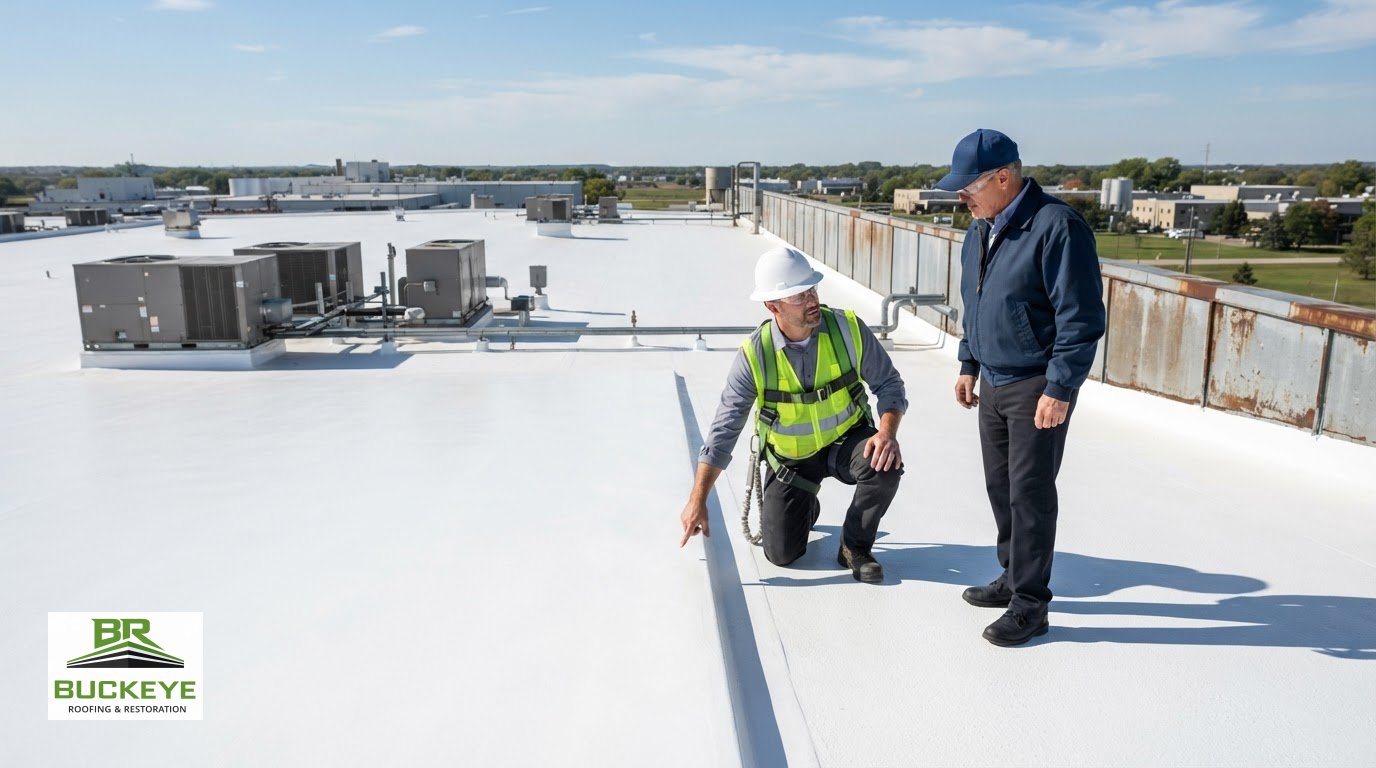
What if an active leak over your production floor doesn't actually mean your building needs a complete roof tear-off? If you manage an industrial plant or commercial facility, you've likely sat through conflicting evaluations and high-pressure quotes from aggressive sales reps. It's frustrating when you can't tell whether you're speaking with a dedicated commercial specialist or a crossover crew working outside their depth. Learning how to choose a commercial roofing contractor who prioritizes honest diagnostic inspections is the single best way to protect your physical building and your bottom line.
You shouldn't have to risk inventory damage, operational downtime, or an unnecessary capital expense just to keep water out of your facility. In this guide, you'll discover how to verify regional contractor credentials, evaluate safety standards, and demand real physical evidence before approving major work. We will walk through the exact steps to determine whether your low-slope roof truly requires targeted repairs, restorative coatings, or a complete replacement.
Key Takeaways
- Understanding how to choose a commercial roofing contractor starts with screening for dedicated low-slope specialists who have documented experience in single-ply and commercial metal systems.
- Always verify that prospective contractors carry full commercial general liability, completed operations coverage, and active workers' compensation before stepping foot on your property.
- Insist on objective diagnostic evaluations, such as non-destructive moisture scans, to determine whether targeted flat-roof repairs or restorative coatings can resolve leaks before considering a disruptive tear-off.
- Ask direct questions regarding daily crew supervision and weather tie-in protocols to protect your inventory, interior operations, and production schedule during active projects.
Essential Criteria: How to Screen a Commercial Roofing Contractor
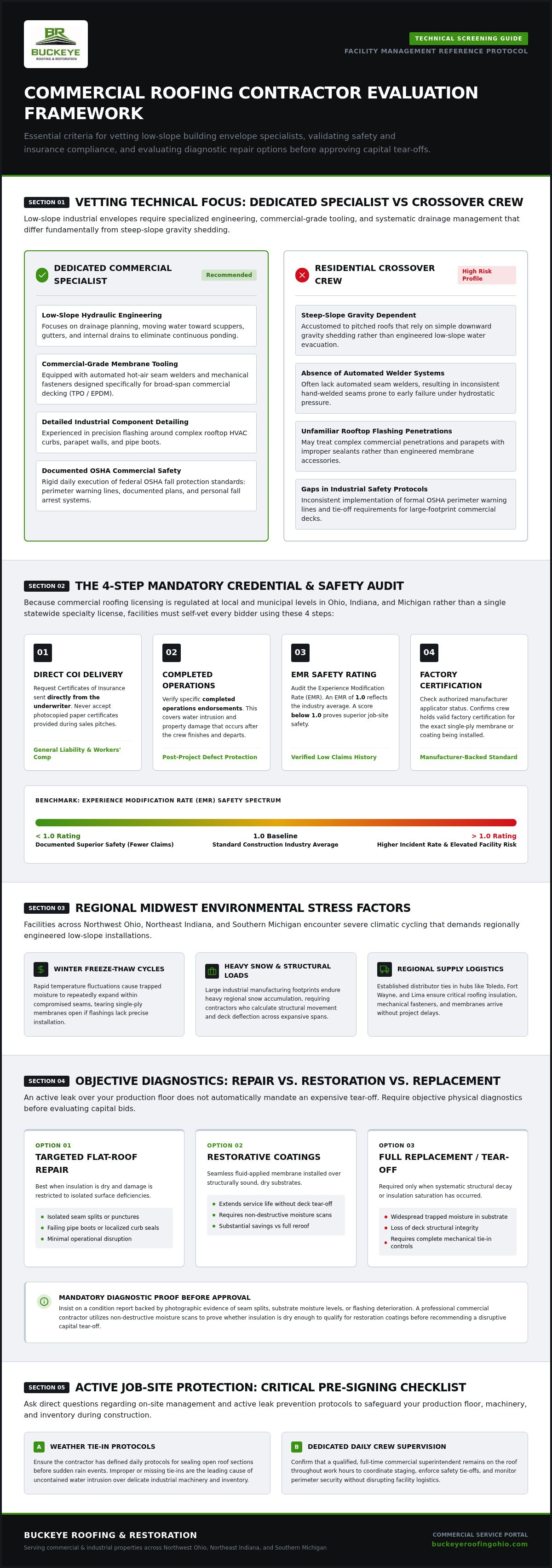
Screening candidates comes down to verifying technical focus and regional accountability. When evaluating how to choose a commercial roofing contractor, the first step is separating dedicated commercial operations from outfits that treat low-slope facilities as side work. You need a team that spends every working day dealing with broad-span decks, internal drainage, and industrial rooftop equipment. Before reviewing bids, insist on a thorough condition report backed by photographic evidence of seam splits, substrate moisture, or flashing deterioration. A reputable partner welcomes this transparency and proves what is happening on your roof before recommending work.
Commercial Specialization vs. Residential Crossover Crews
Steep-slope residential roofs rely on gravity to shed precipitation over overlapping materials. Low-slope commercial roofs behave entirely differently; they require precise slope and drainage planning to move water toward scuppers, gutters, and internal drains without continuous ponding.
Single-ply systems like TPO and EPDM demand specific equipment, including automated hot-air seam welders and mechanical fasteners designed for commercial decking. Crews crossing over from residential work often lack these tools, along with the specialized training required to detail curbs, parapet walls, and pipe boots. Commercial job sites also mandate strict adherence to federal OSHA fall protection standards, requiring documented safety plans, perimeter warning lines, and personal fall arrest systems that dedicated industrial roofers practice daily.
Regional Experience and Local Midwest Climate Knowledge
Midwest weather puts extraordinary mechanical stress on commercial building envelopes. Throughout Northwest Ohio, Northeast Indiana, and Southern Michigan, rapid winter freeze-thaw cycles cause trapped moisture to expand within compromised seams, tearing membranes open over time.
A contractor rooted in the Tri-State region understands local snow loads and structural movement across wide manufacturing footprints. Established regional specialists also maintain steady relationships with commercial building supply distributors in regional hubs like Toledo, Fort Wayne, and Lima. That network ensures roofing insulation, fasteners, and membranes arrive on schedule without logistical stalls. Knowing how to choose a commercial roofing contractor with proven local roots guarantees your facility gets a system engineered for the exact weather patterns it will face year after year.
Verifying Commercial Roofing Credentials, Insurance, and Safety Standards
Paper credentials separate legitimate commercial roofers from fly-by-night operations. Knowing how to choose a commercial roofing contractor requires digging into their risk profile and safety history. In Ohio, Indiana, and Michigan, commercial roofing licensing is largely governed at the local municipal and county levels rather than through a single statewide specialty license. That makes self-vetting critical for plant engineers and property managers.
Follow these four verification steps before allowing any crew on your roof:
- Step 1: Request Certificates of Insurance directly from the underwriter. Demand proof of commercial general liability and workers' compensation coverage. Don't rely on a photocopied paper certificate handed over during a sales pitch.
- Step 2: Confirm completed operations coverage. This specific endorsement protects your facility from water intrusion that occurs after a crew packs up their tools and leaves your property.
- Step 3: Review their Experience Modification Rate (EMR). An EMR of 1.0 represents the industry average for safety. A rating below 1.0 reflects a proven safety record and fewer injury claims on commercial jobs.
- Step 4: Check authorized manufacturer applicator status. Verify that the contractor holds current factory certification for the specific single-ply or coating product they plan to install.
Essential Insurance Coverage and Liability Protection
Standard contractor liability limits rarely protect an industrial operation. If a crew triggers an uncontained leak over delicate electronics, production machinery, or palletized inventory, a basic policy runs dry fast. Verify that their commercial general liability limits comfortably match your building's interior value.
Equally important is verifying policy exclusions. Some basic policies exclude work involving commercial fluid application, flame-free adhesives, or hot-air seam welders. If your facility manager needs an independent condition report, requesting a commercial roof inspection from a properly insured partner guarantees clear documentation without operational liability.
Manufacturer Certifications and Workmanship Standards
Manufacturer certifications confirm that technicians receive factory training on exact installation details. Uncertified crews often skip critical steps around scuppers, drain sumps, and expansion joints, voiding the material coverage before the project even wraps.
Authorized status also grants contractors access to comprehensive manufacturer warranties, including long-term membrane guarantees that third-party roofers cannot issue. When you understand how to choose a commercial roofing contractor with direct factory backing, you ensure your flashing assemblies and deck terminations match rigorous commercial engineering standards.
Evaluating Contractor Recommendations: Repair, Restoration, or Replacement
Every commercial roof leak does not warrant an immediate capital expenditure. Understanding how to choose a commercial roofing contractor means finding a partner who relies on physical diagnostics rather than sales quotas. An honest assessment determines whether your low-slope system requires isolated repairs, a restorative coating, or an inevitable tear-off. Isolated punctures, failing perimeter caulking, or split pipe boots require fast, targeted repairs to halt immediate water intrusion. Recommending a six-figure replacement for isolated surface issues is a disservice to your operational budget.
Why Diagnostic Inspections Must Precede Proposals
Visual walkthroughs only reveal surface symptoms. Trapped moisture inside underlying polyisocyanurate insulation boards remains completely hidden to the naked eye. Legitimate commercial roofers conduct non-destructive moisture scans, thermal infrared surveys, and physical core cuts to confirm insulation condition before writing a scope of work.
Core samples verify membrane adhesion, substrate moisture levels, and structural deck integrity. If infrared imaging reveals that moisture is confined to small, localized sections, your contractor can replace those specific wet boards rather than tearing down the entire roof envelope.
The Financial Case for Restorative Roof Coatings
When the underlying insulation is dry and structurally sound, applying a seamless elastomeric coating is often the most economical path. Fluid-applied systems form a monolithic waterproofing layer directly over weathered single-ply membranes or aged metal panels without opening the facility to interior weather exposure.
This approach eliminates noisy tear-off machinery, dumpster rentals, and hefty landfill disposal fees. Building occupants continue manufacturing, warehousing, and logistics operations without disruptive interruptions. Discover if your facility qualifies through commercial roof restoration.
When Complete Commercial Roof Replacement Is Necessary
Restoration cannot cure every roofing problem. Under International Building Code provisions, buildings are restricted to a maximum of two roof covering layers. If two assemblies already exist, the entire system must be stripped down to the structural deck before installing a new single-ply membrane.
Widespread insulation saturation is another dealbreaker; trapping wet insulation under a new coating causes blister formation and accelerated deck rot. When steel decking suffers advanced corrosion or wood planking shows severe deflection, full teardown is the only responsible safety choice. Learn what a comprehensive tear-off entails at commercial roof replacement. Knowing how to choose a commercial roofing contractor who honors these engineering distinctions ensures you never fund a tear-off you don't actually need.
Key Questions to Ask a Roofing Contractor Before Signing
Signing an agreement without asking hard logistical questions exposes your daily operations to severe risk. When deciding how to choose a commercial roofing contractor, the vetting process must focus on how work is managed on the ground. A proposal might look great on paper, but unexpected supply drop-offs, blocked freight bays, or sloppy weather seals can shut down an entire shift. Before putting pen to paper, present candidates with four fundamental questions:
- Question 1: Who will serve as the full-time on-site superintendent? You need an authorized decision-maker on the deck every day, not an account executive managing jobs by phone.
- Question 2: What is your exact daily tie-in protocol? A tie-in seals unfinished roof sections to the existing deck before crews leave for the evening, shielding machinery and inventory against unpredicted overnight downpours.
- Question 3: How does your quote distinguish between contractor workmanship and manufacturer material warranties? Ensure you understand where the installer's labor warranty ends and the manufacturer's sheet or chemical warranty begins.
- Question 4: What staging and safety measures protect our loading docks and employee parking? Commercial facilities have active traffic; cranes, disposal dumpsters, and material staging must never block distribution lanes.
Clarifying Jobsite Supervision and Operational Continuity
Establish direct communication channels with your job supervisor before crews mobilize. Your plant staff needs to know who to notify if interior equipment requires vibration monitoring or if a staging truck obstructs a freight door.
Review cleanup routines as well. Industrial sites cannot afford stray fasteners or metal trimmings scattered across employee parking lots or active shipping aprons. A disciplined crew runs magnetic sweepers across traffic paths at the close of every shift.
Evaluating Workmanship Guarantees vs. Material Warranties
Material manufacturer warranties cover physical defects within the roll of single-ply membrane or pail of coating. However, they routinely exclude leaks caused by faulty hand-welded seams, improperly adhered perimeter edge metal, or flawed counterflashing details.
Your contractor's workmanship warranty fills this gap by guaranteeing field installation labor. Demand written terms covering response times for active leaks, along with any mandatory annual maintenance inspections required to keep both warranties in good standing.
Reviewing References for Similar Commercial Roof Systems
Always ask candidates for references from property managers running facilities of comparable size and layout. Speaking with other regional facility directors provides candid feedback on how smoothly a crew handled unpredictable weather shifts or discovered deck deterioration. Take time to evaluate real job quality by reviewing past commercial roofing projects.
Asking targeted questions lets you evaluate how to choose a commercial roofing contractor who respects your operational boundaries. If you want a dependable partner to evaluate your facility's flat roof, contact our team to schedule an on-site commercial roof evaluation today.
Partnering with Buckeye Roofing & Restoration for Your Facility
Selecting a commercial partner shouldn't feel like a high-stakes gamble. Buckeye Roofing & Restoration delivers dedicated commercial flat and low-slope roofing craftsmanship tailored directly to commercial property owners and plant engineers. Headquartered in Edon, Ohio, our regional crews serve facilities throughout Northwest Ohio, Northeast Indiana, and Southern Michigan, with service capabilities extending across Ohio. When you review how to choose a commercial roofing contractor, our restoration-first philosophy stands out because we advocate for your capital budget, recommending the precise scope of work your building actually requires.
Dedicated Low-Slope Expertise in the Tri-State Area
Our work focuses entirely on broad-span industrial and commercial facilities. We work on manufacturing plants, distribution hubs, warehouses, and institutional buildings across Toledo, Fort Wayne, Findlay, Defiance, and surrounding industrial hubs. Because our crews work exclusively on TPO, EPDM, and commercial metal roofing, we bring focused field experience without residential distractions. If ponding water or failing seams threaten interior assets, address active facility leaks promptly through dependable commercial roof repair.
A Pragmatic, Consultative Assessment Process
We treat building owners as professional peers rather than sales targets. Every roofing project begins with an unhurried, diagnostic inspection to determine what the physical roof assembly needs to stay watertight. You receive clear visual documentation and straightforward guidance rather than inflated tear-off bids. Discover our background and field standards by visiting about Buckeye Roofing & Restoration.
Schedule an Honest Commercial Roof Evaluation
Midwest freeze-thaw cycles and seasonal rainfall test every seam on your deck. Learning how to choose a commercial roofing contractor gives you the tools to separate high-pressure pitches from honest trade craftsmanship. An objective diagnostic inspection provides the facts needed to decide whether spot repairs, an elastomeric coating, or an engineered replacement makes the most sense for your facility. Start a conversation with our commercial team at request a quote or inspection.
Make the Confident Call for Your Facility
Managing an industrial or commercial building requires clear facts rather than sales pressure. Knowing how to choose a commercial roofing contractor comes down to finding an accountable partner who backs every recommendation with diagnostic data. When you insist on verified credentials, demand non-destructive moisture testing, and clarify daily weather tie-in protocols, you protect both your interior assets and your capital budget.
At Buckeye Roofing & Restoration, our crews focus exclusively on commercial flat, low-slope, and industrial metal roofing. Serving facilities throughout Northwest Ohio, Northeast Indiana, and Southern Michigan, our restoration-first philosophy helps property managers extend existing roof life while avoiding premature replacements. You deserve candid advice from craftsmen who treat your building like their own.
Ready to evaluate your roof's actual condition with complete transparency? Schedule an honest commercial roof inspection with Buckeye Roofing & Restoration today to keep your operations watertight and productive.
Frequently Asked Questions
How do I choose the best commercial roofing contractor for my facility?
Focus on dedicated commercial specialization, transparent diagnostic assessments, and regional Midwest experience. Avoid outfits that push full replacements before conducting core cuts or infrared scans. Request verified certificates of insurance directly from underwriters and inspect past projects on buildings with similar low-slope designs. Learning how to choose a commercial roofing contractor means prioritizing trade partners who recommend targeted repairs or restorative coatings when your underlying deck remains dry.
What is the difference between a commercial and a residential roofing contractor?
Commercial contractors specialize in low-slope systems, broad spans, and industrial waterproofing membranes like TPO and EPDM. Residential roofers work primarily on steep-slope structures using gravity-shedding materials. Commercial work requires heavy installation equipment such as robotic hot-air seam welders, continuous compliance with strict OSHA commercial fall protection regulations, and careful coordination around complex rooftop machinery like commercial HVAC units and internal drainage sumps.
How can I tell if my commercial flat roof can be restored instead of replaced?
A commercial roof qualifies for restoration if its substrate insulation is structurally intact and largely dry. Contractors verify this using non-destructive infrared moisture surveys and physical core samples. If water intrusion is confined to isolated patches, a crew can replace those specific wet boards before applying a seamless elastomeric coating across the entire deck. However, if wet insulation covers significant portions of the roof, building codes require a complete tear-off.
What certifications and insurance coverage should a commercial roofer possess?
A qualified contractor must carry comprehensive commercial general liability matching your interior inventory value, completed operations coverage, and active workers' compensation. In Ohio, Indiana, and Michigan, verify local municipal contractor registrations. You should also verify authorized applicator status with recognized roofing manufacturers. Factory certifications confirm the crew follows proper detailing standards and grants your facility access to long-term manufacturer system warranties.
How does a commercial roofing contractor avoid disrupting daily facility operations?
Disciplined commercial roofers establish designated staging zones that keep cranes, roll-off dumpsters, and material deliveries away from active loading bays and customer parking. Strict daily tie-in procedures ensure open sections remain watertight overnight during sudden Midwest rainstorms. Work schedules and noisy tasks are coordinated in advance with facility directors, while daily magnetic sweeps prevent stray fasteners from puncturing fleet or employee tires.
How often should a commercial flat or low-slope roof be professionally inspected?
Schedule professional commercial roof inspections at least twice a year, ideally in spring and late autumn. Midwest freeze-thaw cycles and heavy winter snow loads place heavy stress on single-ply seams and metal flashings. Semiannual inspections catch minor sealant splits, clogged scuppers, or mechanical punctures before trapped moisture ruins expensive polyisocyanurate insulation boards beneath the surface.
What questions should I ask before signing a commercial roofing proposal?
Ask who will oversee daily on-site crew execution, whether work is handled by direct crews, and what specific tie-in protocols protect open decking from sudden storms. You should also ask the contractor to separate their installation workmanship warranty from the manufacturer's material guarantee. Knowing how to choose a commercial roofing contractor involves verifying these operational terms in writing before committing your facility's capital budget.

Article by
Harry Stanley III
Harry Stanley III is a construction marketing strategist and fractional CMO at H&A Marketing. He has helped construction companies grow through website strategy, SEO, paid advertising, branding, lead generation, CRM systems, and professional content. His past work includes helping Meraki Solar generate an additional $3.7 million in revenue in his first year and supporting American Builders as a fractional CMO. Today, Harry works directly with custom home builders and construction companies to build marketing systems designed to generate qualified leads and measurable growth.
