
Single Ply Membrane Roofing: A Commercial Building Owner's Guide
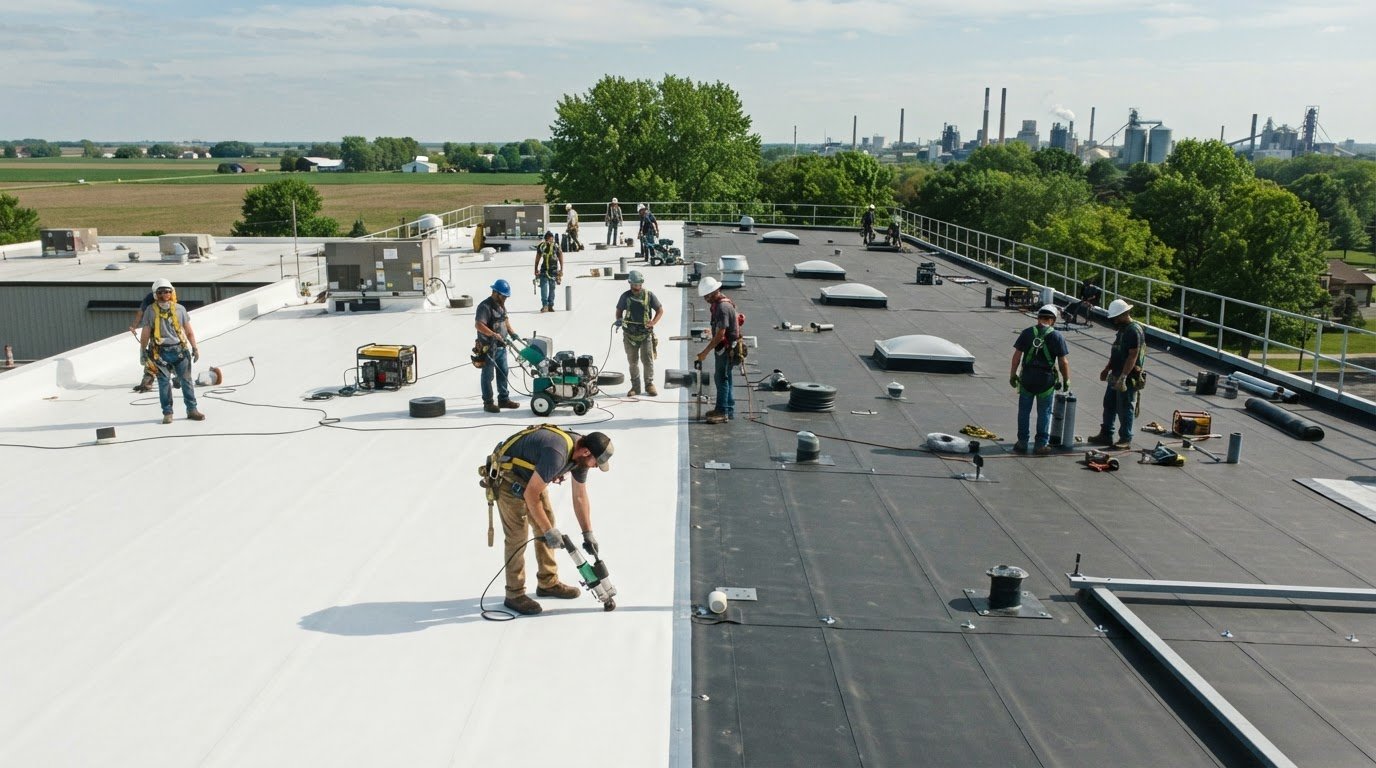
What if that stubborn leak dripping onto your warehouse floor doesn't mean your facility needs an immediate, costly tear-off? When you are responsible for an industrial or commercial building, recurring seam splits and puncture repairs disrupt operations and create needless headaches. You depend on single ply membrane roofing to protect critical equipment and inventory, yet figuring out whether your roof demands white TPO, black EPDM, or chemical-resistant PVC often feels clouded by contradictory advice and aggressive sales presentations.
You deserve an objective assessment grounded in sensible building maintenance rather than inflated pitches. This guide evaluates commercial single-ply systems clearly, helping you select the proper membrane chemistry, attachment profile, and upkeep plan for your building's specific operational needs. Ahead, we detail the structural differences across TPO, EPDM, and PVC assemblies, explain how attachment methods stop wind uplift and sheet flutter, and outline how to establish whether localized repair, fluid restoration, or full replacement delivers maximum value for your bottom line.
Key Takeaways
- Understand how modern single ply membrane roofing options like TPO, EPDM, and PVC differ in seam strength, solar reflectivity, and chemical resistance.
- Compare mechanical fastening against fully adhered bonding to choose the proper defense against wind uplift and membrane flutter.
- Spot vulnerable stress points around rooftop penetrations, curbs, and drains before seasonal freeze-thaw cycles pry seams apart.
- Learn the diagnostic standards, including building code layer rules and sub-surface moisture thresholds, that determine whether an aging roof qualifies for restoration or requires a full replacement.
What Is Single Ply Membrane Roofing for Commercial Buildings?
Commercial flat roofs are rarely flat; they are low-slope assemblies engineered to channel water toward drains and scuppers. In these environments, single ply membrane roofing consists of factory-manufactured, flexible polymeric sheets designed to provide a continuous, waterproof barrier across large square footage. Unlike multi-layer tar roofs built by hand directly on a deck, single-ply materials arrive on site in rolls with tightly controlled chemical properties and consistent thickness.
Over past decades, commercial properties shifted decisively away from multi-ply asphalt systems. Modern distribution hubs, cold storage spaces, and manufacturing facilities across Ohio, Michigan, and Indiana require clean installations without lingering asphalt odors or open flames. Today, commercial membrane roofing systems dominate commercial architecture because they provide high elasticity, reliable puncture resistance, and predictable installation timelines without unnecessary deck stress.
Anatomy of an Engineered Membrane Sheet
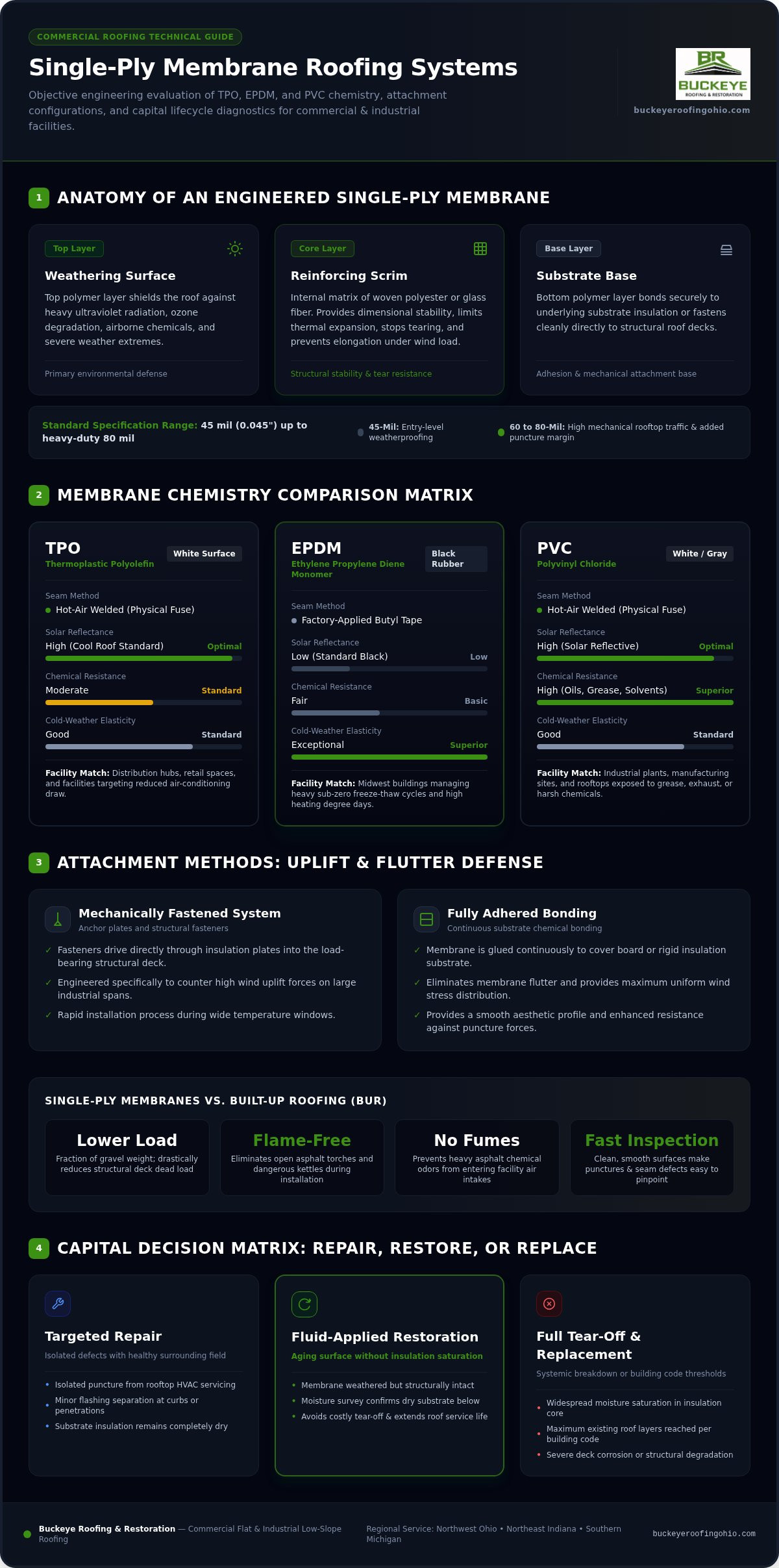
A standard single-ply sheet contains three functional layers pressed into one unified membrane:
- Weathering surface: The top polymer layer shields the roof against heavy ultraviolet radiation, ozone degradation, airborne chemicals, and severe weather.
- Reinforcing scrim: An internal matrix of woven polyester or glass fiber provides structural stability. It limits thermal expansion, stops tearing, and prevents elongation under wind load.
- Base layer: The bottom polymer layer bonds securely to underlying substrate insulation or fastens cleanly to structural decks.
Commercial sheets range from entry-level 45 mil (0.045 inches) up to heavy-duty 80 mil. While 45-mil sheets provide basic weatherproofing, facility operators managing frequent rooftop mechanical traffic typically specify 60-mil or 80-mil options for added puncture margin and extended durability.
Single-Ply Membranes vs. Built-Up Roofing Systems
Traditional built-up roofs (BUR) rely on multiple plies of fiberglass felt mopped together with hot asphalt, often topped with gravel ballast. That dead weight stresses building structures. Single-ply membranes weigh a fraction of gravel-surfaced systems, cutting down structural load and speeding up installation.
Single-ply sheets also eliminate open flame torches and hazardous hot asphalt kettles from your job site, lowering fire risks and chemical fumes near facility air intakes. Smooth single-ply surfaces simplify routine inspections as well. Maintenance technicians can easily spot punctures, walk safely around rooftop HVAC units, and address isolated issues through commercial roof repair before minor leaks reach active inventory.
Evaluating TPO, EPDM, and PVC: Selecting the Right Chemistry
Selecting the right single ply membrane roofing comes down to your facility's daily operations and regional climate. Thermoplastic sheets like TPO and PVC feature seams fused with hot air, creating a physical weld. Thermoset materials like EPDM rely on vulcanized synthetic rubber joined with advanced factory-applied butyl tape. In the Midwest, where bitter sub-zero winters shift into humid summers, commercial building owners must weigh heating degree days against cooling demands rather than relying on one-size-fits-all recommendations.
| Membrane Type | Seam Method | Solar Reflectance | Chemical Resistance | Cold-Weather Elasticity |
|---|---|---|---|---|
| TPO | Hot-air welded | High (White) | Moderate | Good |
| EPDM | Butyl seam tape | Low (Standard Black) | Fair | Exceptional |
| PVC | Hot-air welded | High (White/Gray) | High (Oils/Grease) | Good |
TPO (Thermoplastic Polyolefin): Reflectivity and Welded Seams
TPO fuses overlapping sheets with hot-air equipment to create a continuous seam. Its bright white surface reflects solar radiation away from large distribution centers and retail complexes. Aligning with EPA cool roof membrane guidelines, TPO lowers rooftop temperatures during hot summer afternoons, cutting air-conditioning draw. However, standard formulations degrade faster when exposed to direct restaurant exhaust, chemical solvents, or heavy petroleum discharge.
EPDM (Ethylene Propylene Diene Monomer): Durable Synthetic Rubber
EPDM synthetic rubber offers unmatched flexibility when regional temperatures plummet. It expands and contracts across intense freeze-thaw cycles without growing brittle or cracking. Black EPDM also absorbs solar heat throughout long northern winters, helping melt heavy snow loads around roof drains. While older systems relied on liquid glues that broke down over time, modern EPDM uses primer-activated butyl tape to produce durable, watertight laps.
PVC (Polyvinyl Chloride): Chemical and Flame Resistance
Manufacturing plants, food processing hubs, and commercial kitchens produce venting that ruins conventional single-ply sheets. PVC handles animal fats, jet fuels, harsh oils, and industrial chemicals without softening or dissolving. It also delivers high fire-retardant performance and superior tensile strength. While PVC carries a higher upfront material cost, facilities with demanding discharge environments benefit from the added chemical defense. If you aren't sure which membrane matches your facility's ventilation profile, an honest assessment from a contractor specializing in commercial roof replacement will help clarify the right system before you invest.
Attachment Methods: Mechanically Fastened vs. Fully Adhered
Severe storms generate intense low-pressure vortices across low-slope roofs, pulling upward on the surface. How your single ply membrane roofing attaches to the structural deck determines whether it withstands these wind uplift forces or pulls loose. While gravel-ballasted roofs once held down unattached membranes through sheer dead weight, modern structural building codes and seismic limits largely restrict ballasted assemblies due to roof deck load limits. Today, commercial property managers choose between mechanical fasteners and continuous adhesive bonds.
Internal facility conditions impact this attachment decision directly. Warehouses and distribution facilities with roll-up loading dock doors experience sudden spikes in internal air pressure during high winds. As exterior drafts enter open bays, positive indoor air pushes upward against the underside of the roof deck while outdoor winds pull from above. Matching your attachment method to your building layout stops premature seam failure.
Mechanically Attached Systems: Speed and Flutter Dynamics
Mechanically attached systems secure membranes directly to steel or wood roof decks using heavy-duty barbed fasteners and circular steel stress plates along the sheet seams. Subsequent sheets cover these fasteners before technicians weld or tape the lap closed. This approach installs rapidly across vast open square footage, like logistics hubs and pre-engineered metal buildings. However, high winds cause the unbonded membrane between fastener rows to billow upward. This sheet flutter transfers repetitive pulling stress into the fastener lines and deck flutes, increasing wear over time.
Fully Adhered Systems: Wind Resistance and Stress Distribution
Fully adhered assemblies bond the membrane continuously to underlying coverboards using low-VOC adhesives, contact cements, or hot asphalt. Eliminating loose spans between sheets prevents membrane flutter entirely, spreading wind loads uniformly across the whole surface. This stability protects perimeter parapet walls and rooftop HVAC curbs from mechanical fatigue. Manufacturing facilities housing sensitive clean rooms or precision machinery often favor adhered systems because they limit draft movement and prevent interior air leakage.
Insulation Substrates and Coverboards
A reliable attachment strategy depends entirely on the substrate below. Modern building codes require staggered, multi-layer polyisocyanurate (polyiso) insulation boards to eliminate thermal bridging pathways at board joints. Integrating a high-density polyiso or gypsum coverboard over the insulation shields the assembly against puncture hazards, hail impacts, and repetitive maintenance foot traffic. Coverboards also optimize building thermal performance, which aligns directly with Berkeley Lab research on cool roofs regarding structural efficiency and surface heat transfer.
Common Vulnerabilities, Seam Stress, and Preventative Care
Low-slope commercial roofs rely on gravity to direct water toward drains, but every penetration interrupts that flow. Rooftop HVAC curbs, internal drainage bowls, and building expansion joints represent the most common leak sites. In the Midwest, rapid freeze-thaw cycles constantly stress these transition zones. When melted snow creeps into hairline fissures at perimeter flashings and freezes overnight, expanding ice levers the seams open. Prolonged ponding water poses an equal threat; standing water accelerates plasticizer loss in thermoplastics and breaks down older seam adhesives. Establishing a scheduled roof walk program every spring and autumn helps your team catch these strain points early.
Preventing Rooftop Punctures and Service Traffic Damage
Third-party service technicians often cause accidental punctures without realizing it. Dropped sheet metal screws, sharp utility blades, and unlatched access panels frequently pierce single-ply sheets around mechanical equipment. Installing heavy-duty sacrificial walkway pads along high-traffic routes from roof hatches to rooftop units provides an effective barrier. These durable paths absorb repetitive foot traffic, give technicians secure footing, and protect the underlying membrane from dropped tools.
Diagnosing Moisture Intrusion and Seam Separation
Water rarely travels straight down through a commercial assembly. It can seep through an unbonded lap, spread across hundreds of square feet of polyiso insulation, and finally drip into your facility far from the breach. Commercial roof technicians use blunt metal probes along field seams to spot mechanical separations and inspect cracked pipe boots or dried-out pitch pockets. For deeper diagnosis, non-destructive infrared moisture surveys identify saturated insulation trapped beneath your single ply membrane roofing without damaging the membrane. If persistent leaks are disrupting production or threatening your inventory, schedule a commercial roof inspection to diagnose the exact issue before taking on costly structural repairs.
Capital Planning: When to Repair, Restore, or Replace Single-Ply Roofs
Capital planning for commercial roofing often gets derailed by sales pitches pushing premature tear-offs. When managing an aging single ply membrane roofing system, replacing the entire roof isn't the only path forward. Clear technical indicators separate an assembly that can be preserved from one that has failed. Under International Building Code regulations, a commercial building cannot carry more than two complete roof systems. If your facility already has two layers, or if trapped moisture exceeds twenty-five percent of the total insulation volume, building code and standard engineering practice require a complete tear-off down to the deck.
Extending Membrane Life with Restorative Roof Coatings
If non-destructive moisture testing confirms your underlying insulation is dry and the structural deck remains sound, you don't need to default to a disruptive reroof. An aged membrane with weathered but intact seams is an ideal candidate for liquid-applied elastomeric or silicone coatings. These fluid-applied systems cure into a seamless, highly reflective barrier over existing laps and curbs, adding years of weatherproofing without filling landfills. Unlike a noisy tear-off that risks contaminating sensitive production floors, coating applications generate minimal disruption while keeping indoor operations running smoothly. As an added financial advantage, restorations can often be expensed in the current tax year as maintenance. Learn how commercial roof restoration delays capital tear-offs and protects your bottom line.
When Full Commercial Roof Replacement Is Necessary
Certain structural conditions leave no practical alternative to a full tear-off. Extensive insulation saturation, severe deck corrosion, rotted substrates, or older single ply membrane roofing that has shrunk and grown brittle beyond repair compromise the entire building envelope. In these cases, installing a new assembly protects valuable machinery and restores verified thermal resistance. A professional contractor schedules the teardown carefully to manage dust, isolate debris, and protect building access points. Working methodically through the entire process, from deck repairs to final inspection, ensures that your commercial roof replacement meets current regional energy codes. To evaluate your low-slope roof objectively and choose the right maintenance strategy, schedule a thorough evaluation with Buckeye Roofing & Restoration.
Making Practical Decisions for Your Commercial Roof
Selecting the right single ply membrane roofing system comes down to understanding your facility's operational demands, rooftop equipment, and regional weather patterns. Whether your building benefits most from the solar reflectivity of TPO, the sub-zero flexibility of EPDM, or the chemical resistance of PVC, proper attachment and disciplined maintenance will protect your bottom line. Most importantly, an active leak or weathered surface doesn't automatically mean your capital budget must absorb a disruptive, premature tear-off.
Buckeye Roofing & Restoration specializes exclusively in commercial low-slope, flat, and industrial roofing across Ohio, Northeast Indiana, and Southern Michigan. We take a pragmatic approach rooted in non-destructive evaluations, helping facility managers prioritize timely repairs and protective coatings over total replacements whenever the underlying assembly remains sound. When you are ready to cut through high-pressure sales pitches and get the facts about your roof, schedule an honest commercial roof evaluation with Buckeye Roofing & Restoration. You'll gain the clear, practical guidance needed to protect your facility for years to come.
Frequently Asked Questions
How long does a commercial single ply membrane roofing system typically last?
Most commercial single-ply roofs last between 20 and 30 years, depending on membrane thickness, installation quality, and preventative care. Specifying a thicker 60-mil or 80-mil sheet provides significantly more puncture resistance and weathering life than a baseline 45-mil membrane. Scheduling bi-annual inspections, keeping internal drains clear, and addressing localized wear around mechanical equipment helps facility managers achieve maximum longevity without early capital outlay.
What is the primary difference between TPO and EPDM roofing membranes?
The primary difference lies in their chemical makeup and seaming technology. TPO is a white thermoplastic membrane joined using hot-air welds, making it highly reflective to lower summer cooling loads. EPDM is a synthetic black thermoset rubber membrane joined with primer-activated butyl tape. EPDM delivers exceptional elasticity, allowing it to expand and contract across freezing Midwest winters without cracking or growing brittle.
Can a new single ply membrane roof be installed over an existing flat roof?
Yes, provided the building has only one existing roof layer and the substrate is dry. Building codes legally restrict low-slope commercial roofs to two complete assemblies. If non-destructive moisture scans confirm your insulation is sound and holds minimal trapped moisture, a recover system saves money. However, if two systems already exist, building code mandates a complete tear-off down to the structural deck.
How do severe Midwest freeze-thaw cycles impact single ply seams?
Freeze-thaw cycles exert extreme mechanical tension on lap joints and perimeter flashings. Melted snow and ice frequently pool in low deck areas or back up around slow drains. As night temperatures plummet across Ohio and Indiana, trapped water freezes and expands, gradually prying apart microscopic separations in older seams. Over successive winters, this expansion turns minor seam stress into active leaks.
Can an aging single ply membrane roof be restored with a commercial coating?
Yes, an aging single ply membrane roofing system can often be restored if its underlying insulation is dry. When thermal imaging confirms the substrate remains sound, applying an elastomeric or high-solids silicone coating creates a continuous waterproof barrier. This process seals weathered laps, restores solar reflectivity, and extends functional service life at a fraction of full replacement costs without disrupting daily facility operations.
Is a mechanically attached or fully adhered membrane better for high winds?
Fully adhered systems generally deliver superior wind resistance and stress distribution. While mechanically attached sheets install quickly into steel decks, unattached areas between fastener rows can flutter and billow during high winds. Adhering the membrane continuously to high-density coverboards eliminates flutter entirely, protecting rooftop curbs and parapets from fatigue. Buildings with open loading docks particularly benefit from the airtight stability of adhered assemblies.
What happens if water ponds on a single ply membrane roof for over 48 hours?
Ponding water that lingers beyond 48 hours accelerates chemical degradation and can void manufacturer warranties. Standing water acts like a magnifying lens for solar ultraviolet rays, accelerating plasticizer loss and causing single-ply sheets to turn brittle. In winter, standing pools freeze solid, adding heavy dead load and stressing seam bonds. Regular maintenance should ensure drains, sumps, and scuppers flow freely.

Article by
Harry Stanley III
Harry Stanley III is a construction marketing strategist and fractional CMO at H&A Marketing. He has helped construction companies grow through website strategy, SEO, paid advertising, branding, lead generation, CRM systems, and professional content. His past work includes helping Meraki Solar generate an additional $3.7 million in revenue in his first year and supporting American Builders as a fractional CMO. Today, Harry works directly with custom home builders and construction companies to build marketing systems designed to generate qualified leads and measurable growth.
