
EPDM Roof Restoration Guide: Findlay Commercial Buildings
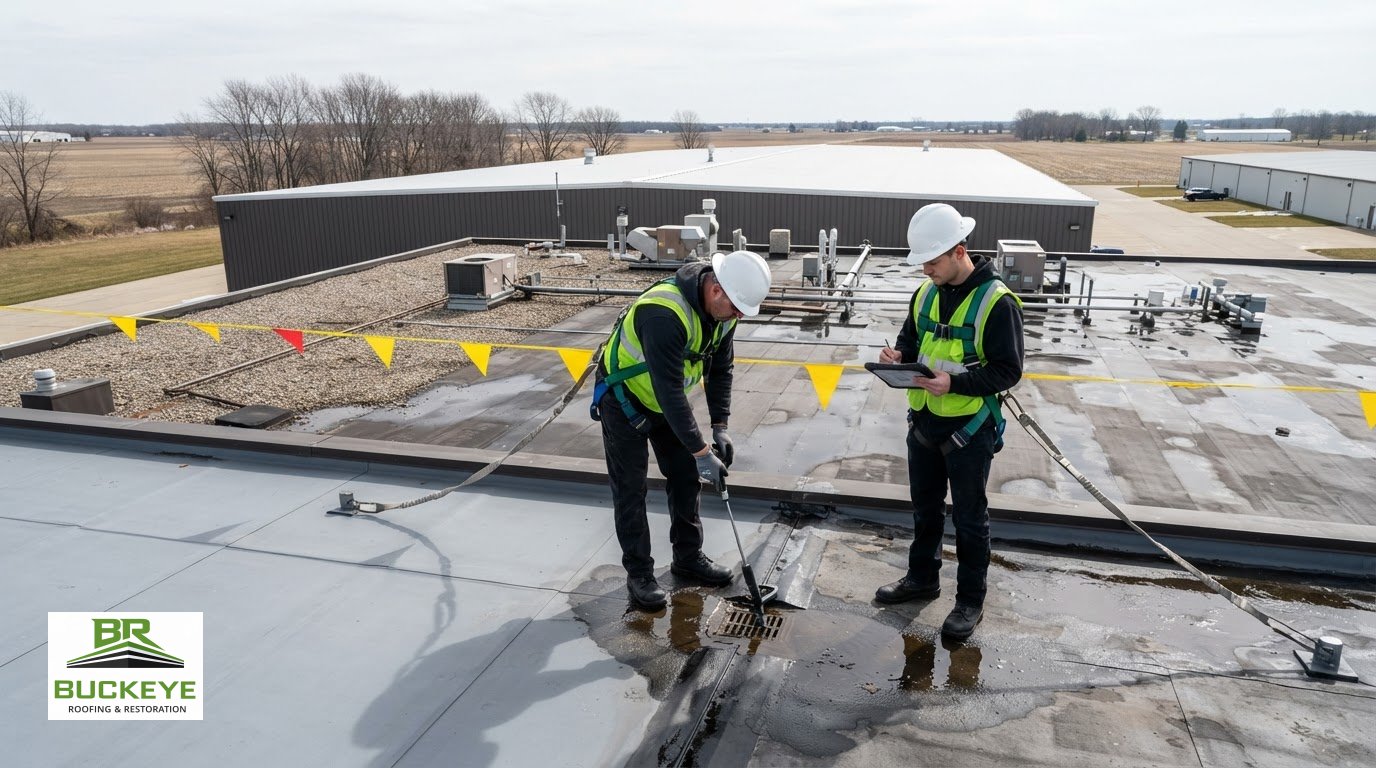
What if the best first step toward EPDM roof restoration isn’t a coating, but a closer look at the roof’s maintenance history? For commercial buildings in Findlay, small changes such as recurring interior stains, open seams, or water that lingers after snowmelt can raise practical questions. It’s sensible to address minor defects before they disrupt operations, but not every concern calls for restoration.
Routine checks can help you spot warning signs without putting staff on the roof. Note changes inside the building and observe the roof from a safe location. If you see signs of a leak, loose material, or standing water, have a commercial roofer assess it rather than attempting a repair yourself.
This guide explains what routine maintenance can reveal, which conditions deserve prompt professional attention, and how a roofer evaluates an EPDM system before recommending a next step. You’ll learn the difference between a targeted repair, restoration with a coating system, and replacement, along with the factors that affect restoration suitability, including membrane condition, moisture, drainage, and the roof’s underlying structure. The goal is a measured plan that fits your building’s needs and commercial operations.
Key Takeaways
- Use maintenance records and safely observed warning signs to build a clearer picture of your EPDM roof’s condition.
- Learn what a commercial roofer assesses, from drainage and roof details to moisture and the condition of the underlying structure.
- EPDM roof restoration may suit a viable existing roof, but inspection findings determine whether repair, coating, or replacement is more appropriate.
- Keep a practical maintenance log and plan professional checks around seasonal changes to track concerns and recommended work.
- Findlay-area building owners can use an inspection to plan roof work around the facility’s needs and operations.
EPDM Roof Restoration Starts with Understanding the Roof’s Condition
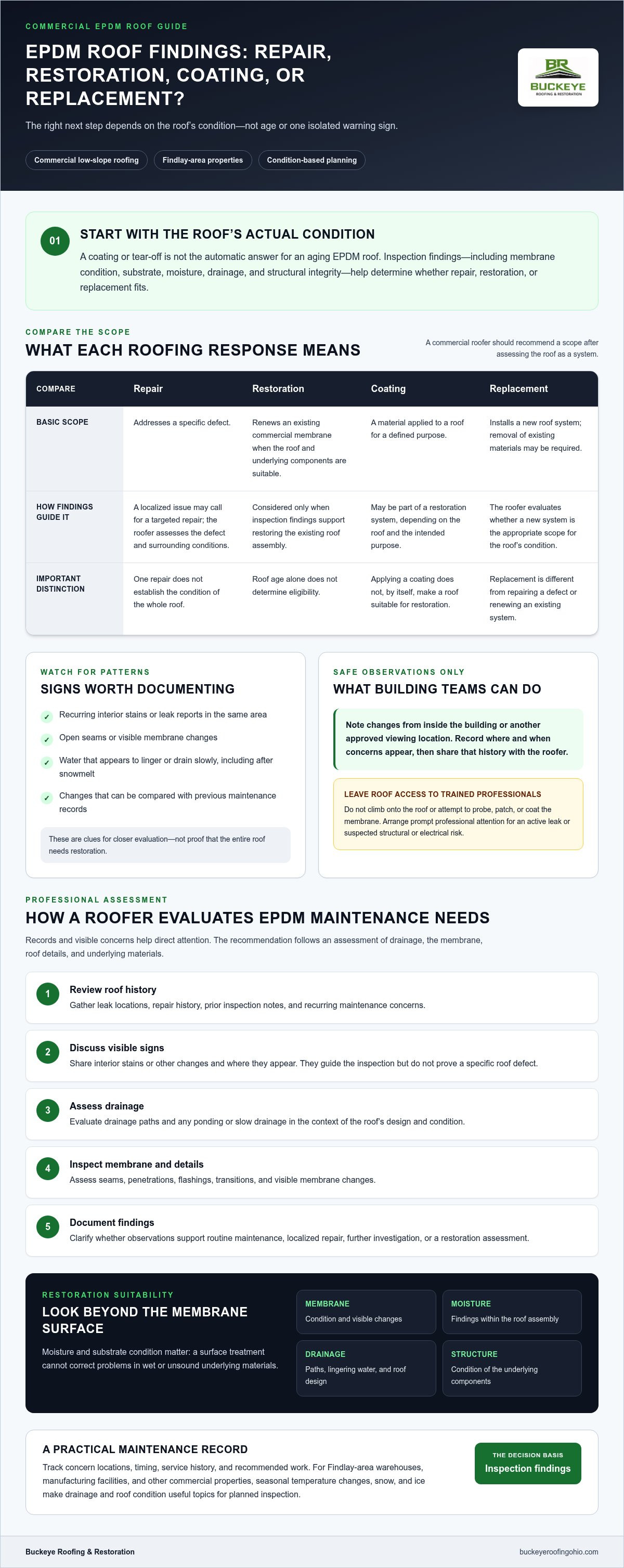
An aging EPDM roof doesn’t automatically need a coating or a tear-off. EPDM roof restoration is a condition-dependent effort to renew an existing commercial membrane when the roof and its underlying components are suitable for that approach. Restoration eligibility depends on inspection findings, including membrane condition, substrate, moisture, drainage, and structural integrity, not assumptions based on roof age alone.
Restoration is broader than patching a puncture or sealing one seam. A repair addresses a specific defect; a coating is a material applied to a roof for a defined purpose and may be part of a restoration system, but applying any coating does not by itself make a roof suitable for restoration. Replacement is different again: it involves installing a new roof system, which may require removing existing materials. A commercial roofer can help determine which scope fits the roof’s actual condition. Learn more about Buckeye’s commercial roof restoration service.
EPDM roofs are low-slope systems designed to drain water, not perfectly level surfaces. The membrane’s condition is only part of the picture; drainage, roof details, and what lies beneath it also matter. For industry context on EPDM roofing systems and their environmental considerations, see the EPDM Roofing Association’s discussion of EPDM roofing.
What routine EPDM roof maintenance can reveal
Maintenance helps connect isolated observations to patterns. Repeated leak reports in the same area, new interior stains, visible membrane changes, or water that appears to linger can all prompt closer evaluation. Keep notes on where and when concerns appear, and compare them with previous service records. A recurring issue or a change over time gives a roofer useful context, but it doesn’t prove the entire roof needs restoration.
Keep observations to areas you can view safely from inside the building or another approved access point. Don’t climb onto the roof or attempt to probe, patch, or coat the membrane. A trained roofing professional should assess roof surfaces and details using appropriate safety practices.
Why Findlay-area buildings need condition-based planning
For warehouses, manufacturing facilities, and other commercial properties in Findlay, seasonal temperature changes, snow, and ice make drainage and roof condition useful topics for planned inspection. These conditions can coincide with changes in how water moves or drains, but they don’t establish that a membrane has failed. Maintenance records and professional observations help identify concerns that warrant closer assessment.
Planning around seasonal changes can also help facility teams coordinate roof evaluations with operating schedules. The goal is not to assume a particular outcome, but to understand what the roof needs before selecting repair, restoration, or replacement.
How a Commercial Roofer Evaluates EPDM Roof Maintenance Needs
A useful inspection follows a sequence. Records and visible concerns help direct attention, but a recommendation should come after the roofer assesses the roof as a system, including its drainage, membrane, details, and underlying materials.
- Review records. Gather leak locations, repair history, prior inspection notes, and recurring maintenance concerns.
- Discuss visible signs. Note interior stains or other changes and where they appear. These observations guide the inspection, but don’t prove a specific roof defect.
- Assess drainage. A roofer evaluates drainage paths and any ponding or slow drainage in the context of the roof’s design and condition.
- Inspect the membrane and details. Professional assessment includes seams, penetrations, flashings, and other transitions where the membrane meets roof components.
- Document findings. The roofer records observed conditions and explains whether they support routine maintenance, localized repair, further investigation, or a restoration assessment.
Review roof history and visible concerns first
Patterns matter. If leak reports repeatedly point to one area, service records can show what was addressed and whether the concern returned. Interior signs are useful clues, not a diagnosis: water may travel before it becomes visible inside. Share records and approximate locations with the roofer so those details can inform the assessment.
Arrange prompt professional attention for an active leak or suspected structural or electrical risk. Don’t access the roof or investigate hazards yourself. Roof access and hands-on assessment belong to trained personnel following appropriate safety practices.
Assess drainage, membrane, and roof details professionally
Water that lingers or drains slowly deserves evaluation, but it needs to be considered alongside the roof’s intended drainage design and overall condition. The roofer also checks seams, penetrations, flashings, and visible membrane changes, then documents what was observed. No single sign should determine the scope on its own.
Moisture and substrate condition shape restoration suitability because a surface treatment can’t correct problems in wet or unsound underlying materials. If findings leave uncertainty about the roof assembly, further investigation may be needed before selecting a remedy. That measured approach supports a more useful decision about maintenance, repair, or restoration.
EPDM Repair, Restoration, Coating, or Replacement: What Do Findings Support?
The right scope depends on what an inspection finds, not just the roof’s age or the presence of a leak. A targeted repair can address a diagnosed defect, but it won’t correct unrelated deterioration elsewhere. Restoration and replacement require a broader look at the membrane and the layers below it.
| Option | Purpose | What assessment should establish |
|---|---|---|
| Repair | Correct a specific defect, such as damage at a seam, penetration, flashing, or membrane area. | The source and extent of the defect, plus whether other concerns need attention. |
| Restoration | Renew a suitable existing roof with a planned system of work. | Membrane condition, moisture, substrate, drainage, and structural integrity. |
| Coating | Provide a protective layer when the product and application are compatible with the existing roof. | Roof condition and system compatibility. A coating alone isn’t a cure for underlying problems. |
| Reroofing | Install a new roof layer over an existing roof when the assembly and project conditions support that approach. | Whether the existing roof can remain and whether the added system is appropriate. |
| Full replacement | Remove existing roofing as needed and install a new roof system. | The condition of the roof assembly and requirements of the building and project. |
When EPDM repair may address a localized issue
A repair may fit when a professional identifies a limited defect, such as a damaged membrane section or a problem at a seam, penetration, or flashing. It’s a targeted response, not a substitute for evaluating repeated leaks or wider deterioration. If a leak is active or its source is difficult to locate, arrange a professional assessment rather than attempting roof access or repairs. See Buckeye’s commercial roof restoration information for more on evaluating that option.
When restoration or replacement needs a broader assessment
EPDM roof restoration may be considered when inspection findings support renewing the existing system. Wet materials, a compromised substrate, poor drainage, or structural concerns can change the scope or make restoration unsuitable. A roofer should document these conditions before recommending a coating or restoration plan.
Reroofing and full replacement aren’t interchangeable terms. Reroofing may involve placing a new system over an existing roof, while full replacement involves removing existing roofing and installing a new system. Whether either approach fits depends on the roof assembly and inspection findings. No option should be treated as a guaranteed fix or chosen on assumed savings or lifespan.
A Safe, Practical EPDM Maintenance Routine for Findlay Commercial Properties
A useful maintenance routine doesn’t require facility staff to inspect or service the roof themselves. It gives them a consistent way to spot changes, preserve records, and arrange professional follow-up. For warehouses, manufacturers, and other commercial properties in Findlay, plan checks around seasonal changes and building operations rather than relying on an arbitrary schedule.
What facility managers can observe without climbing onto the roof
From inside the building or another approved viewpoint, staff can note new or recurring leaks, ceiling stains, and changes to interior finishes. Record the room or area and the date. These clues help direct a professional assessment, but they don’t identify the exact roof defect on their own.
From a safe, approved vantage point, note visible changes in drainage or water accumulation and report them to qualified personnel. Take dated photos only if you can do so safely. Don’t climb onto the roof, clear drains, or patch membrane defects. Active leaks, suspected structural concerns, and possible electrical hazards call for prompt professional assessment.
How to organize maintenance around building operations
Keep one roof history that facility staff and the roofing professional can refer to. Include:
- Leak reports, approximate locations, and dated photos taken safely.
- Past inspection notes, repairs, and maintenance records.
- Observed concerns, completed work, and follow-up recommendations.
Before an inspection, coordinate approved roof access and share relevant information about rooftop equipment, restricted areas, production schedules, and tenant needs. Clear access rules help the inspection proceed with fewer surprises and make it easier to plan work around facility operations.
Review the maintenance record when seasons change or after a new concern appears. If recommendations include coating or restoration, ask for the proposed scope to reflect the roof’s condition and system compatibility. A coating is not a universal remedy, and EPDM roof restoration should follow inspection findings, not a calendar entry or a desire to avoid disruption.
For commercial properties in Findlay, Buckeye Roofing & Restoration can assess an EPDM roof and help connect the findings to a practical next step. Schedule a commercial roof inspection to discuss your building’s maintenance concerns.
How Buckeye Helps Findlay Businesses Decide Whether EPDM Restoration Fits
Buckeye Roofing & Restoration serves commercial and industrial properties in Findlay and throughout its regional service area. For an aging EPDM roof, the first step is an assessment, not a preset choice of coating or tear-off. An inspection connects observed conditions to a practical next step for the building.
What an inspection-led recommendation should account for
A recommendation should reflect the whole roof assembly and how the facility uses its building. The inspection considers the membrane, moisture levels, substrate condition, drainage, and structural integrity. It also accounts for building needs, such as access, rooftop equipment, and operating requirements that may affect the work plan.
Findings may support ongoing maintenance, a targeted repair, an evaluation for restoration, or replacement. A coating or fluid-applied system is only appropriate when the existing roof’s condition and system compatibility support its use. Wet materials, a compromised substrate, drainage problems, or structural concerns may change the scope or rule out restoration. The goal is to recommend work that fits the roof, not default to tear-off or assume restoration will suit every building.
For more information about the assessment and scope involved, see Buckeye’s commercial roof restoration service.
Planning the next step for a commercial EPDM roof
Before an inspection, gather leak records, prior repair information, and any notes about recurring concerns. Share facility access requirements, restricted areas, and scheduling needs tied to tenants, production, or warehouse operations. These details help frame the assessment and support practical planning.
The inspection findings can then be discussed alongside the building’s needs. A clear recommendation should explain the observed conditions and why they support maintenance, repair, restoration evaluation, or replacement. The assessment informs the decision; it doesn’t guarantee that one specific outcome will fit.
If you manage a commercial property in Findlay, Buckeye can help assess your EPDM roof and discuss suitable next steps. Request a commercial roof inspection or quote.
Plan the Right Next Step for Your EPDM Roof
Routine maintenance gives facility managers a clearer record of leaks, visible changes, and drainage concerns. A commercial inspection puts those observations in context by assessing the membrane and the roof assembly before recommending work.
EPDM roof restoration is one possible outcome, not a default. Findings may support targeted repairs, a compatible restoration approach, or replacement, depending on membrane condition, moisture, substrate, drainage, and structural integrity. That measured process helps you plan roof work around your building’s needs instead of committing to a solution before the roof has been assessed.
Buckeye Roofing & Restoration focuses on commercial flat-roof and EPDM services, including inspections, repairs, restoration, and replacement. The company serves businesses in Findlay and across Ohio. If you’re weighing options for an aging commercial roof, discuss a commercial EPDM roof inspection with Buckeye Roofing & Restoration. A clear assessment is a practical place to start, and it can help you make a confident plan for your facility.
Frequently Asked Questions
Can a commercial EPDM roof be restored instead of replaced?
Yes, a commercial EPDM roof may be a candidate for restoration if inspection findings show that its condition supports that approach. The membrane, underlying substrate, moisture levels, drainage, and structural integrity all matter. EPDM roof restoration isn’t suitable for every roof, and a coating won’t correct saturated materials or structural problems. An inspection helps determine whether restoration, targeted repair, or replacement best fits the building.
How do professionals determine whether an EPDM roof is suitable for restoration?
Professionals assess the membrane and the roof assembly, including seams, flashings, penetrations, drainage, substrate, and signs of moisture or structural concerns. They may recommend further investigation if surface observations don’t reveal the full condition of underlying materials. The findings guide the scope: routine maintenance, a localized repair, a restoration evaluation, or replacement. A coating should be considered only when roof condition and system compatibility support its use.
What should facility managers check during routine EPDM roof maintenance?
From inside the facility or another approved viewing point, track leaks, ceiling stains, and changes to interior finishes. Note approximate locations and dates, and keep service records and safely obtained photos together. Report visible drainage changes or roof concerns to qualified personnel. Don’t climb onto the roof, clear drains, or patch defects. These records help a roofer identify patterns and focus a professional assessment.
Is it safe to inspect or repair a commercial EPDM roof yourself?
Untrained staff shouldn’t access or repair a commercial roof. Roof surfaces, edges, equipment, and other site conditions can create hazards that require appropriate training and safety practices. Facility personnel can document concerns from inside or another approved access point, then arrange professional assessment. For active leaks, suspected structural problems, electrical risks, loose materials, or unsafe access, keep staff away from the hazard and contact qualified roofing professionals.
What is the difference between EPDM roof repair, restoration, and coating?
Repair addresses a specific diagnosed defect, such as damage at a seam, flashing, penetration, or membrane area. Restoration is a broader effort to renew an existing roof when its overall condition supports that scope. A coating is a material used as part of an appropriate roof system or restoration approach, not a repair by itself. Compatibility, moisture, substrate, drainage, and roof condition all factor into the decision.
How often should a commercial EPDM roof be professionally inspected?
There isn’t one inspection interval that fits every commercial EPDM roof. Timing depends on the roof’s condition, repair history, building operations, and concerns observed between inspections. Facility managers can plan professional checks around seasonal changes and arrange an assessment when leaks, visible changes, or drainage concerns arise. Buckeye serves commercial properties in Findlay and across Ohio, Northeast Indiana, and Southern Michigan, including Toledo, Fort Wayne, Lima, Jackson, Battle Creek, Elkhart, Defiance, Bryan, Kalamazoo, Adrian, Bowling Green, Perrysburg, and Auburn.
Can ponding water affect an EPDM roof restoration plan?
Yes. Ponding or slow drainage can affect a restoration plan because the roofer needs to evaluate water movement alongside roof design, membrane condition, and underlying materials. Water that lingers doesn’t automatically rule out restoration, but it does warrant professional assessment. The inspection can identify whether drainage concerns need to be addressed and whether the roof’s overall condition supports repair, restoration, coating, or replacement.

Article by
Harry Stanley III
Harry Stanley III is a construction marketing strategist and fractional CMO at H&A Marketing. He has helped construction companies grow through website strategy, SEO, paid advertising, branding, lead generation, CRM systems, and professional content. His past work includes helping Meraki Solar generate an additional $3.7 million in revenue in his first year and supporting American Builders as a fractional CMO. Today, Harry works directly with custom home builders and construction companies to build marketing systems designed to generate qualified leads and measurable growth.
