
Commercial Roof Care: A Practical Checklist for Building Owners
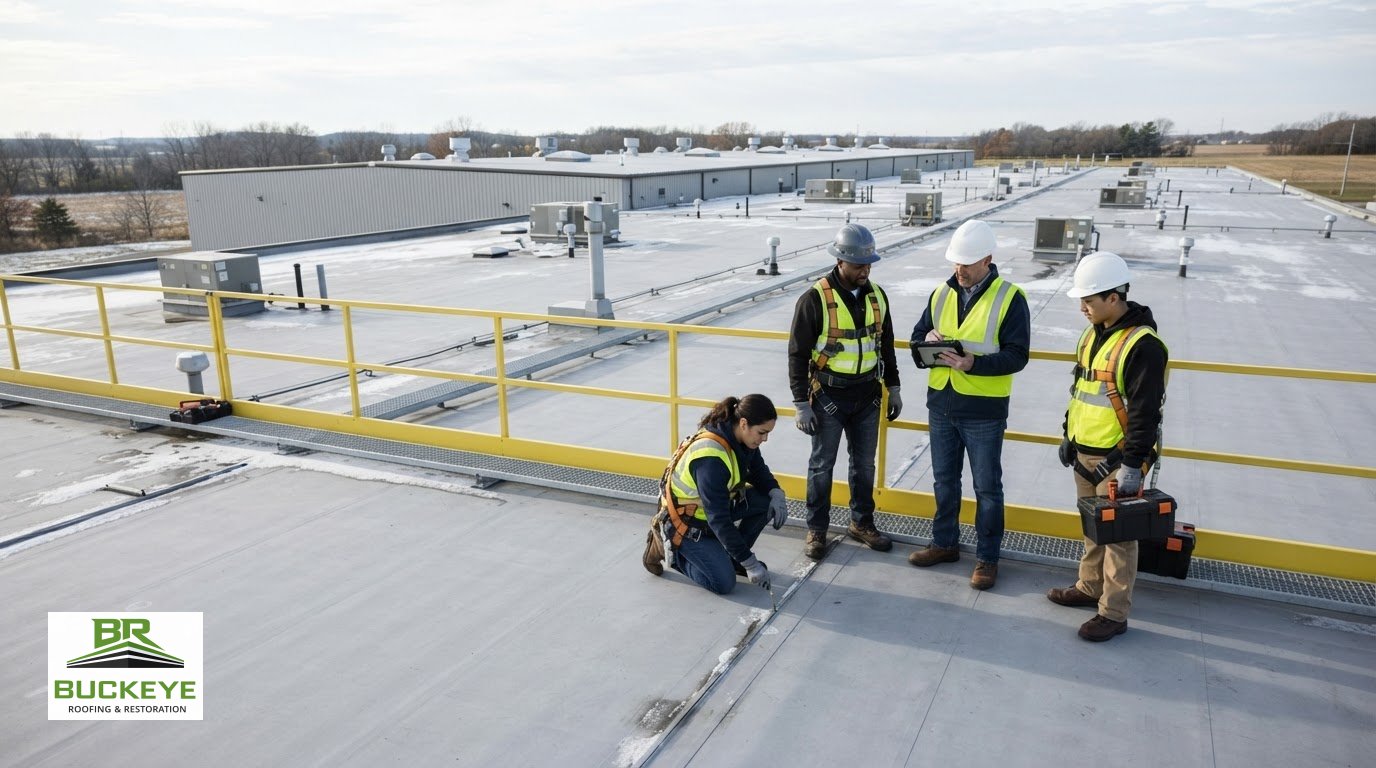
Could a small roof concern become harder to address when winter weather arrives? For commercial property owners and facility managers, commercial roof care starts with a pre-winter review that records visible changes before cold, snow, or ice complicates roof access.
It isn’t always clear which signs call for a roofer and which simply belong in the maintenance log. A visual observation can help you track what has changed, but it can’t diagnose the cause or determine the right fix.
This guide explains what to look for safely, how to document concerns, and when to ask a commercial roofer for an assessment. You’ll learn how inspection findings can guide a proportionate next step, whether that means continued monitoring, repair, restoration, or another option suited to the roof’s condition.
Key Takeaways
- Build commercial roof care into a documented routine that reflects the roof system, drainage, and observed condition.
- Account for Midwest freeze-thaw cycles, snow, and ice when planning seasonal observations.
- Record interior signs of moisture and visible roof concerns from a safe location. Don’t attempt repairs or use unsafe roof access.
- Sort findings into routine monitoring, contractor review, or prompt professional assessment so each concern gets an appropriate next step.
- Have a commercial roofer assess the roof before deciding whether repair, restoration, coating, reroofing, or replacement is appropriate.
Commercial Roof Care Starts With a Consistent, Building-Specific Routine
Commercial roof care combines planned observation, basic upkeep, recordkeeping, and timely attention from a qualified roofing contractor. A repeatable routine helps owners and facility teams track visible changes and pass concerns along before they affect building operations. It can’t guarantee that a roof won’t leak, but it gives decision-makers a clearer record of its condition and of issues that may need professional review.
Make the routine fit the building. A warehouse, manufacturing facility, office, or retail property may have different roof systems, drainage layouts, access limits, and operational needs. Commercial “flat” roofs are generally low-slope roofs, not level surfaces. They’re designed to drain, so the roof’s slopes, drains, and other drainage points matter. This overview of flat roofs explains the term and drainage concept.
For properties in Ohio, Northeast Indiana, and Southern Michigan, a useful routine also considers the building’s condition before winter. The goal isn’t to assume every roof needs repair. It’s to notice changes, keep a reliable record, and ask a roofer to assess concerns that require more than observation.
What belongs in a commercial roof-care routine?
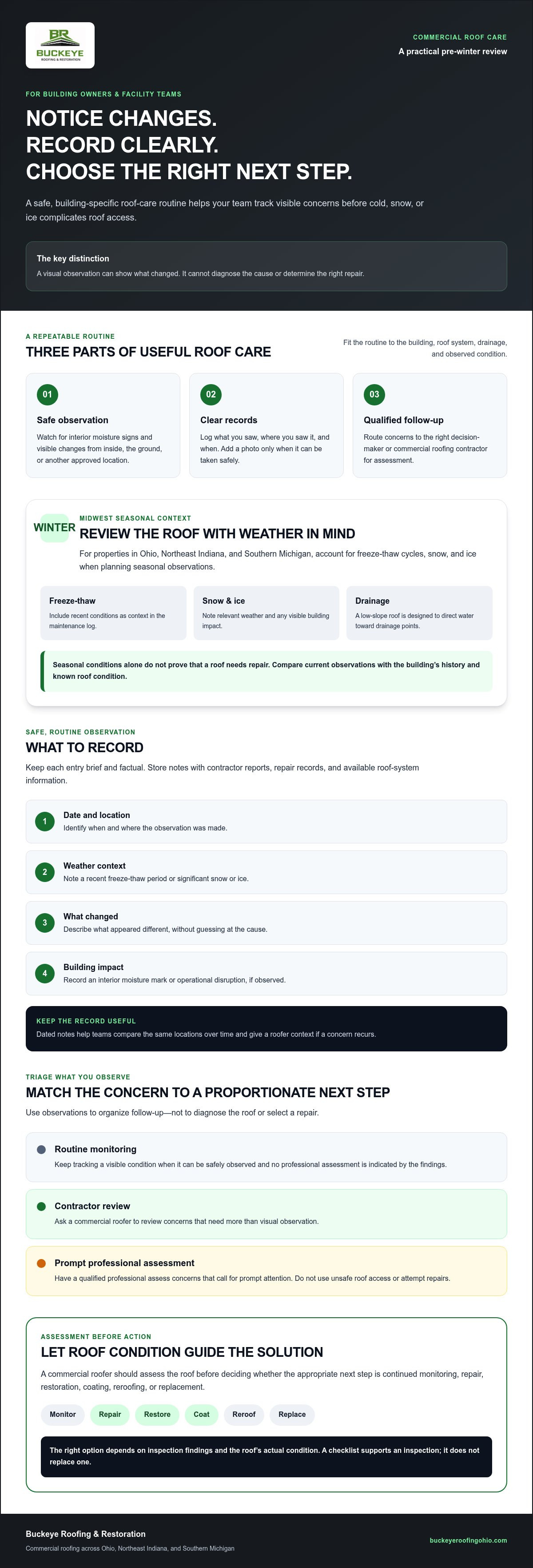
A practical routine has three parts: safe observation, clear records, and qualified contractor follow-up. Staff can watch for interior signs of moisture and visible changes from the ground or another approved location. Record the date, location, and observation, and include a photo when it can be taken safely. This checklist supports a professional roof inspection, but doesn’t replace one.
Who should use the checklist and keep records?
Building owners, facility managers, property managers, and operations staff can all contribute observations. Assign one person to maintain the log and route concerns to the right decision-maker or roofing contractor. That helps keep observations from getting lost between shifts or departments. Before anyone checks the roof, confirm the property’s access rules and responsibilities. They vary by building, and a checklist isn’t permission to enter an unsafe or restricted area.
What Commercial Roof Care Should Account for Across Midwest Seasons
Seasonal planning should reflect the building, roof system, drainage layout, and known condition. In Ohio, Northeast Indiana, and Southern Michigan, freeze-thaw cycles, snow, and ice are useful context when deciding when to review records and observe the roof. Those conditions alone don’t prove that a roof needs repair.
A low-slope roof should direct water toward its drainage points. As conditions change through the year, teams can watch for visible drainage concerns and changes in areas they can observe safely. The Unified Facilities Criteria for roofing offers a detailed reference on roofing design, installation, and maintenance. For a specific building, follow its roof-system information and qualified contractor guidance.
How should teams plan for seasonal changes?
Before a seasonal review, read previous maintenance notes and contractor reports. That history helps the team compare current observations with known conditions instead of treating each one as a new issue. Plan to observe after seasonal transitions and significant weather, when conditions and access are safe. Look from inside the building or another approved location. Note visible drainage areas or changes without trying to reach or clear them. If roof access is unsafe or the condition is unclear, leave the assessment to a qualified professional.
What should facility teams document over time?
Keep each entry brief and factual. Record:
- The date and observed location
- Weather context, such as a recent freeze-thaw period or significant snow or ice
- What changed or appeared different
- Any building impact, such as an interior moisture mark or operational disruption
Store these notes with contractor reports, repair records, and available information about the roof system. Dated records help teams compare the same locations over time, connect observations with weather or building impacts, and give a roofer useful context if a concern recurs.
This recordkeeping makes commercial roof care more useful without turning every seasonal change into a repair call. If your notes point to a condition that needs a professional opinion, Buckeye Roofing & Restoration provides commercial roofing services to properties across Ohio, Northeast Indiana, and Southern Michigan.
A Commercial Roof Care Checklist for Safe, Routine Observation
A useful commercial roof care checklist focuses on what staff can observe safely and how to route concerns. Use it to record changes, not to diagnose the roof or attempt do-it-yourself repairs.
What can staff observe without climbing onto the roof?
Start inside and at ground level. Follow property access rules, and use roof access only if it’s authorized and safe. Staff can check for:
- Water marks or damp areas inside. Record the location without assuming the cause.
- Visible debris or drainage concerns from a safe vantage point. Don’t climb up to investigate or clear them.
- Apparent roof-surface changes, such as materials that look displaced or different from earlier observations.
- Building impacts, including an active leak or disruption to operations.
Escalate active leaks, structural concerns, electrical risks, loose materials, or unsafe conditions to qualified help. For repair-focused information, see this guide to commercial roof repair. The National Roofing Contractors Association (NRCA) also provides general roofing information.
What should a roof-care log include?
Keep the record simple and factual. Note the observation date and location, what you saw, relevant weather or building impacts, and whether you took a photo from a safe position. Record who received the concern and whether follow-up occurred. Add prior repairs or recurring observations when known.
Store the log with contractor reports and repair records. This history can give a roofer useful context, but documentation alone doesn’t establish the roof’s condition or prevent damage.
How to Turn Roof-Care Findings Into Proportionate Next Steps
A recorded concern is a starting point, not a diagnosis. Match the next step to what’s known, and ask a qualified roofer to assess conditions that can’t be confirmed safely or from visual observations alone.
| Finding | Possible next step |
|---|---|
| A minor observation with no known safety concern or building impact | Record it and continue routine monitoring from a safe location. |
| A visible change that’s unclear or appears more than once | Ask a commercial roofer to review the concern and relevant roof history. |
| An active leak, storm damage, standing water, loose material, structural concern, or electrical risk | Arrange prompt professional assessment and keep staff away from unsafe areas. |
When is routine monitoring enough, and when is help appropriate?
Monitoring may suit a non-urgent observation when there’s no known safety concern or building impact. Leaks, storm damage, standing water, loose materials, and signs of structural or electrical risk call for professional assessment. Don’t attempt a repair based on a checklist. A roofer needs to evaluate the condition before suggesting work.
How should a contractor’s recommendation be evaluated?
Ask which inspection findings support the proposed scope and what remains uncertain. Repair addresses specific damage. Restoration treats the existing roof as a system, while a coating is a separate treatment that may suit only roofs that qualify. Reroofing adds a new layer; full replacement removes and replaces the existing system.
The recommendation should account for the roof’s condition, moisture, drainage, substrate, and structural integrity. If restoration is proposed, ask how the findings support that option for your roof. Learn more about commercial roof restoration. A repair recommendation should identify the affected areas and explain why the proposed scope fits.
To discuss a concern with a commercial roofing professional, ask about an inspection or quote. The assessment can help establish an appropriate next step without assuming replacement is necessary.
When to Bring in a Commercial Roofer for Ongoing Roof Care
A routine log is useful, but it can’t confirm whether a roof is ready for winter or identify the right work. Ask a commercial roofer to assess active leaks, storm damage, standing water, loose materials, structural concerns, electrical risks, or any condition staff can’t evaluate safely. A professional review can also help when the same concern appears repeatedly or building operations are affected.
The inspection should establish the roof’s condition before a contractor recommends repair, restoration, a coating, reroofing, or full replacement. Those options address different needs. Findings about the roof system, moisture, drainage, substrate, and structural integrity help determine which options are appropriate. Restoration or coating, for example, isn’t suitable for every roof, so eligibility should be based on inspection findings rather than assumption.
What should a commercial roof-care conversation cover?
Share the roof’s known history, your observation log, prior repair records, and operational priorities, such as areas where water could affect equipment or work. Ask the roofer to explain what they found in plain language, which conditions remain uncertain, and why a proposed scope fits the evidence. If there are alternatives, ask how each addresses the observed condition and what further assessment may be needed.
This discussion should lead to a clear next step, not an automatic decision to replace the roof. A focused repair may address a specific issue; broader work should be supported by the roof’s overall condition. Good commercial roof care includes understanding the reasoning behind a recommendation and keeping the inspection findings with the building’s records.
How can regional commercial properties get an assessment?
Buckeye Roofing & Restoration is based in Edon, Ohio, and serves commercial and industrial properties across Ohio, Northeast Indiana, and Southern Michigan. Its regional markets include Toledo, Fort Wayne, Findlay, Lima, Jackson, Battle Creek, Elkhart, Defiance, Bryan, Kalamazoo, Adrian, Bowling Green, Perrysburg, and Auburn. Bring your records and questions to the conversation so the roofer can understand both the roof concern and the building’s needs.
If you have a documented concern or want a professional assessment before winter, an inspection can help clarify the roof’s condition and the appropriate next step.
Make Roof Care Part of Your Building Routine
As winter approaches, use your observations to decide whether a concern needs professional review. A log provides useful context, but only an inspection can establish the roof’s condition and inform the next step.
Buckeye Roofing & Restoration provides commercial roof inspections, maintenance, repair, restoration, and replacement across Ohio, Northeast Indiana, and Southern Michigan. The right recommendation depends on the roof’s condition, not a checklist alone.
Have a documented concern or want a professional assessment? Request a commercial roof inspection from Buckeye Roofing & Restoration to discuss the roof’s condition and appropriate next step.
Frequently Asked Questions
What does commercial roof care include?
Commercial roof care includes planned observations, basic upkeep, recordkeeping, and professional attention when a concern needs closer review. Building staff can note interior water marks or visible changes from safe locations, then record where and when they noticed them. A qualified roofer assesses the roof itself and recommends any needed work. The routine should fit the building, roof system, drainage, access rules, and operational needs. It supports awareness, but can’t guarantee that a roof won’t leak.
How often should a commercial roof be checked?
The National Roofing Contractors Association recommends professional roof inspections at least twice a year, typically in spring and fall, and after severe weather. The right schedule for a specific property should also account for its roof system, drainage, condition, and prior findings. Staff can make safe observations between professional inspections, especially after seasonal changes, but those checks don’t replace a roofer’s assessment. Keep inspection notes so the next review has useful context.
Can I inspect a commercial roof myself?
You can make basic observations from inside the building or another safe, authorized vantage point, but don’t climb onto a roof unless you’re specifically authorized and properly equipped. Note interior moisture marks, visible debris, or apparent surface changes without trying to diagnose or repair them. Roof access and responsibilities vary by property. If access is unsafe, or you notice loose materials, a leak, a structural concern, or an electrical risk, contact a qualified commercial roofer.
What should I do if I find standing water on a commercial roof?
Don’t climb onto the roof or try to move water or debris yourself. Record when and where the water is visible, if you can observe it safely, and share that information with a qualified commercial roofer. Standing water may point to a drainage or roof-condition concern, but an observation alone can’t establish the cause. Ask for a professional assessment, especially if water is recurring, entering the building, or associated with other visible changes.
Does routine roof maintenance prevent leaks?
No. Maintenance can help identify developing concerns and provide a record of changes, but it can’t guarantee that a roof will never leak. Weather, roof condition, drainage, and other factors may still lead to problems. If staff notices interior water marks or an active leak, document the location and contact a commercial roofer rather than assuming routine maintenance addressed the issue. Use inspection findings to decide whether monitoring or further professional attention makes sense.
When should a commercial roof be repaired instead of replaced?
A roofer can recommend repair instead of replacement only after assessing the roof’s condition. Repair may be appropriate for a specific, limited concern, while broader deterioration or other findings may call for a different scope. The assessment should consider the roof system, moisture, drainage, and structural integrity. Don’t decide from a checklist or the roof’s age alone. Ask the contractor to explain what they found and why the proposed work fits those findings.
Can an aging commercial roof be restored or coated?
Possibly, but age alone doesn’t establish whether restoration or a coating is suitable. A roofer should assess the existing roof’s condition, substrate, moisture, drainage, and structural integrity before recommending either option. Restoration addresses the existing roof as a system; a coating is a separate treatment, and neither is appropriate for every roof. Buckeye Roofing & Restoration serves commercial properties across Ohio, Northeast Indiana, and Southern Michigan, including Toledo, Fort Wayne, Findlay, Lima, and other regional markets.

Article by
Harry Stanley III
Harry Stanley III is a construction marketing strategist and fractional CMO at H&A Marketing. He has helped construction companies grow through website strategy, SEO, paid advertising, branding, lead generation, CRM systems, and professional content. His past work includes helping Meraki Solar generate an additional $3.7 million in revenue in his first year and supporting American Builders as a fractional CMO. Today, Harry works directly with custom home builders and construction companies to build marketing systems designed to generate qualified leads and measurable growth.
