
Commercial Flat Roof Restoration in Lima, Ohio: A Practical Buying Guide
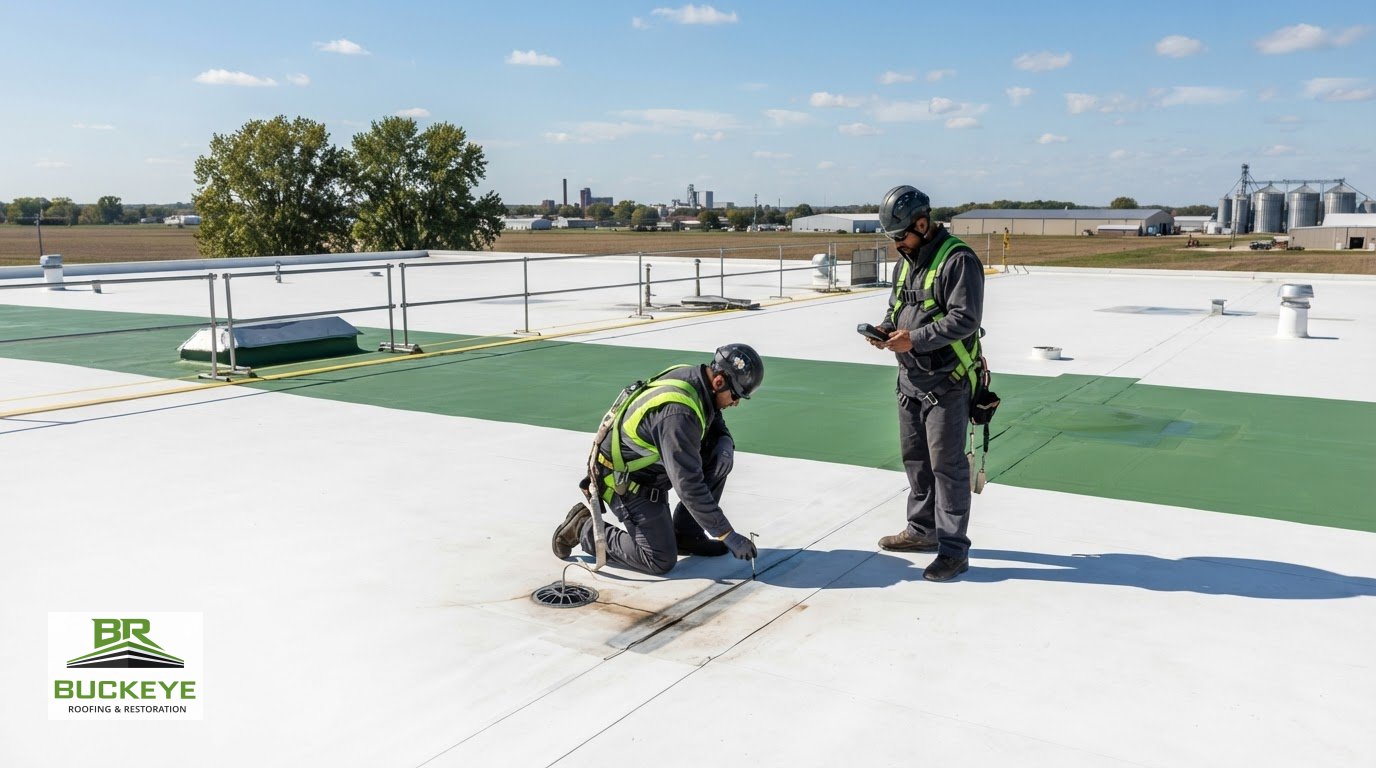
Replacing an aging commercial roof isn’t always the only sensible option, but restoration isn’t right for every roof. Commercial flat roof restoration in Lima Ohio may be worth considering when the existing roof is dry and structurally sound. If leaks or drainage problems are disrupting building operations, first find out what’s happening beneath the surface. Don’t choose a solution based on roof age alone.
It’s reasonable to want to address current problems without paying for work your building doesn’t need. Restoration may help preserve a roof that’s still suitable for continued service. Repairs can address isolated damage, while replacement may be necessary when underlying issues are too extensive. Coatings can be part of restoration, but they can’t correct every roof defect.
This guide explains what restoration includes, what it can’t fix, and which inspection findings affect eligibility. It also compares repair, restoration, coatings, and replacement for commercial properties in the Lima area. The right next step depends on the roof’s condition, moisture, drainage, and structural integrity, so let an inspection guide the decision.
Key Takeaways
- Learn what commercial flat roof restoration in Lima Ohio can involve, and how it differs from a repair, coating, reroofing, or full replacement.
- Understand why membrane condition, seams, moisture, drainage, and structural soundness matter when assessing restoration eligibility.
- Compare the purpose and limitations of repair, restoration, and replacement before weighing options for your building.
- Use focused inspection questions to understand how a roofer evaluated the roof and reached a recommendation.
- Follow a practical path from inspection findings to a documented scope, with Buckeye Roofing & Restoration serving commercial properties in Lima from its Edon base.
Commercial Flat Roof Restoration in Lima, Ohio: What It Does, and What It Does Not
For a Lima warehouse, manufacturing facility, office, or other commercial property, restoration is work intended to preserve an existing roof that remains suitable for continued service. In Northwest Ohio, freeze-thaw cycles make seams, flashing, and drainage details important inspection points. Water entering through a defect can freeze and thaw as conditions change. Restoration isn’t simply a fresh layer applied over every aging or leaking roof. The scope depends on the existing system and inspection findings, including whether the materials beneath the surface are dry and structurally sound.
Commercial “flat” roofs are generally low-slope systems designed to direct water toward drains or other drainage points. Restoration aims to preserve the existing system. A localized repair addresses a defined defect, such as a damaged seam or flashing detail. A coating is a protective layer that may be part of restoration, but applying one alone doesn’t necessarily constitute a complete restoration. Reroofing adds a new layer over an existing roof when appropriate. Full replacement removes and replaces the existing system.
What commercial roof restoration typically involves
A restoration project may include inspection, surface preparation, repairs to identified defects, and a protective coating compatible with the existing roof. The work must suit the roof’s material and condition. TPO and EPDM are roofing systems, not coatings, and a coating isn’t interchangeable with either. For background on coatings as a fluid-applied roofing membrane, see this general reference. Inspection findings should determine the scope, rather than an assumption that every roof needs the same preparation or product.
That distinction matters for commercial flat roof restoration in Lima Ohio. Freeze-thaw exposure may make a seam or flashing defect worth documenting, but it doesn’t establish restoration eligibility. A warehouse roof with isolated seam issues may need a different approach than an office roof with broader surface deterioration. In both cases, the roofer should assess the roof system and drainage before recommending work.
What restoration cannot correct by itself
A coating can’t make concealed moisture disappear or restore compromised insulation. If moisture is present within the roof assembly, the affected area may need a different remedy before restoration is considered. Poor drainage can leave water standing on the roof, and covering the surface won’t resolve the underlying drainage problem. Structural concerns or widespread system failure call for careful evaluation, not an automatic coating recommendation.
Restoration suitability depends on documented roof condition, including moisture, drainage, substrate, and structural integrity. If leaks, recurring ponding, or visible deterioration affect building operations, arrange a professional inspection rather than attempting to access or repair the roof yourself. An assessment can clarify whether targeted repair, restoration, or replacement is the appropriate next step.
How a Lima Commercial Roofer Determines Whether Restoration Is Suitable
A roof’s age can inform an inspection, but it doesn’t decide whether restoration is appropriate. A roofer assesses the complete assembly, including the membrane, seams, previous repairs, insulation, drainage, and structural condition. For a Lima warehouse, manufacturing facility, or office, the assessment should also account for building operations, including areas where roof access or ongoing work could affect day-to-day activity.
Ask the roofer to document observations and explain how they support the recommendation. The Roofing Systems Materials Standards resource provides general background on roof systems and materials. It doesn’t replace an inspection of your building’s existing assembly. That inspection should guide any recommendation about repair, restoration, or replacement.
What inspectors assess on TPO and EPDM roofs
TPO and EPDM are distinct roofing systems. A repair or coating suitable for one should not be assumed to suit the other. The inspector should identify the roof system and evaluate it before recommending materials or methods.
A roofer may examine seams, penetrations, flashing, surface damage, and previous repairs for separation, deterioration, or signs of recurring trouble. They should also consider how those areas connect with the rest of the roof. If your building has multiple roof areas or systems, ask whether the assessment distinguishes their condition rather than treating the entire roof as uniform.
When a roof needs more than a restoration coating
Some findings require further evaluation before restoration is considered. Widespread deterioration may mean the existing surface cannot support the proposed work. Trapped moisture or compromised insulation can affect what needs attention within the roof assembly. Poor drainage may leave water standing, and a coating alone won’t resolve a structural concern.
These findings don’t automatically dictate one outcome. Depending on the inspection, the next step could be a defined repair, replacement, or additional assessment. If the concern appears limited, Buckeye’s commercial roof repair services offer more information about that option. The right decision for commercial flat roof restoration in Lima Ohio should follow documented findings, not assumptions based on age or appearance.
To discuss an inspection and possible next steps for your commercial roof, contact Buckeye Roofing & Restoration.
Restoration vs. Repair vs. Replacement for Lima Commercial Roofs
These options address different roof conditions. A repair corrects a defined defect. Restoration aims to preserve an existing roof that is suitable for continued service. Replacement installs a new roof system when preserving the current assembly is no longer appropriate. A coating may be part of restoration, but it isn’t a universal substitute for a complete roofing system.
Use inspection findings to compare the options, not a blanket rule about roof age or appearance. This overview can help frame the discussion with a commercial roofer:
| Option | Purpose | When it may fit | Key limitation |
|---|---|---|---|
| Repair | Address a defined leak or damaged detail. | The defect is identifiable and the surrounding roof remains serviceable. | It may not resolve broader deterioration or recurring leaks elsewhere. |
| Restoration | Preserve an existing roof through suitable repairs and, where appropriate, a compatible coating. | The roof assembly is eligible, and its deficiencies can be addressed. | It cannot correct every concealed, structural, or drainage problem. |
| Replacement | Remove and install a new roof system. | Underlying conditions make preservation unsuitable or system failure is widespread. | It is a broader project, and the new system must suit the building and its needs. |
When targeted repair may be enough
A qualified roofer can assess a localized issue, such as a damaged seam, flashing detail, or penetration, and determine whether a defined repair is appropriate. If leaks recur in different areas or signs of deterioration extend beyond one spot, ask for a broader condition assessment rather than treating each symptom separately. For more detail about this option, see Buckeye’s commercial roof repair services.
When restoration or replacement deserves consideration
Restoration may be worth evaluating if the existing assembly is in suitable condition and identified deficiencies can be addressed. That decision depends on inspection findings about moisture, drainage, insulation, and structural integrity. A coating alone won’t make an unsuitable roof eligible.
Replacement deserves consideration when underlying conditions prevent reliable preservation or deterioration is widespread. A roofer should explain the findings behind that recommendation and whether repair or restoration remains viable. For commercial flat roof restoration in Lima Ohio, the right choice depends on the documented condition of the specific roof, not a standard answer applied to every building.
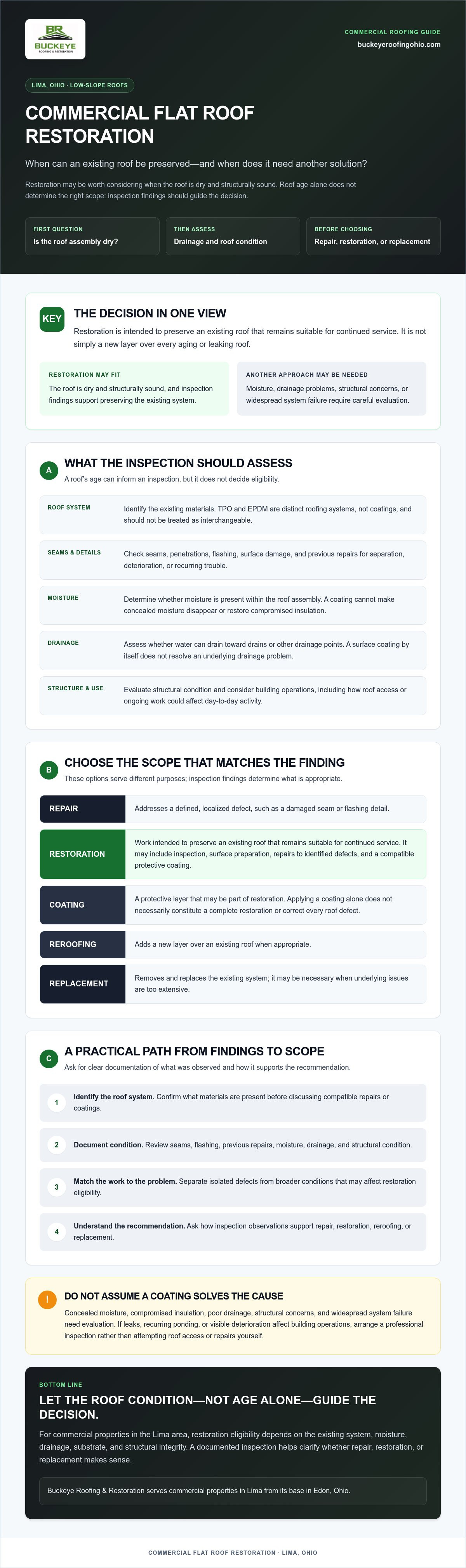
What to Ask During a Commercial Roof Restoration Inspection in Lima
A useful inspection should leave you with more than a coating recommendation. If you manage a Lima warehouse, manufacturing facility, office, or other commercial building, ask the roofer to explain what they observed, how the findings affect restoration eligibility, and what the proposed work will address. You don’t need to access the roof yourself to have a productive conversation.
Questions that clarify the restoration scope
Use this checklist to understand the assessment and proposed work:
- How did you assess moisture and insulation? Ask what was checked and whether there are signs of concealed moisture or compromised insulation.
- What did you find at seams, penetrations, and flashing? Ask which defects need attention and whether the concerns are isolated or appear across the roof.
- How is drainage performing? Discuss any areas where water remains on the roof and whether drainage concerns are included in the recommendation.
- Which conditions will restoration address, and which will it not? Ask the roofer to identify limitations or issues that may need separate work or further investigation.
- Are repairs and preparation included? Clarify what will be repaired or prepared before a coating is applied, and what falls outside the proposed scope.
- Why do the recommended materials suit this roof? Ask how the recommendation accounts for the existing roof assembly instead of treating coatings as interchangeable.
How to compare contractor recommendations
Compare documented findings and scope, not just the name of a coating or restoration approach. Ask each contractor to explain why repair, restoration, or replacement best fits the observed condition. A clear proposal should state what work is included, what is excluded, and which alternatives were considered. If you want context on a specific roofing system, ask how it relates to your existing assembly and building needs.
For commercial flat roof restoration in Lima Ohio, an inspection should address drainage, seams, penetrations, moisture, and overall system condition. Don’t climb onto the roof to verify findings yourself. If access is unsafe, or you have concerns about loose materials, structural conditions, or active leaks, leave the assessment to a qualified professional.
To discuss an inspection and options for your commercial roof, contact Buckeye Roofing & Restoration.
Plan a Commercial Roof Restoration Next Step in Lima, Ohio
A sound decision about restoration starts with a clear picture of the roof, not a commitment to a particular treatment. For commercial flat roof restoration in Lima Ohio, follow a practical sequence: have the roof inspected, document the findings, compare repair, restoration, and replacement, then agree on a scope that addresses the identified conditions. Restoration eligibility should be established through inspection, not assumed in advance.
Buckeye Roofing & Restoration is based in Edon, Ohio, and serves commercial properties in Lima. Its commercial roofing services include inspections, repairs, restoration, coatings, and replacement. Buckeye serves businesses across Ohio, Northeast Indiana, and Southern Michigan, including Toledo, Fort Wayne, Findlay, Lima, Jackson, Battle Creek, Elkhart, Defiance, Bryan, Kalamazoo, Adrian, Bowling Green, Perrysburg, and Auburn. The right recommendation depends on the specific roof and its condition, so an inspection is a sensible starting point for owners and facility managers weighing their options.
Prepare useful information before requesting an inspection
A few details from your building records can help focus the assessment. Before speaking with a roofing professional, gather what’s available:
- Note where leaks or interior water marks appear, and when you first observed them.
- Share records of previous roof repairs, inspections, or other work.
- Describe operational needs, such as areas that must remain accessible or sensitive building activities that could affect planning.
- Point out access limitations or known safety concerns so they can be discussed before the inspection.
Don’t climb onto the roof to collect information. Use safe observations from inside the building or at ground level, and leave roof access and assessment to a qualified professional, especially if there are concerns about standing water, loose materials, or structural conditions.
Discuss restoration with Buckeye Roofing & Restoration
Once the findings are documented, ask how the proposed work addresses them and what alternatives make sense. A restoration scope should explain the planned work and its limitations, rather than relying on a coating label as a substitute for a condition-based recommendation. To learn more about the service, see Buckeye’s commercial roof restoration services.
There’s no need to decide on restoration before the roof is assessed. A clear discussion can help you understand whether repair, restoration, or replacement is the more suitable path for your building. Request a commercial roof inspection to discuss your Lima property’s condition and possible next steps.
Choose the Right Next Step for Your Lima Commercial Roof
Restoration can be a practical option, but only when the existing roof is suitable for it. A professional inspection helps establish that by assessing the roof’s condition, moisture, drainage, and structural integrity. From there, compare targeted repair, restoration, and replacement using documented findings, not assumptions about age or a coating label.
For commercial flat roof restoration in Lima Ohio, the goal is to match the work to the roof’s actual needs. Buckeye Roofing & Restoration serves Lima-area commercial properties from its Edon, Ohio base, with services that include inspections, repairs, restoration, coatings, and replacement.
If you’re unsure which option fits your building, start with an inspection and a clear discussion of the findings. Request a commercial roof inspection in Lima to review your roof’s condition and possible next steps. With a sound assessment, you can move forward with a plan that makes sense for your property.
Frequently Asked Questions
What is commercial flat roof restoration?
Commercial flat roof restoration is work intended to preserve an existing commercial roof that remains suitable for continued service. Depending on the roof system and inspection findings, it may include inspection, preparation, repairs, and a compatible protective coating. Restoration isn’t the same as installing a new roof, and it isn’t right for every building. A professional assessment should establish whether the existing roof assembly can support the proposed work.
Can every commercial flat roof be restored?
No. Restoration is not suitable for every commercial flat roof. A roofer needs to assess the membrane, moisture within the roof assembly, insulation, drainage, structural condition, and existing system. A coating won’t resolve concealed damage or an ongoing water-management problem by itself. After documenting the roof’s condition, a qualified commercial roofer can explain whether repair, restoration, further investigation, or replacement is more appropriate.
How does roof restoration differ from roof coating?
Roof restoration describes a broader preservation approach, while a coating is one possible part of that work. Restoration may include inspection, surface preparation, and repairs before a compatible coating is applied. A coating alone isn’t a complete remedy for every roof or defect. Ask the contractor to explain the full proposed scope, how materials suit the existing roof assembly, and which conditions the work will and won’t address.
Is restoration better than replacing a commercial flat roof?
Neither option is automatically better. Restoration may make sense if the existing roof remains suitable and its deficiencies can be addressed. Replacement may be appropriate if inspection findings show that preserving the roof isn’t suitable. The decision should consider the roof assembly, moisture, drainage, structural integrity, building use, and documented condition. Roof age or a general preference for one option shouldn’t replace an inspection-based recommendation.
What does a commercial roofer inspect before recommending restoration?
A commercial roofer should identify the roof system and assess its membrane, seams, penetrations, flashing, prior repairs, drainage, and visible deterioration. The inspection should also consider moisture, insulation condition, and structural concerns where relevant. Ask the roofer to explain what they found and how it supports the proposed scope. Don’t climb onto the roof to check it yourself. Leave access and assessment to a qualified professional.
Does Buckeye Roofing & Restoration serve commercial properties in Lima, Ohio?
Yes. Buckeye Roofing & Restoration is based in Edon, Ohio, and serves commercial properties in Lima. The company focuses on commercial roofing, including inspections, repairs, restoration, coatings, and replacement. It doesn’t claim to have a Lima office. If you’re researching commercial flat roof restoration in Lima Ohio, an inspection can help clarify your roof’s condition and which options may be appropriate.
What should I ask a contractor about commercial roof restoration?
Ask which inspection findings make the roof suitable for restoration, what preparation and repairs the scope includes, and which conditions the work won’t correct. Confirm that proposed materials suit the existing roof assembly. If repair or replacement may also be appropriate, ask why the contractor recommends one option over the others. A clear recommendation should connect documented roof conditions to the proposed work without promising an outcome before inspection.

Article by
Harry Stanley III
Harry Stanley III is a construction marketing strategist and fractional CMO at H&A Marketing. He has helped construction companies grow through website strategy, SEO, paid advertising, branding, lead generation, CRM systems, and professional content. His past work includes helping Meraki Solar generate an additional $3.7 million in revenue in his first year and supporting American Builders as a fractional CMO. Today, Harry works directly with custom home builders and construction companies to build marketing systems designed to generate qualified leads and measurable growth.
