TPO vs. EPDM Roofing: How to Choose for a Commercial Building
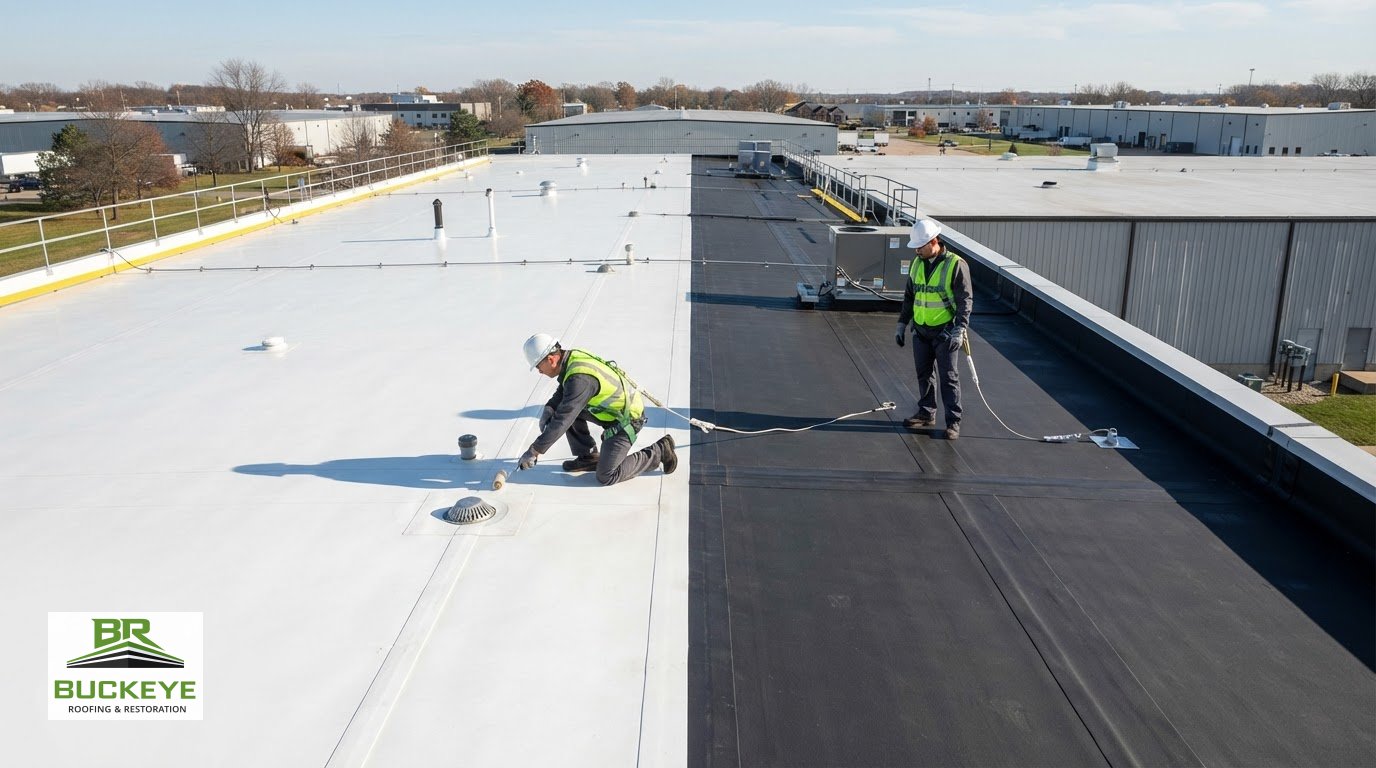
The brighter membrane isn’t automatically the better roof. For a commercial building in Ohio, Indiana, or Michigan, TPO vs EPDM Roofing is about more than choosing between a white and a black surface. The right fit depends on the roof’s condition, drainage, building use, and what the owner needs from the system.
It’s reasonable to want a clear answer, especially when a roofing decision could affect maintenance and performance through Midwest freeze-thaw cycles. TPO’s reflective surface and heat-welded seams may suit some buildings, while EPDM’s flexibility and different seam method may suit others. Neither option can fix poor drainage or make an aging roof sound.
This comparison explains the practical differences between TPO and EPDM, including the trade-offs to consider for your building and operating needs. It also covers how an inspection can clarify whether the issue is membrane selection or the condition of the existing roof, and whether repair, restoration, or replacement deserves a closer look.
Key Takeaways
- TPO and EPDM are single-ply membranes, but their materials and installation methods differ.
- TPO vs EPDM Roofing is best assessed against the building’s use, roof assembly, drainage, access, and project needs.
- Seams, penetrations, drainage details, and workmanship all affect the performance of the finished roof.
- Review roof records and operating requirements before narrowing down a system; avoid choosing by membrane colour alone.
- An inspection can show whether the priority is selecting a membrane or addressing the existing roof through repair, restoration, or replacement.
TPO vs. EPDM roofing: what are these commercial membranes?
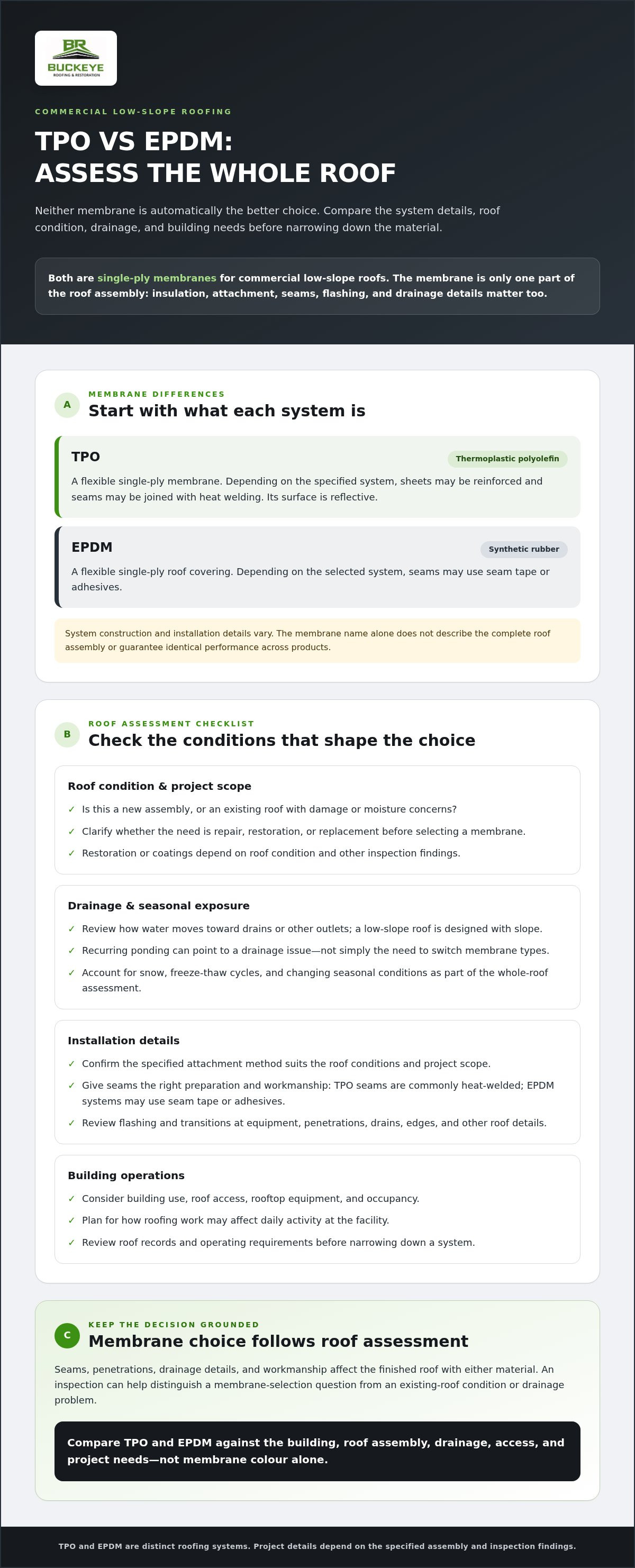
For a building owner, “flat roof” is a familiar term, but it doesn’t mean the roof should be level. Commercial low-slope roofs are designed with slope so water can move toward drains or other outlets. The roofing membrane is one part of that assembly. Insulation, attachment, seams, flashing, and drainage details all contribute to how the complete roof performs.
TPO and EPDM are both single-ply membranes: roofing sheets installed as a membrane layer rather than built up from multiple plies. They’re distinct materials and systems, not interchangeable names for every low-slope roof. The general overview of membrane roofing includes both types. In a TPO vs EPDM Roofing decision, the building’s use, existing roof condition, drainage, and project requirements matter alongside the membrane itself.
What is TPO roofing?
TPO stands for thermoplastic polyolefin. It’s a flexible, single-ply roofing membrane used on commercial low-slope roofs. Depending on the specified system, sheets may be reinforced and seams may be joined with heat welding. The exact product construction and installation details vary, so “TPO” alone doesn’t describe every part of the roof assembly or guarantee identical performance across products.
What is EPDM roofing?
EPDM, short for ethylene propylene diene monomer, is a synthetic rubber used to make single-ply roofing membranes. It serves as a flexible roof covering for commercial low-slope buildings. Seams and details are assembled according to the selected system, which may use adhesives or seam tape. Product construction, attachment, and installation requirements vary, so the roof plan should address the specific materials and details being used.
These definitions are a starting point, not a recommendation. A warehouse with rooftop equipment, a manufacturing facility with operational access needs, and an office building may have different priorities even if each has a low-slope roof. Before comparing membrane options, consider:
- Existing roof condition: Identify whether the project involves a new assembly or an existing roof with damage or moisture concerns.
- Drainage: Review how water reaches drains and whether recurring ponding points to a separate drainage issue.
- Building operations: Consider roof access, equipment, occupancy, and how roofing work may affect daily activity.
- Project scope: Establish whether the need is repair, restoration, or replacement before selecting a membrane.
An inspection helps separate a material-choice question from a condition problem. If the existing roof has localized damage, a repair may be appropriate; if broader issues are present, the next step may differ. Restoration or coatings also depend on roof condition and other inspection findings. TPO and EPDM systems are among the options Buckeye Roofing & Restoration works with, but the suitable approach depends on the building and the roof, not just the membrane label.
How TPO and EPDM differ in installation and Midwest roof conditions
A membrane’s name doesn’t tell the whole installation story. The complete assembly, attachment method, roof layout, and manufacturer’s system details all shape how TPO or EPDM is installed. For facility teams, the practical concern is whether seams, edges, penetrations, and drainage details are planned and completed to suit the building.
What installation details matter for TPO and EPDM?
TPO seams are commonly joined using heat, while EPDM systems may use seam tape or adhesives. Those broad differences don’t define every product or installation. The specified system determines the materials, preparation, attachment, and methods required. The EPDM Roofing Association offers additional background on EPDM systems, but project details still need to match the chosen assembly.
Seams deserve close attention because they connect membrane sheets. Roof penetrations, such as equipment supports and vent openings, also need carefully fitted flashing and secure transitions. A sound field membrane can still be undermined by weak details around edges, drains, or rooftop equipment. Qualified installation and inspection matter for either material; property staff shouldn’t attempt roof work themselves.
What should Midwest building teams account for?
Snow, freeze-thaw cycles, and changing seasonal conditions make drainage and roof condition important parts of a project assessment. They don’t automatically make TPO or EPDM the right choice. A roof’s slope, insulation, existing assembly, building use, and maintenance history all affect how its performance should be evaluated. For example, recurring water near a drain calls for investigating drainage and the surrounding roof details, not simply switching membrane types.
Use this comparison as a starting point. The details below are project-dependent, not guarantees for every system.
| Detail | What teams should consider |
|---|---|
| Attachment | Specified methods vary by system and roof conditions; confirm the assembly suits the building and project scope. |
| Seams | TPO heat-welded seams and EPDM seam treatments require appropriate preparation and workmanship. |
| Penetrations and edges | Equipment, drains, and roof edges need compatible detailing that accounts for the roof layout. |
| Drainage and weather exposure | Review water movement, ponding concerns, and seasonal exposure as part of the whole-roof assessment. |
After snow or a thaw, a facility manager can safely note interior staining, active leaks, or water that remains visible from the ground. Don’t climb onto the roof to investigate. A professional inspection can assess seams, penetrations, drainage paths, and signs of trapped moisture. Those findings help separate a membrane-selection question from a repair need or a broader roof-condition issue.
For a building in Northwest Ohio or nearby areas, the useful TPO vs EPDM Roofing comparison starts with site conditions, not a blanket claim about Midwest weather. If concerns have surfaced, schedule a commercial roof inspection to understand what the roof needs before choosing a system.
TPO vs. EPDM roofing: compare the factors that affect the choice
A useful TPO vs EPDM Roofing comparison starts with the building, not a universal list of winners and losers. A new roof assembly and an existing roof with leaks raise different questions. For an existing roof, its condition, substrate, moisture concerns, and drainage may determine whether membrane selection is even the first decision. For new construction, the team can plan the assembly around the building’s design and operating needs.
How should building use and roof condition shape the comparison?
A warehouse may prioritize access around rooftop equipment, while a manufacturing facility may need to plan roofing work around operations. Retail and office properties have their own occupancy and disruption concerns. These differences don’t automatically point to TPO or EPDM. First establish the project scope, document the existing roof’s condition, and identify operational constraints that could affect the system design and installation plan.
For an existing roof, a professional assessment should consider the membrane and the layers beneath it, including the substrate, signs of moisture, and drainage. A sound area beside a leak doesn’t necessarily tell the whole story. A new-system selection can compare proposed assemblies; an existing-roof decision may instead call for targeted repair, restoration, or replacement, depending on inspection findings.
What can a comparison table tell, and not tell, you?
A table can help facility teams organize project questions. It can’t establish that one membrane is best, confirm compatibility with a particular roof, or replace an assessment of the building. Treat product-specific details as items to verify against manufacturer documentation and the project specification before making a decision.
| Project criterion | What the team should evaluate |
|---|---|
| Existing roof | Is this a new assembly, or do moisture, damage, or substrate concerns change the scope? Inspection findings are project-specific. |
| Building use | Consider occupancy, equipment access, and work sequencing. The right plan depends on the facility’s operations. |
| Drainage | Review slope, drains, and areas where water collects. A membrane choice alone won’t resolve a drainage problem. |
| Energy performance | Assess the complete assembly and operating conditions, including insulation and building use. Verify product claims in manufacturer documentation. |
| System details | Confirm product, attachment, and installation requirements for the specified assembly. Details vary by system. |
Energy performance isn’t determined by membrane material alone. The full roof assembly, insulation, building operations, and conditions inside the facility all influence how the roof relates to energy use. A claim about one membrane shouldn’t be applied automatically to another building or system.
The suitable membrane depends on the building and inspection findings. Use the comparison to identify the questions that matter, then base the selection on the actual roof, project scope, and documented system requirements.
How to narrow down TPO or EPDM for a commercial building
Start with the roof you have and the work the building needs. A membrane comparison is useful only after the project team understands the existing system, known trouble spots, and how roof work could affect daily operations. Use this sequence to prepare for a focused assessment.
What should a facility manager gather before comparing systems?
Roof records help connect recurring problems to the building’s history. Gather what’s available, then note operating requirements that could shape access and work planning. Don’t climb onto the roof to collect details; record observations from inside or from a safe ground-level location.
- Review roof records. Look for installation or replacement information, previous repairs, leak reports, and maintenance notes. If some records are missing, note that rather than guessing at the roof’s age or construction.
- Map recurring concerns. Record where leaks or interior staining have appeared and whether they return after certain weather. These observations can help an inspector focus on areas for closer assessment.
- Describe building requirements. Note equipment access needs, occupancy, work-hour restrictions, and areas where disruption could affect production, tenants, or customer access.
- Capture visible drainage concerns. From a safe location, note known drain issues or areas where water appears to remain after rain. A qualified roofer can assess roof drainage directly.
For broader context on system options beyond this comparison, use the commercial flat roof systems selection guide. It can help frame the discussion, but the building’s records and condition should guide the next step.
Which inspection findings can change the next step?
A commercial roofer assesses more than the visible membrane. Inspection findings may include moisture within the roof assembly, substrate condition, drainage, penetrations, and structural concerns. The results help determine whether the project is a membrane choice, a repair need, or a broader roof-system issue. If there are signs of structural damage, active leaks, or standing water, arrange a professional assessment rather than investigating on the roof yourself.
The available paths are different:
- Repair addresses specific damage or a leak while retaining the existing roof where appropriate.
- Restoration renews an existing roof system when its condition and other inspection findings support that approach.
- Coating applies a protective layer to a suitable roof surface; it isn’t a substitute for correcting underlying problems.
- Reroofing describes adding a new roof covering, with project details determining how the existing assembly is handled.
- Full replacement removes and replaces the existing roof system when the assessment supports that scope.
These terms describe different scopes, not automatic steps in a fixed sequence. The guide to repairing, restoring, or replacing a commercial roof explains that separate decision. For a building-specific recommendation, schedule a commercial roof inspection so the findings can guide the TPO or EPDM discussion.
Choosing a TPO roofing contractor in Elkhart, Indiana: assess the roof before the system
For a commercial property in Elkhart, the TPO-versus-EPDM decision should follow an assessment of the roof and the project, not a material preference made in isolation. Buckeye Roofing & Restoration serves commercial properties in Elkhart and across Northeast Indiana, Northwest Ohio, and Southern Michigan from its base in Edon, Ohio. The goal is a recommendation that reflects what the building needs, whether that means addressing an existing problem or planning a new roof system.
What does an inspection need to establish?
A commercial roof inspection considers the visible membrane, seams, penetrations, drainage paths, and available roof records. If restoration or coatings are being considered, the assessment also needs to address the substrate, moisture, and structural integrity. Those findings help determine whether the existing assembly is a suitable candidate, or whether another scope deserves consideration. Leaks, standing water, loose materials, or unsafe access call for professional assessment.
The inspection also puts building requirements into context. Equipment locations, roof access, occupancy, and operating schedules can affect project planning and system details. A manufacturing facility may need work coordinated around active operations, while a property manager may need to account for tenant access. These aren’t reasons to assume one membrane is right; they help define what the roofing plan must accommodate.
When should an Elkhart-area property manager discuss next steps?
Start the conversation when planning a commercial roofing project or when recurring issues could affect a material decision. Share roof records, leak locations, known drainage concerns, and operational constraints. An inspection can help separate a TPO vs EPDM Roofing question from a condition issue that may call for repair or a broader scope. Don’t access the roof yourself to investigate.
Repair addresses specific damage. Restoration renews an existing system when its condition supports that approach, while a coating is a separate application that requires a suitable roof surface. Replacement may be appropriate when inspection findings indicate the existing roof cannot reasonably support the other options. None should be assumed before the roof is assessed.
If restoration is under consideration, review Buckeye’s commercial roof restoration services alongside the inspection findings. Restoration and coatings aren’t suitable for every roof, and the recommendation should account for moisture, substrate, drainage, and structural condition.
Whether you’re comparing membranes for a planned project or managing an active roof concern, a measured assessment can clarify the options without treating replacement as the default. Buckeye provides commercial roof inspections and works with TPO and EPDM systems. Schedule a commercial roof inspection to discuss the building’s condition and the next practical step.
Make your next roofing decision with a clear plan
Before your next facilities or budget meeting, turn the roof discussion into a short project brief. Record the decisions your team needs to make, the operational constraints that matter, and what information is still missing. That gives decision-makers a clearer basis for comparing proposals and keeping the project aligned with the building’s priorities.
TPO vs EPDM Roofing is one part of that conversation, not the whole plan. Keep the focus on what the building needs and what the inspection supports. A measured next step can help your team move forward without assuming a particular material or scope before the facts are clear.
Ready to discuss the roof’s condition and your project needs? Discuss a commercial roof inspection with Buckeye Roofing & Restoration. A clear plan can help your team make the next decision with confidence.
Frequently Asked Questions
Is TPO or EPDM better for a commercial roof?
Neither is automatically better for every commercial building. The right option depends on the planned roof assembly, how the facility operates, and what the roof assessment shows. For example, rooftop equipment access or a known drainage concern may affect system planning regardless of membrane type. Treat TPO vs EPDM Roofing as a project comparison, not a universal ranking, and evaluate the specified system against the building’s requirements.
Can TPO or EPDM be installed over an existing commercial roof?
Sometimes, but it depends on the existing roof and the proposed assembly. A roofer needs to assess conditions such as trapped moisture, damaged areas, substrate stability, and the number and condition of existing layers. The project must also fit the applicable system requirements and building conditions. A new membrane over a roof that needs underlying repairs can leave the source of trouble unaddressed, so inspection should come first.
How does Midwest weather affect TPO and EPDM roofing?
Ohio, Northeast Indiana, and Southern Michigan see seasonal changes that make roof drainage and condition worth tracking. Snow and freeze-thaw cycles can expose weaknesses around drains, seams, or penetrations, but they don’t by themselves make one membrane the right choice. For example, note recurring interior leaks after a thaw and share that history with a roofer. The roof assembly, building, and maintenance records help put weather exposure in context.
What happens if a TPO or EPDM roof has standing water?
Standing water can point to a drainage, slope, or roof-condition problem that needs professional assessment. It may also add concern if the water is associated with leaks, soft areas, or visible roof damage. Don’t walk through pooled water or attempt to clear a drain from the roof. Record where and when water is visible from a safe location, then arrange an inspection to identify the cause and appropriate next step.
How do I know whether an existing EPDM or TPO roof can be restored?
You can’t determine restoration eligibility from the membrane name or age alone. A commercial roofer needs to assess the roof’s condition, substrate, moisture, drainage, and structural integrity. For instance, widespread moisture or an unstable substrate may change the options, while a more limited issue may call for a different scope. An inspection helps establish whether restoration or coatings are suitable, or whether repair or replacement is more appropriate.
Can a commercial building owner safely inspect a TPO or EPDM roof?
Building staff can note signs from inside or from the ground, such as ceiling stains, active drips, or loose material visible from a safe vantage point. They shouldn’t climb onto the roof to check seams, drains, or equipment. Low-slope roofs can still have fall, electrical, and access hazards. If there’s an active leak, standing water, loose material, or any concern about safe access, arrange a professional roof inspection.
Does choosing TPO or EPDM determine whether a roof needs full replacement?
No. Membrane selection and replacement scope are related but separate decisions. A building with an existing TPO or EPDM roof may need a localized repair, while another roof may have conditions that call for broader work. The inspection determines what the existing assembly can support. A roofer can assess whether repair, restoration, coatings, reroofing, or full replacement fits the roof’s condition and the project requirements.

Article by
Harry Stanley III
Harry Stanley III is a construction marketing strategist and fractional CMO at H&A Marketing. He has helped construction companies grow through website strategy, SEO, paid advertising, branding, lead generation, CRM systems, and professional content. His past work includes helping Meraki Solar generate an additional $3.7 million in revenue in his first year and supporting American Builders as a fractional CMO. Today, Harry works directly with custom home builders and construction companies to build marketing systems designed to generate qualified leads and measurable growth.