
Flat Roof Leak Detection in Elkhart, Indiana
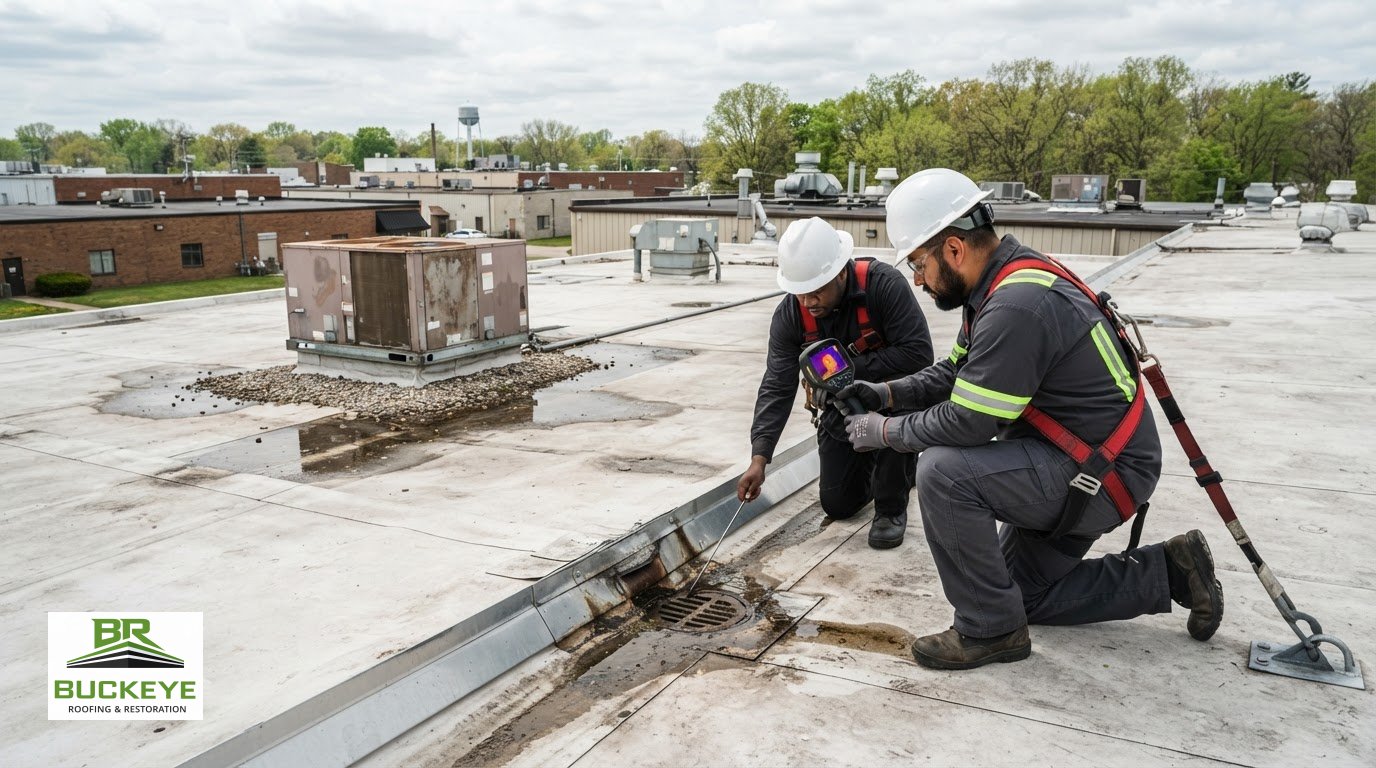
What if the ceiling stain points away from the actual roof leak? Water can travel along a roof deck or building structure before it shows inside, so the visible damage may not line up with the entry point. For facility managers seeking flat roof leak detection in Elkhart Indiana, tracing that path matters. A missed source can put stored materials or daily operations at risk, while guessing at the cause can lead to unnecessary work.
If you’ve spotted a stain or recurring moisture, it’s reasonable to want a clear answer before deciding what the roof needs. A careful inspection can connect interior signs with roof conditions and help distinguish a targeted repair from a broader concern.
This article explains what to record safely before an inspection, how commercial leak detection typically proceeds, and when methods such as infrared imaging or electronic testing may help. You’ll also learn what those methods can’t establish on their own, and how roof condition, moisture, drainage, and structural integrity inform a proportionate next step: repair, restoration, coating, or replacement.
Key Takeaways
- For flat roof leak detection in Elkhart Indiana, use interior evidence as a starting point, not proof of where water entered.
- Share leak timing, affected areas, and repeat patterns so an inspector can compare them with roof details and drainage conditions.
- Visual checks and specialized testing can each provide useful clues, but no single method necessarily confirms the full extent or cause of a leak.
- Before the inspection, gather roof-system records and repair notes, and coordinate safe access around building operations.
- Choose repair, restoration, coating, or replacement based on confirmed damage and the roof’s overall condition, moisture, drainage, and structural integrity.
Flat roof leak detection in Elkhart, Indiana: start with the evidence
A drip in a warehouse aisle or a stain in an office ceiling confirms that water has reached the interior. It doesn’t identify where water entered the roof. That distinction matters for flat roof leak detection in Elkhart Indiana: the visible symptom is a clue, not a repair plan.
Commercial “flat” roofs are generally low-slope systems designed to direct water toward drains or other outlets. They aren’t perfectly level surfaces. The Flat roof overview provides background on the term and common construction principles. During an inspection, a roofer considers how water could move across the roof and through the building before appearing indoors.
Leak detection means tracing water evidence back toward its entry source. The goal is to connect what the building team sees inside with roof conditions that could explain it, rather than assuming the opening sits directly above the stain. Until a professional assesses the roof, keep occupants away from unsafe areas and don’t climb onto the roof to investigate.
What can a building team observe safely?
Useful notes help an inspector understand when and where the problem occurs. Record details from inside the building, without touching wet materials or entering an unsafe area:
- Room or work area, approximate time, and whether the leak recurs.
- Weather conditions when the leak was noticed, if known.
- Photos of staining or dripping from a safe location. Don’t disturb ceiling tiles or other materials.
- Nearby equipment, stored goods, or operations that may need protection or coordination.
Why the visible stain may not mark the roof opening
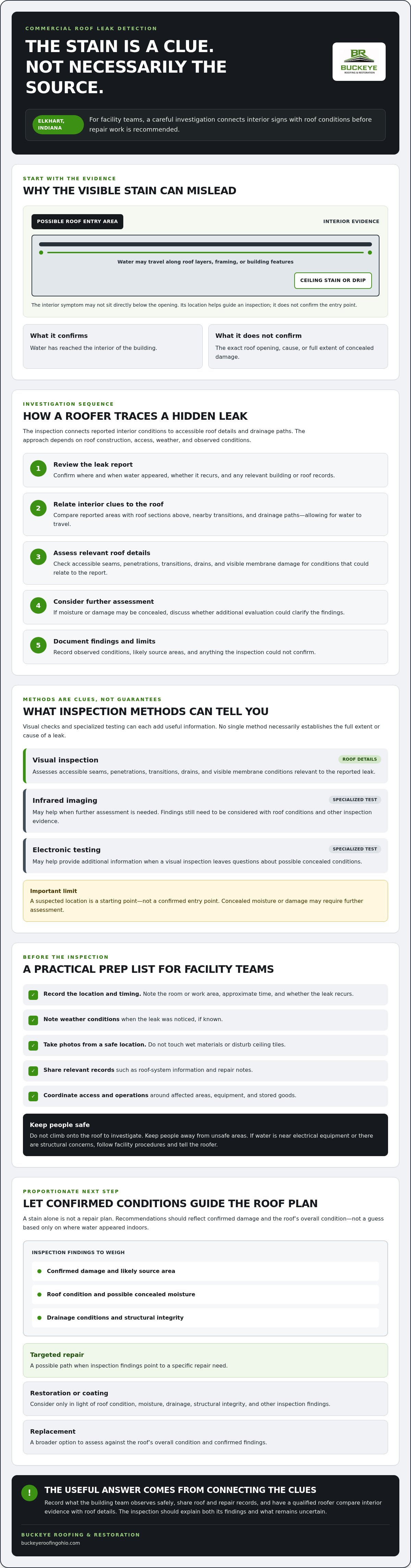
Water can travel along roof layers, framing, or building features before it becomes visible. A stain may therefore sit some distance from the roof defect. Its shape alone can’t confirm whether the cause is a damaged membrane, a roof detail, or another issue. Treat interior evidence as a guide for the inspection, not proof of a specific failure.
If water is near electrical equipment, keep people clear and follow your facility’s procedures for reporting the hazard. Structural concerns also warrant prompt professional attention. Share those observations with the roofer so the inspection can account for both the leak and affected building areas.
How a commercial roofer traces a hidden leak on an Elkhart roof
A sound diagnosis connects what’s happening inside with roof conditions that could explain it. The roofer considers the building as a whole, not just the spot where water appears. The Whole Building Design Guide’s Building Enclosure Design resource explains how the roof is part of the enclosure that manages moisture. For flat roof leak detection in Elkhart Indiana, that perspective helps keep the investigation focused on evidence before anyone recommends work.
The inspection moves from interior clues to roof details
The roofer records the reported leak locations and compares them with the roof areas above, allowing for the possibility that water traveled before becoming visible. The inspection approach depends on roof construction, access, weather, and observed conditions. On TPO or EPDM roofs, the roofer assesses details relevant to that system rather than assuming every membrane has the same vulnerabilities.
A typical diagnostic sequence includes:
- Review the report. Confirm where and when water appeared, whether it recurs, and any relevant building or roof records.
- Relate interior clues to the roof. Compare the leak pattern with roof areas above, nearby transitions, and drainage paths.
- Assess relevant roof details. Inspect accessible seams, penetrations, transitions, drains, and visible membrane damage for conditions that could relate to the reported leak.
- Decide whether more assessment is needed. If moisture or damage may be concealed, the roofer explains what additional evaluation could clarify the findings.
- Document the results. Record observed conditions, likely source areas, and any limits on what the inspection could confirm.
A suspected leak location is a starting point for investigation, not a confirmed entry point. Wet insulation or other concealed damage may not be visible at the surface and can require further assessment.
When specialized testing may help
Infrared or electronic leak-detection methods may be considered when the roof assembly and inspection conditions make them suitable. They aren’t automatic add-ons or guarantees of a precise answer. Roof construction, moisture conditions, weather, and access can affect which approach is appropriate and how results should be interpreted. Ask the roofer what a proposed test can assess and what its limits are.
Ask for findings that distinguish observed damage from suspected causes and identify any areas that remain uncertain. For a commercial property in Elkhart, a commercial roof inspection from Buckeye Roofing & Restoration can help assess roof conditions and inform the next step.
Comparing commercial roof leak-detection methods for Elkhart properties
No single inspection method fits every commercial roof. The right approach depends on the roof assembly, suspected leak area, safe access, and site conditions. For flat roof leak detection in Elkhart Indiana, a roofer may begin with a visual review, then consider moisture assessment or specialized testing if the initial findings leave important questions open.
| Method | What it can help assess | What it cannot establish alone |
|---|---|---|
| Visual inspection | Accessible seams, penetrations, transitions, drains, visible membrane damage, and drainage conditions that may relate to the reported leak. | A visible defect does not by itself confirm it caused the interior leak or show whether moisture has spread beneath the roof surface. |
| Moisture assessment | Whether areas of the roof assembly may be affected by moisture, using an approach suited to the roof construction. | The full extent or source of concealed moisture, or whether the affected area requires repair, restoration, or another response. |
| Specialized testing, such as infrared or electronic methods | Additional information about suspected wet areas or membrane leak locations when the roof and site conditions are suitable. | A complete diagnosis or a guaranteed result across every roof system and set of conditions. |
Visual inspection and moisture assessment
A visual review is a practical starting point. The roofer checks accessible roof details and drainage, then compares those observations with the leak report. This can identify conditions worth investigating, but may not reveal what is hidden within the assembly. Moisture assessment can add information about potentially affected areas, though its usefulness depends on the method and roof construction.
That distinction matters before choosing work. If concealed moisture may be present, its extent may need confirmation before a roofer can reasonably recommend a targeted repair or assess whether restoration or coating is appropriate.
Specialized testing and its limits
Infrared imaging and electronic leak detection are possible tools, not automatic next steps. Their suitability depends on roof-system details and the inspector’s assessment of conditions at the property. Ask what a proposed test is intended to identify, what its results can show, and what may still require further assessment.
A sound recommendation weighs test results alongside visible conditions, roof history, drainage, and the reported leak pattern. No tool should be treated as proof by itself, and no method should be assumed to work on every TPO, EPDM, or other commercial roof.
What Elkhart facility managers should prepare before a leak inspection
A little preparation can help the roofer focus the inspection on relevant areas and work around your facility’s needs. For flat roof leak detection in Elkhart Indiana, you don’t need to diagnose the problem yourself. Gather the information you already have, coordinate access, and leave roof investigation to a qualified professional.
Information that helps the roofer investigate
- Record the leak history. Note dates, approximate times, interior locations, and whether the leak recurs. Include photos taken safely from inside the building.
- Share roof records. Provide any available information about the roof system, prior repair notes, and previous inspection or maintenance records.
- Describe site conditions. Identify sensitive equipment, stored materials, active work areas, and access arrangements the inspection team should coordinate with facility staff.
- Note weather context. If you’ve noticed a connection with rain, snow, or changing temperatures, include that in your notes. Weather history can help frame the investigation, but it can’t confirm the leak source by itself.
Don’t remove ceiling materials, test suspected roof defects, or climb onto a roof to gather evidence. Those steps can create safety risks or disturb clues the inspector needs to assess. Keep people clear of unsafe areas and follow your facility’s procedures if water is affecting operations or equipment.
Questions to ask after the inspection
A useful inspection should leave you with a clear account of what was observed and what remains uncertain. Ask the roofer:
- Where does the evidence point, and which findings support that conclusion?
- Is additional testing or assessment needed to clarify concealed moisture or damage?
- What uncertainty remains, and what precautions should facility staff take while the issue is evaluated?
These questions help separate confirmed observations from a likely explanation. They also give your team a practical basis for planning next steps without attempting roof work or making a decision from the interior stain alone.
When arranging an inspection for a commercial property in Elkhart, share your notes and available roof records with Buckeye Roofing & Restoration. That information can help the inspection account for the building’s history and operations.
After leak detection: choose a repair, restoration, or replacement path
Finding the likely leak source is only part of the decision. The next step should reflect what the inspection confirms about the defect and the rest of the roof, including its condition, moisture, drainage, and structural integrity. For flat roof leak detection in Elkhart Indiana, a leak doesn’t automatically mean the entire roof needs replacement.
When a repair may fit the inspection findings
A targeted repair addresses identified damage while preserving the existing roofing system where its surrounding condition supports that approach. The scope depends on the confirmed defect and nearby materials. A problem limited to a roof detail may call for a different repair than damage accompanied by broader deterioration. See Buckeye’s commercial roof repair information and commercial flat roof repair guide for more context.
When broader work needs consideration
Widespread deterioration, extensive moisture concerns, or other system-level issues may prompt an assessment beyond one leak repair. The options differ:
- Restoration addresses the existing roof more broadly, when inspection findings show the system is a suitable candidate.
- A coating applies a protective layer to an eligible roof surface. It is not a fix for every roof or a substitute for correcting underlying issues.
- Reroofing adds a new roof system over an existing one when the roof’s condition and other considerations allow it.
- Full replacement removes and replaces the existing roof system when its condition calls for that level of work.
Restoration or coating isn’t appropriate for every roof. Moisture, drainage, substrate condition, and structural integrity all matter. If replacement is under consideration, the inspection should explain why and what findings support it. Review Buckeye’s commercial roof restoration and commercial roof replacement information to understand these distinct paths.
The practical choice is the one supported by the evidence, not the broadest scope by default. An inspection can help clarify which option fits the roof’s condition.
Get a clear next step for your commercial roof
For flat roof leak detection in Elkhart Indiana, the visible stain is a clue, not a diagnosis. Record what your team observes safely, then let a professional compare the interior evidence with roof details and drainage. The inspection findings can help determine whether a targeted repair is appropriate or whether the roof needs a broader assessment.
Repair, restoration, coating, and replacement address different conditions. The right recommendation depends on confirmed damage, moisture, drainage, and the roof’s overall condition, not on the presence of a leak alone.
Buckeye Roofing & Restoration focuses exclusively on commercial roofing and serves properties across Ohio, Northeast Indiana, and Southern Michigan, including Toledo, Fort Wayne, Findlay, Lima, Jackson, Battle Creek, Elkhart, Defiance, Bryan, Kalamazoo, Adrian, Bowling Green, Perrysburg, and Auburn. Its commercial services include flat-roof inspections, leak repair, restoration, coatings, and replacement. Request a commercial roof inspection or discuss a leak with Buckeye Roofing & Restoration.
A clear assessment gives your team a practical basis for deciding what to do next, without assuming more work than the roof needs.
Frequently Asked Questions
How do roofers find a leak on a commercial flat roof?
Roofers compare interior leak locations with roof areas and details that could relate to them. For flat roof leak detection in Elkhart Indiana, an inspection may include accessible seams, penetrations, transitions, drains, visible membrane conditions, and drainage paths. The roofer may consider moisture assessment or specialized testing if needed. The approach depends on roof construction and site conditions, and findings should distinguish observed damage from a suspected source.
Can a roof leak show up far from where water enters?
Yes. Water can travel along roof layers, framing, or other building features before it appears inside, so a ceiling stain may not sit directly below the entry point. The stain and any dripping are still useful clues. Record where they appear and whether they recur, but don’t treat their location as proof of a specific roof defect. A professional inspection can compare interior evidence with roof conditions.
What should I do when I notice a commercial roof leak?
Keep occupants clear of unsafe areas and follow your facility’s procedures to protect people, equipment, or stored goods. From a safe location, note the room, time, weather, and whether the leak returns. Take photos without disturbing ceiling materials. Don’t climb onto the roof or test a suspected defect yourself. If water is near electrical equipment or you see structural concerns, treat the situation as a prompt safety issue.
Can infrared testing find every flat roof leak?
No. Infrared testing can help assess possible moisture patterns under suitable conditions, but it doesn’t guarantee that every leak will be found or confirm the entry point by itself. Results depend on factors such as the roof assembly and site conditions. A roofer should explain why a method fits the roof, what its findings may indicate, and whether additional assessment is needed before deciding on repair or restoration.
How long does commercial roof leak detection take?
There isn’t one set timeframe for every inspection. The time required can depend on the roof’s size and construction, safe access, weather, the reported leak pattern, and whether further moisture assessment or specialized testing is appropriate. Share available roof records and prior repair notes when arranging an inspection. The roofer can discuss the expected scope once they understand the building and the conditions that need to be evaluated.
Does a commercial roof leak mean the whole roof needs replacement?
No. A leak may come from a limited area that can be addressed with a targeted repair, depending on the confirmed defect and surrounding roof condition. Broader deterioration or moisture concerns may warrant evaluation of restoration, coating, or replacement, but those options are not interchangeable. The recommendation should account for the roof’s overall condition, moisture, drainage, and structural integrity, rather than assuming one leak requires a full replacement.
Does Buckeye Roofing & Restoration serve commercial properties in Elkhart, Indiana?
Yes. Buckeye Roofing & Restoration serves commercial properties in Elkhart and Northeast Indiana. The company is based in Edon, Ohio, and focuses exclusively on commercial roofing. Its services include flat-roof inspections, leak repair, restoration, coatings, and replacement, along with TPO and EPDM roofing systems. An inspection can help determine which next step fits the building’s roof conditions and the evidence found.

Article by
Harry Stanley III
Harry Stanley III is a construction marketing strategist and fractional CMO at H&A Marketing. He has helped construction companies grow through website strategy, SEO, paid advertising, branding, lead generation, CRM systems, and professional content. His past work includes helping Meraki Solar generate an additional $3.7 million in revenue in his first year and supporting American Builders as a fractional CMO. Today, Harry works directly with custom home builders and construction companies to build marketing systems designed to generate qualified leads and measurable growth.
