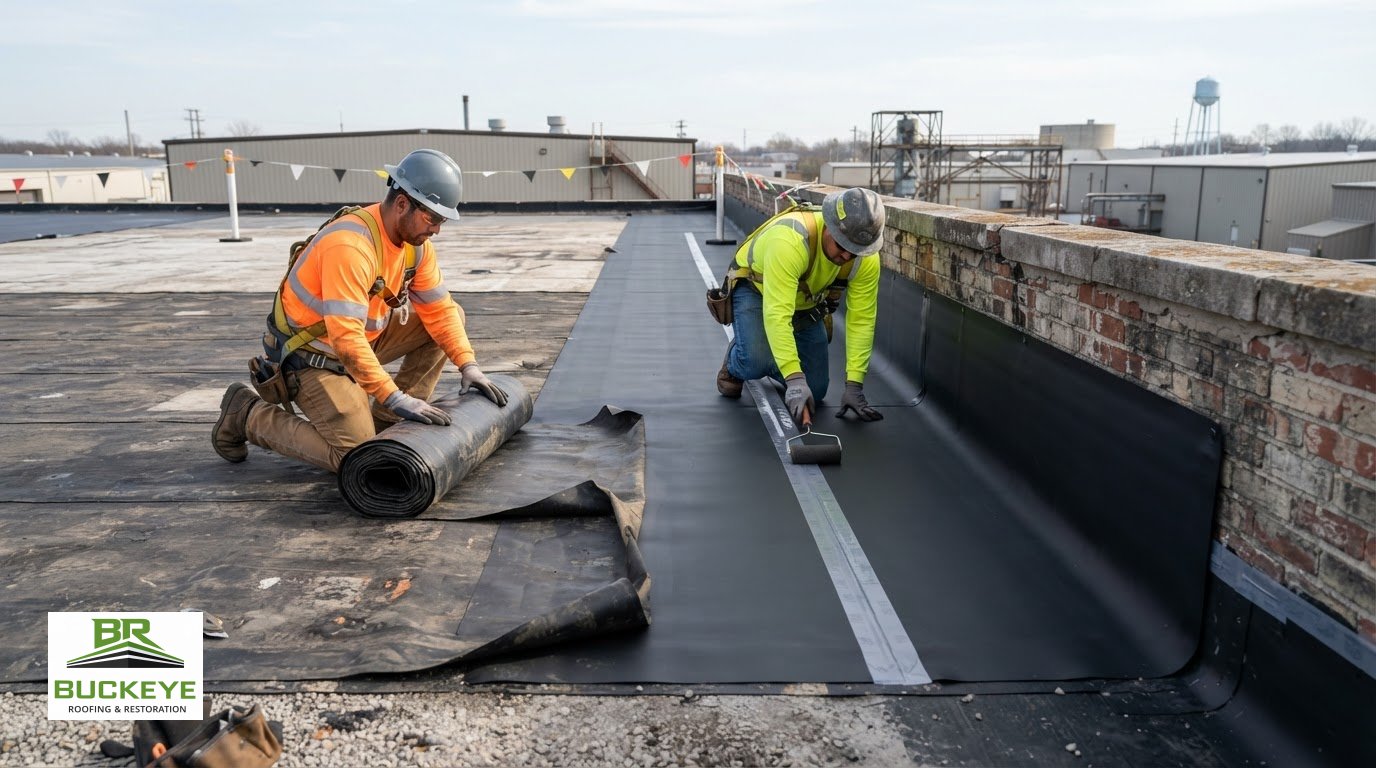
A roof leak doesn’t automatically mean the entire EPDM system needs replacing. An EPDM roof replacement company in Lima, Ohio, should first assess the membrane, seams, flashing, drainage, and signs of moisture beneath the surface to determine whether repair, restoration, or full replacement is the practical option.
For commercial and industrial buildings, the right scope depends on the roof’s condition, not just one visible leak. A targeted repair may address isolated damage, while widespread deterioration or underlying problems may call for a larger project, including removal of the existing system.
This guide explains EPDM installation, repair, replacement, and removal, what an inspection considers, and how to assess customer reviews. It also covers service around Lima and how Buckeye Roofing & Restoration supports commercial properties across Ohio with roof inspections, EPDM roofing, repairs, restoration, and replacement.
Key Takeaways
- Learn how EPDM installation, leak detection, targeted repairs, and replacement address different roof conditions.
- Understand the service area around Lima and how to assess whether a roofing provider serves your commercial property.
- Use customer reviews to look for useful details about communication, project scope, and the work performed.
- See what a full replacement and roof teardown involve, and why the existing roof’s condition helps determine the scope.
- Explore Buckeye Roofing & Restoration’s commercial EPDM, TPO, flat-roof, and repair services.
Commercial EPDM Roof Installation, Repair, and Replacement
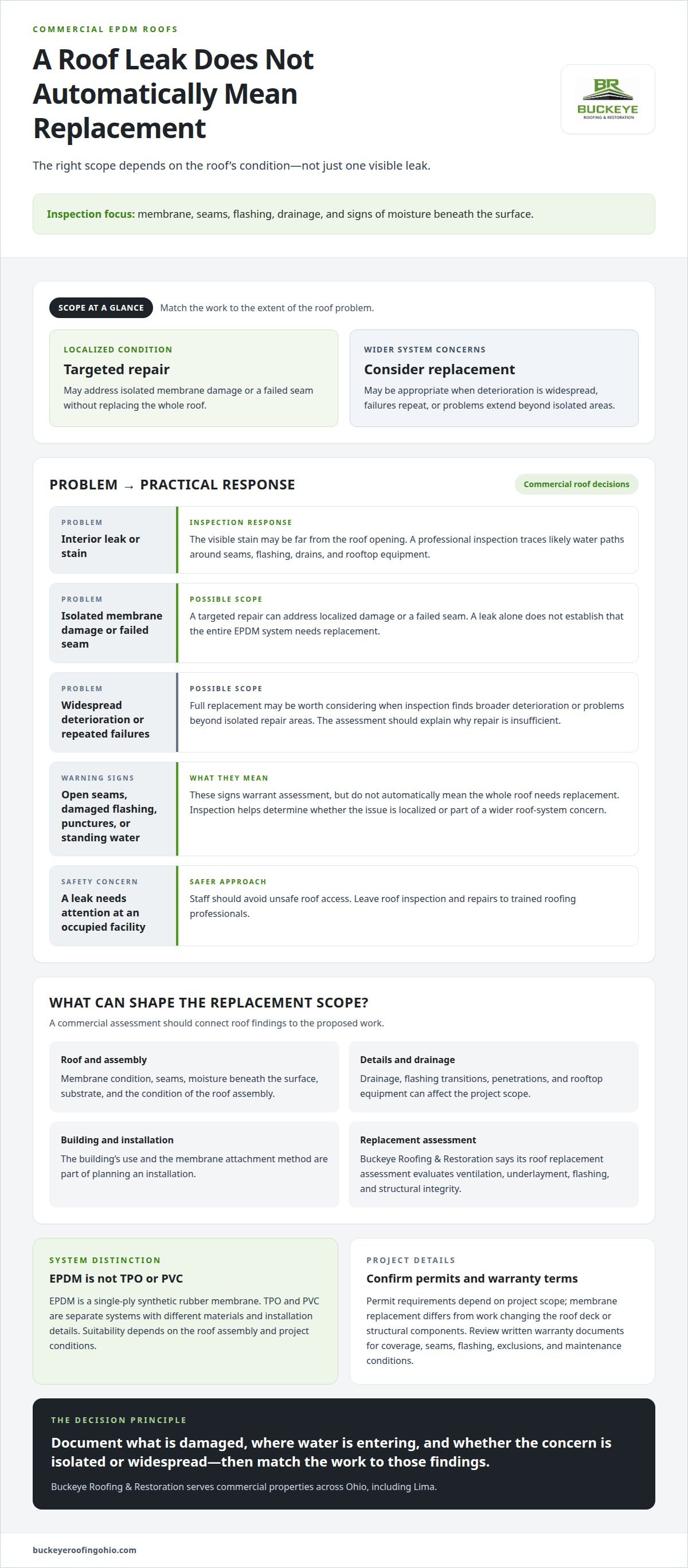
EPDM is a single-ply synthetic rubber membrane used on commercial low-slope roofs. A sound installation starts with assessing the existing roof, drainage, penetrations, and deck. The plan should also account for the building’s use and the membrane attachment method. TPO and PVC are separate systems, not alternate names for EPDM. Their materials and installation details differ, so suitability depends on the roof assembly and project conditions.
When a leak appears inside a Lima warehouse or office, the visible stain may be far from the roof opening. A professional inspection traces likely water paths around seams, flashing, drains, and rooftop equipment. Repair can address localized membrane damage or a failed seam without replacing the whole roof. Water entering an occupied facility needs prompt attention, but staff should avoid unsafe roof access and leave inspection and repairs to trained roofing professionals.
Full replacement is worth considering when an inspection finds widespread membrane deterioration, repeated failures, or problems beyond isolated repair areas. The work may involve removing or preparing existing materials, checking the roof assembly, and installing the specified replacement system. Drainage, flashing transitions, penetrations, and substrate condition all affect the scope. A commercial roofing assessment should explain why repair is insufficient before recommending replacement.
For a commercial roof replacement in Lima, Ohio, permit requirements depend on the project scope. Membrane replacement differs from work that changes the roof deck or structural components. Before construction, confirm applicable permit requirements and document-submission procedures with the relevant building authority.
EPDM warranty coverage depends on the written project documents. Review what the membrane coverage includes, how seams and flashing are treated, and which exclusions or maintenance conditions apply. Workmanship coverage is separate only when the contract or warranty documents say so.
For properties in Lima, an active leak, recurring interior staining, or visible membrane damage warrants professional assessment. A roofer can document the source and distinguish a repairable section from broader roof-system concerns. That evidence helps facility managers plan roofing work around operations instead of treating every leak as a reason for full replacement.
On a commercial EPDM roof, warning signs can include open or failing seams, damaged flashing, membrane punctures, recurring interior leaks, and areas of standing water. These observations do not automatically mean the entire roof needs replacement. A professional inspection can assess the membrane and roof assembly, identify whether the issue is localized, and determine whether repair or broader work may be appropriate.
Buckeye Roofing & Restoration says its roof replacement assessment evaluates ventilation, underlayment, flashing, and structural integrity. For commercial planning, an assessment should explain the condition of relevant roof components and how those findings relate to the proposed scope. Documented findings can help facility managers discuss whether the work addresses a localized problem or involves broader replacement, and plan decisions around the building’s use.
EPDM Roof Replacement Service Areas Around Lima, Ohio
Lima, Ohio, is one of the commercial roofing markets Buckeye Roofing & Restoration serves. It is a useful reference for owners of warehouses, manufacturing buildings, offices, and other commercial properties considering EPDM roof replacement. Buckeye offers free commercial roof inspections across Ohio. An inspection considers the property and project requirements, rather than assuming a roofing contractor must have an office in Lima.
Commercial roofing service extends throughout Ohio, with Northwest Ohio as a primary region. Lima is among the targeted Ohio markets, alongside Findlay, Toledo, Bowling Green, and Defiance. These cities illustrate the regional and statewide footprint. They don’t mean every project has identical travel or scheduling needs. A warehouse near Lima may need a different work plan from an occupied office in Findlay.
West Central Ohio property managers can start by sharing the building’s address and roof system. A facility with EPDM, rooftop equipment, and several drainage points presents different planning needs from a smaller commercial building. The property’s use matters, too. Work at an active manufacturing site may require coordination around deliveries, operating areas, and access routes. Clear site details help establish practical next steps for repair, restoration, or replacement.
A Lima ZIP code can help identify a property, but it doesn’t describe the roof or project scope. Share the full site address, building type, known roof material, and whether the concern is a leak or planned replacement. Those details help distinguish an EPDM replacement inquiry from a repair request and account for site access and coordination with tenants or facility staff.
For properties beyond Lima, Ohio remains the clearest service-area boundary to consider. The approved markets also include Northwest Ohio, nearby Northeast Indiana, and Southern Michigan. Cities such as Fort Wayne, Adrian, and South Bend represent those neighboring regions. They’re examples of targeted markets, not a guarantee that every project has the same requirements. The building location and work scope guide the conversation.
Before arranging a commercial roof inspection, gather the site address, roof type, visible concerns, and any operating constraints. Buckeye Roofing & Restoration offers free commercial roof inspections across Ohio. For a Lima-area property, sharing the building’s location and roofing needs helps identify an appropriate next step based on the roof itself, not just its ZIP code.
Buckeye Roofing & Maintenance states that it has over 15 years of experience serving Lima, Ohio, and surrounding areas. When discussing a commercial roof project, property owners can provide the site address, building use, known roof material, and the reason for contacting a contractor. These details help keep the conversation focused on the property’s location and needs.
It’s also useful to describe rooftop equipment, drainage areas, access limitations, and scheduling considerations for tenants or facility staff. If the roof is leaking, note where the concern appears and whether it is ongoing. For planned replacement, share any known information about the existing EPDM system. A clear description gives the roofing team context to discuss a suitable next step, since buildings can differ in scope, access, and operating requirements.
How to Evaluate Commercial Roofing Customer Reviews
A review is most useful when it describes a specific commercial roofing job. Look for details about the building type, roof system, and work performed. For example, a facility manager’s account of an EPDM leak repair may be more relevant than a general comment about an unrelated project. Reviews can inform your assessment, but they don’t replace a roof inspection or a clear written scope.
Read for the process, not just the star rating. Useful accounts explain how the roofing contractor communicated, documented the roof condition, and handled changes during the work. A review mentioning a warehouse, recurring leak, and repair plan gives more context than a brief statement that the crew did a good job. Check the review date, too, because older accounts may describe different staff or services.
- Match the project. Look for EPDM installation, commercial roof replacement, or roof repair examples relevant to your building.
- Look for specifics. Note whether the reviewer describes leak findings, repair scope, scheduling communication, or cleanup.
- Read several accounts. Compare recurring themes rather than treating one unusually positive or negative review as the full picture.
- Check the response. A business reply can show how it addresses a concern without proving the underlying work quality.
Use reviews to prepare focused questions for a commercial roofing assessment. If an account mentions a leak near rooftop equipment, ask how the inspection identified the entry point and distinguished membrane damage from flashing issues. If a replacement review discusses project coordination, consider your facility’s access, delivery, and operating constraints. Specific questions make the conversation more useful.
Keep claims in perspective. A reviewer’s statement that a roof has stayed dry describes one property and its conditions; it doesn’t establish the same result for another building. Roof age, drainage, penetrations, installation details, and maintenance all affect performance. Reviews also can’t confirm whether a roof is suitable for restoration or needs full replacement. That decision calls for an inspection of the actual roof assembly.
Before choosing a contractor, compare review details with the proposed scope, inspection findings, and written project terms. A review that describes EPDM work may help you assess relevant experience, while a vague rating offers little technical context. Use both positive and critical feedback as prompts for practical questions about communication, documentation, and how recommendations relate to observed roof conditions.
Full Commercial EPDM Roof Replacements
A full EPDM replacement is also a project-management task for a commercial property owner. The written plan should make responsibilities, communication, and completion records clear. When working with an EPDM roof replacement company in Lima, Ohio, look for a proposal that explains how the team will coordinate with building staff, document decisions, and close out the work.
Before work starts, facility managers can establish one point of contact for project updates. The plan should identify how schedule changes, access needs, and questions about the approved scope will be communicated. At an active warehouse, coordinating material staging with loading operations can help staff plan around work areas. Clear communication reduces avoidable confusion during the project.
Workmanship is easier to evaluate when project documents describe the expected installation details. The owner’s representative can compare completed work with the agreed specifications and record questions for the project team. This is more useful than relying on broad assurances. A written process for documenting and resolving open items gives both parties a shared reference.
During project review, building owners can look for clear documentation of:
- The designated contact for project questions and updates.
- How schedule or scope changes will be recorded and approved.
- The process for tracking open items before project closeout.
- Installation records and documents provided when work is complete.
- Any maintenance guidance and warranty documents included in the agreement.
These records help facility staff understand what work was completed and which documents to retain. They can also support future planning by keeping project decisions and closeout information together. For example, a maintenance manager who takes over a building can refer to the project file rather than rely on informal notes from previous staff.
When comparing proposals, an EPDM roof replacement company in Lima, Ohio should provide a scope that building representatives can follow. A clear commercial roof replacement scope helps align the proposal, project communication, and closeout records. It gives owners a practical way to understand what the agreement covers without relying on vague descriptions.
At completion, review the finished work against the agreed documents and discuss open items with the project contact. Keep the final scope, installation records, and applicable warranty documents with the building’s maintenance files. This creates a useful record for future facility managers without assuming any roof system will be free from future maintenance needs.
Commercial Roof Replacement and Teardown
Replacement planning involves more than choosing an installation date. For an EPDM project, the work sequence needs to account for active building operations and how crews will phase the work.
EPDM Replacement Process and Timeline
The schedule should show the major phases, including site setup, removal or preparation, membrane installation, and final review. It should also identify which areas are scheduled together and how the sequence affects building access. These milestones give facility staff a practical way to plan around work without assuming every roof follows the same schedule.
Project duration varies with roof size and layout, the agreed work sequence, weather, and changes discovered during construction. Ask for the schedule to distinguish planned work from factors that may shift it. A clear update process helps property managers adjust deliveries, tenant notices, or production plans as the project progresses.
Signs Replacement Is Needed
Maintenance history can help determine whether replacement merits consideration. Review records for repeated repair visits, recurring interior damage, or sections that keep returning to the work list. A pattern over time may signal that continued spot work no longer meets the building’s needs, even when no single issue appears decisive.
Facility managers can also consider how roof concerns affect operations. For example, recurring disruptions in a production area may warrant a broader project review. These records don’t establish the technical remedy by themselves, but they help frame the inspection and clarify the effects of ongoing maintenance. The roof’s actual condition remains central to the decision.
Roof Tear-Down Work
Teardown means removing specified existing roof materials before installing the new assembly. It differs from an overlay, which leaves some existing material in place. The project documents should state which approach is planned and which layers are included. That distinction affects what building staff can expect during work and what the crew may encounter as removal proceeds.
During removal, crews can open planned sections rather than treat the entire roof as one continuous operation. The sequence should account for protecting exposed areas and keeping debris away from building entrances, equipment, and active work zones. Facility staff should follow posted site directions and stay clear of designated roofing areas while teardown is underway.
Before work begins, agree on how the project team will communicate daily progress and changes. This helps building representatives know which areas are active and what to expect next.
Buckeye Roofing & Restoration: Commercial Roof Replacement
Buckeye Roofing & Restoration helps Lima-area commercial owners assess EPDM roof replacement needs. A replacement project should start with the roof’s condition, not the assumption that every leak requires a new system. Depending on the damage, existing assembly, drainage, and building use, the practical choice may be repair, restoration, or full replacement.
For a Lima warehouse, manufacturing facility, or office, a roof assessment connects visible concerns with the wider system. Repeated leaks, deteriorated membrane areas, and problems around roof openings can help show whether damage is isolated or widespread. The existing roof’s condition and the substrate beneath it matter, too. These findings guide a proportionate recommendation and help the property owner understand the proposed scope.
Buckeye Roofing & Restoration provides commercial roof replacement and installs TPO and EPDM roofing systems. EPDM and TPO are distinct membrane options, not interchangeable names for one material. Selecting a system depends on the building, existing roof, drainage, use, and project conditions. The replacement plan should explain the chosen system and how it fits the roof assembly, including transitions around edges and penetrations.
Repair may make sense when a problem is limited to one area and the surrounding roof remains serviceable. Commercial flat-roof repair addresses localized damage without automatically replacing the whole system. Broad deterioration or recurring issues across separate roof areas may warrant evaluating full replacement. An assessment helps distinguish these conditions and gives facility managers a basis for planning work around normal operations.
Commercial flat roofing also requires attention to drainage. Low-slope roofs are designed to direct water toward drains or other drainage points, so roof layout and water movement inform replacement planning. A proposal should describe the system and work areas clearly, rather than treating the membrane as the entire roof. Building access and operating needs also help shape a workable project plan.
For property owners considering EPDM replacement in Lima, Buckeye Roofing & Restoration can assess the roof’s condition, repair needs, and replacement scope. The goal is to understand the building first and determine which roofing approach fits the findings. Commercial roof replacement is a substantial decision, so a clear explanation of the work matters as much as the selected membrane system.
Contact Buckeye Roofing & Restoration to discuss your commercial roof.
Choose the Next Step for Your Commercial Roof
The next step doesn’t have to be a commitment to full replacement. For a Lima commercial property, an inspection can help clarify whether the roof needs focused repair, broader restoration, or a new EPDM system. An EPDM roof replacement company in Lima, Ohio, should connect its recommendation to the roof’s observed condition and the building’s needs.
Buckeye Roofing & Restoration offers commercial flat roofing, commercial flat-roof repair, and commercial roof restoration. Those options give building owners a way to discuss different paths before deciding on a project scope. The right solution depends on inspection findings, including the roof assembly, drainage, and extent of damage.
Bring forward the details that will help frame the conversation: the property location, roof type, known leak areas, and any operational constraints. An inspection can then help identify a practical course of action. Contact Buckeye Roofing & Restoration to discuss your commercial roof and its next step.

Article by
Harry Stanley III
Harry Stanley III is a construction marketing strategist and fractional CMO at H&A Marketing. He has helped construction companies grow through website strategy, SEO, paid advertising, branding, lead generation, CRM systems, and professional content. His past work includes helping Meraki Solar generate an additional $3.7 million in revenue in his first year and supporting American Builders as a fractional CMO. Today, Harry works directly with custom home builders and construction companies to build marketing systems designed to generate qualified leads and measurable growth.