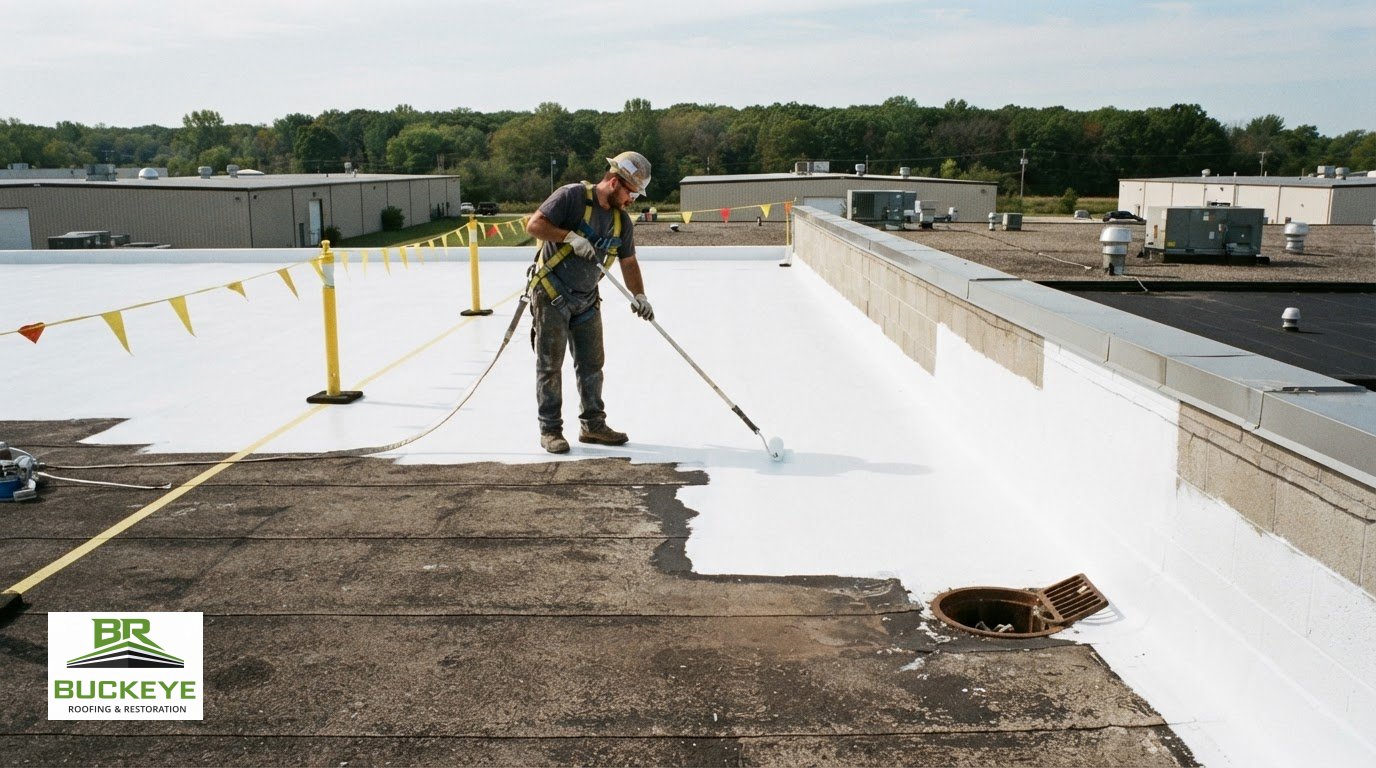
A cool roof does not always require replacing the entire roofing system. A reflective coating can help a suitable commercial roof absorb less heat from sunlight, but the existing roof must be sound enough to support it. For owners considering commercial roof coating services in Jackson, Michigan, the first step is determining whether the roof is a good candidate for coating.
Comparing coating types is a useful starting point. Acrylic and silicone coatings have different properties, and the right fit depends on the roof material, drainage, moisture condition, and exposure. This guide explains how cool roofs work, what distinguishes acrylic from silicone, and what professional preparation and installation involve. An inspection matters because coating over a saturated or structurally compromised roof will not address the underlying problem.
Key Takeaways
- Choose a coating only after assessing the roof’s condition, drainage, moisture, and substrate.
- Understand how acrylic and silicone differ so the coating system suits the building’s needs.
- Professional preparation and installation help address surface issues before the coating is applied.
- Compare coating with repair, restoration, and replacement based on what the existing roof actually needs.
- A cool roof reflects more sunlight, but its suitability depends on the existing roofing system and its condition.
Hiring qualified commercial roofing professionals
For a commercial coating project in Jackson, choose a roofer who assesses the existing system before recommending work. The assessment should cover roof condition, drainage, moisture, substrate compatibility, and installation timing.
Choosing Commercial Roofing Contractors
When choosing commercial roof coating services in Jackson, Michigan, look for a contractor who evaluates the roof in person and explains the proposed scope. The assessment should identify damage, drainage concerns, and signs of trapped moisture. Ask for a written proposal that describes surface preparation, repairs, coating type, and project limits. These details help building owners compare the work itself, not just a coating label.
Relevant experience matters because commercial roofs vary. A warehouse with a large low-slope roof may have different access, drainage, and operating needs than an office building. The contractor should explain how the existing membrane or roof surface affects preparation and coating compatibility. Clear answers about inspection findings help facility managers decide whether coating, repair, or another approach best suits the building.
Local Reviews and Ratings
Reviews can offer insight into how a contractor communicates, manages work areas, and addresses concerns after a project. Look for detailed accounts of commercial roofing work, not just a star rating. A review about a warehouse or occupied business offers more useful context than a general comment about service.
A BBB roofing-contractor search near Jackson displayed 5,046 results. That count reflects search results, not verified coating experience or a quality rating. Read individual reviews for recurring, specific details, then weigh them alongside the contractor’s inspection process and written scope.
Discuss code and permit considerations before work begins. Michigan building codes and permit requirements can depend on the project scope and local jurisdiction. A qualified contractor should explain which requirements apply to the proposed work and identify any permit coordination included in the project.
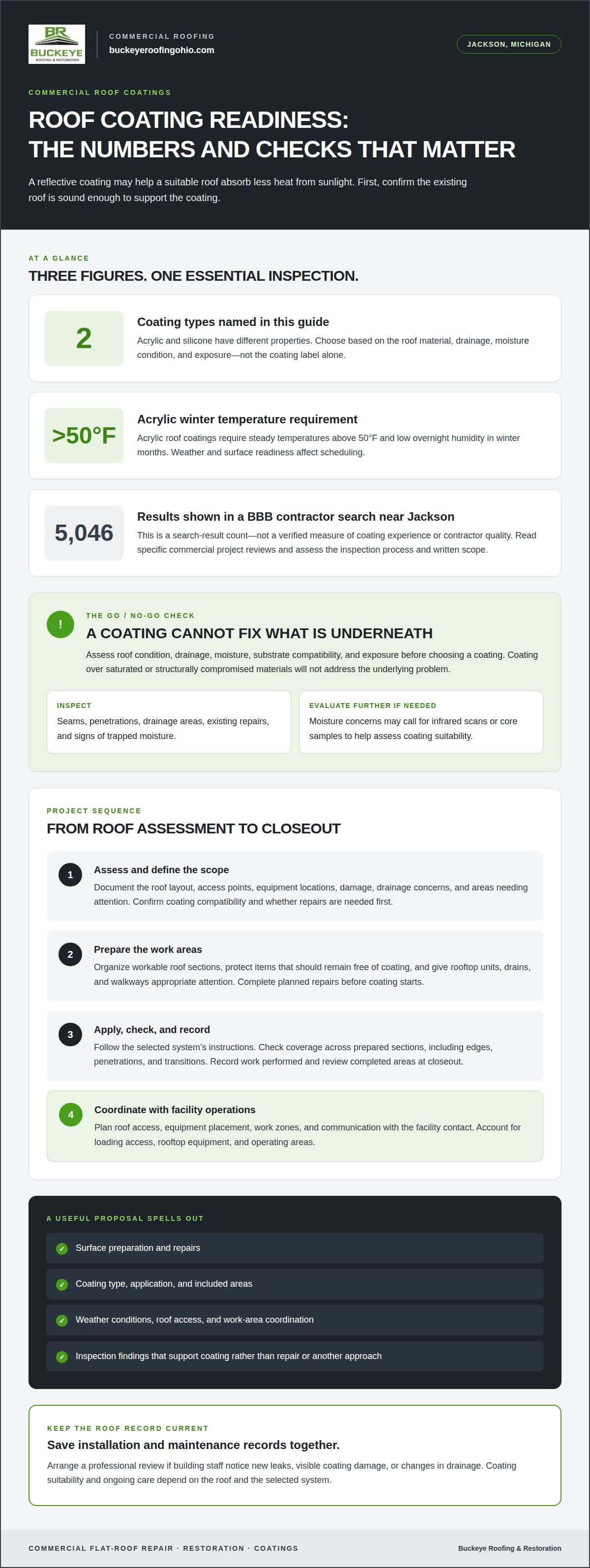
Winter scheduling needs particular attention in Jackson. Acrylic roof coatings require steady temperatures above 50 °F and low overnight humidity in winter months. Weather can affect whether the surface is ready and whether application conditions are suitable. A professional should account for forecast conditions and the coating system’s requirements before setting an installation schedule.
Commercial roofing in Jackson, Michigan, should also account for business operations. A manufacturer may need loading areas kept accessible, while an office property may need advance notice about work zones. Before crews begin, discuss access, roof entry, equipment placement, and communication with the facility contact.
During an assessment, a professional may inspect seams, penetrations, drainage areas, and existing repairs. Moisture concerns may require further evaluation, such as infrared scans or core samples. These checks help determine whether the roof can support a coating or needs repairs first. Coating over saturated materials will not resolve the underlying condition.
Before approving a proposal, confirm that it specifies preparation, repairs, coating application, and the areas included. Winter conditions, roof access, existing damage, and coating compatibility all affect the work plan. A clear scope gives building owners a practical basis for evaluating the recommendation and planning around operations.
Roof coating preparation and installation
A commercial coating project needs a defined work sequence, not just an application crew and materials. Before work begins, the roofing professional documents the roof layout, access points, equipment locations, and areas needing attention. This plan helps coordinate work with facility operations and clarifies which sections crews will address.
Preparation involves organizing the roof into workable areas and protecting items that should remain free of coating. Rooftop units, drains, walkways, and other details need appropriate attention during the job. The crew also confirms that planned repairs are complete before coating starts. This coordination reduces the chance of overlooking transitions or coating areas that still need separate work.
Application proceeds across prepared sections according to the selected system’s instructions. The crew monitors coverage and pays close attention to changes in roof geometry, including edges, penetrations, and transitions. These details interrupt broad, open roof surfaces and require careful workmanship. The application plan should account for how each section connects with adjoining areas.
Quality checks during installation help the roofing professional spot missed areas or uneven coverage while work is underway. The crew can review completed sections before moving on, then record the work performed and any conditions that affected application. For facility managers, this documentation provides a useful record for future maintenance and roof evaluations.
Building operations also shape the installation plan. A warehouse may need loading access maintained, while a manufacturing facility may require coordination around rooftop equipment or operating areas. The roofing professional should explain how crews will access work zones and communicate changes affecting the facility. Clear coordination helps managers plan site activity alongside daily operations.
Commercial roof coating maintenance and inspection needs depend on the selected system and its care instructions. Keep installation and maintenance records together, and arrange a professional review if building staff notice new leaks, visible coating damage, or changes in drainage.
At project closeout, the roofing professional can review completed areas, note repairs, and provide maintenance guidance for the installed system. These details give facility managers a practical reference for future roof reviews. To discuss an assessment for a commercial roof, request a roof inspection.
What Is Best for a Commercial Flat Roof?
In Michigan’s climate, acrylic or silicone may suit a roof when the coating matches its existing surface and drainage conditions. Coating will not fix saturation, insulation failure, structural damage, or persistent drainage problems. Those issues need attention first.
Restoration Eligibility
Suitability depends on the condition of the entire roof assembly, not simply whether the surface looks worn. A professional evaluates the membrane or roof surface, seams, penetrations, drainage, structural integrity, and signs of moisture in the insulation. A dry, stable roof with repairable defects may be a candidate for restoration. Trapped moisture or widespread deterioration changes the decision because coating cannot correct damage beneath the surface.
For example, a roof with isolated seam failures and sound surrounding materials is different from one with recurring leaks and saturated insulation. A moisture assessment helps distinguish between these conditions. Drainage matters too: coating will not correct ponding caused by poor slope or blocked drains. Restoration suitability depends on inspection findings, not on an assumption that every aging roof can be coated.
Restoration, Repair, or Replacement
Repair addresses a specific defect, such as a damaged seam or flashing detail, while leaving the rest of the roof system in place. Restoration involves cleaning and repairing an existing roof before applying a liquid coating system. It can make sense when the underlying assembly remains suitable and the problems can be addressed.
Replacement removes and renews the roofing system rather than treating the existing surface. A professional weighs the extent of deterioration, moisture findings, drainage, and structural condition to compare these options. A targeted repair may fit an isolated leak; broader but manageable wear may support restoration. If the assembly has widespread damage, replacement may be the more appropriate path. A commercial roof restoration assessment can clarify the work involved.
Restoration Benefits and Limitations
A coating can add a protective layer to a suitable existing roof, helping maintain its surface and improve reflectivity when a reflective system is selected. Restoration also means a worn roof does not automatically require replacement. Its practical value comes from matching the work to the roof’s actual condition, rather than applying coating simply because it is available.
There are limits. Coating over saturated insulation, structural problems, or unresolved leaks leaves the underlying issue in place. Coating also depends on compatibility with the existing surface and adequate preparation. In Jackson, seasonal weather affects installation conditions and later roof performance. An inspection should identify repairs and drainage concerns before coating is recommended as a complete solution.
Coating Systems for Michigan’s Climate
Acrylic and silicone are common coating categories, but neither is automatically best for every commercial roof. Acrylic can suit a roof when its surface, drainage, and application conditions align with the system requirements. Silicone needs at least 40 °F to cross-link properly. The building’s exposure and expected weather conditions also influence system selection.
Ask the roofing professional to connect the recommendation to the roof material, water exposure, drainage, and installation conditions. For instance, standing water calls for careful evaluation before selecting a coating, while a roof with reliable drainage presents different considerations. The coating must be compatible with the existing roof and installed under suitable conditions. Jackson’s seasonal temperature shifts make these factors part of the decision, not an afterthought.
Q: What is a Cool Roof?
A cool roof reflects more sunlight and absorbs less solar heat than a darker roof surface. A bright white or light-gray coating can reflect up to 80% of incident sunlight. That reflective surface can reduce roof heat buildup, but it doesn’t correct leaks or replace a sound drainage plan.
Michigan buildings have different low-slope roof assemblies, and coating suitability depends on the existing roof’s material and condition. Buckeye Roofing & Restoration applies coatings to several roof types, but each surface needs preparation suited to its materials. Common candidates include:
- TPO and PVC: These single-ply membranes need preparation compatible with their surfaces.
- EPDM: This rubber membrane has distinct preparation requirements.
- Modified bitumen: Its surfaced or smooth finish affects coating preparation.
- Built-up roofing: The existing surface and condition guide the coating approach.
- Metal roofing: Seams, fasteners, and existing finishes require assessment.
These systems are not interchangeable. An EPDM roof and a metal roof, for example, have different seams, surfaces, and repair details. A professional evaluates the substrate, existing repairs, drainage, and moisture before recommending a coating. That assessment determines whether the roof can accept the system and what preparation it needs.
"Flat" commercial roofs are generally low-slope roofs designed to drain water. A coating can protect a suitable surface, but it does not create slope or fix blocked drains. On a warehouse roof in Jackson, for instance, persistent ponding calls for drainage evaluation before coating. Water movement and roof condition matter as much as reflectivity.
Reflective coatings can change how much heat the surface absorbs. A dark commercial roof in Jackson can absorb solar heat during summer afternoons, with temperatures frequently exceeding 150 degrees Fahrenheit. A properly installed coating from Buckeye Roofing & Restoration can lower roof surface temperatures by 50 degrees. That figure describes a possible surface-temperature change, not a guaranteed indoor temperature or energy result for every building.
In Jackson, coating selection should account for the existing roof, building use, drainage, and installation conditions. A white coating may suit a sound roof where reflectivity is desired, while another roof may need repair first. The right next step is matching coating compatibility and preparation to the specific membrane or roof surface, rather than choosing by color alone.
Acrylic and silicone coating types
Acrylic and silicone describe broad coating categories, not one uniform product. Formulations and performance claims vary, so the category name alone cannot establish how a coating will perform on a commercial roof. Product documentation should identify the intended use and the specific properties of the proposed system.
Some acrylic coating products may be described by their manufacturers as instant-setting, resistant to wash-off, or able to reduce heat transfer. These claims are product-specific and should be verified in the documentation for the proposed system. For a facility manager comparing options, the useful distinction is whether the documentation connects the claimed benefit to the proposed system and the building’s needs.
Silicone and acrylic coatings are designed to resist natural weathering and provide watertight protection. That shared purpose does not make their formulations interchangeable. The professional recommendation should identify the selected coating system and explain why its documented characteristics suit the project. A broad phrase such as “reflective coating” is less clear than a named coating category and defined application scope.
Compare proposals by examining the specific system description, rather than treating “acrylic” or “silicone” as a complete specification. The scope should state which coating category is proposed, where it will be applied, and how the product’s stated properties relate to the roof’s intended use. This helps prevent a performance claim for one formulation from being assumed to apply to every product in that category.
Claims about heat transfer or energy efficiency also need careful interpretation. Some acrylic products may be described as reducing heat transfer or increasing energy efficiency, but these product-specific claims do not establish a particular building’s energy results. Facility managers can consider them as product information while keeping operational outcomes distinct from the coating’s stated features.
For a commercial property in Jackson, the choice should follow the written project scope and the actual product documentation. A warehouse, office, or manufacturing building may have different operating priorities, so the stated coating properties should relate to the building’s purpose. Clear product identification also keeps maintenance records useful after installation.
Before work begins, project documents should identify the selected system, the areas covered, and the coating’s stated purpose. That gives the property team a clear record of what was installed, rather than a generic label. It also makes future maintenance discussions more specific.
To discuss a coating assessment for your commercial building, contact Buckeye Roofing & Restoration.
Buckeye Roofing & Restoration: Commercial Roof Coatings
Buckeye Roofing & Restoration helps commercial property owners assess whether an existing low-slope roof is suitable for coating. An inspection considers the roof surface, drainage, moisture, and repair needs before the next step is recommended.
If coating suits the roof’s condition, Buckeye provides commercial roof coatings and restoration. If specific defects need attention first, its commercial flat roof repair service can address them. Coating is not a substitute for correcting underlying moisture, structural, or drainage problems, so recommendations should reflect inspection findings.
For a commercial property in Jackson, a roof assessment can help clarify whether coating, repair, or restoration makes sense. Contact Buckeye Roofing & Restoration to discuss an inspection for your commercial roof.
Make the Next Roof Decision with a Clear Plan
For commercial roof coating services in Jackson, Michigan, the useful next step is a plan tailored to the roof, not a decision based on coating color or material name. Note what your facility team has observed, such as recurring interior leaks, visible surface changes, or drainage concerns. This context can help focus an inspection on the building’s needs and operating conditions.
Buckeye Roofing & Restoration provides commercial flat roofing, commercial flat roof repair, and commercial roof restoration. An inspection can help determine whether coating belongs in the plan or another roofing solution better suits the roof’s condition. The recommendation should account for the existing system and any work needed before coating is applied.
When you’re ready to discuss your building, contact Buckeye Roofing & Restoration. A clear assessment can help you choose a practical next step for your commercial roof.
Frequently Asked Questions
Q: How long is an Elastomeric Warranty?
There is no standard warranty term for every elastomeric coating system. Coverage depends on the specific product, installation scope, roof condition, and written warranty terms. Review what the document covers, including any maintenance or inspection conditions, before approving a project. A warranty does not replace an assessment of the roof’s condition or establish that coating is the right solution.
Q: What is Fluid Applied Roofing?
Fluid-applied roofing is a liquid coating system installed over a prepared roof surface, where it cures into a protective layer. It can be used for restoration when the existing roof is suitable and compatible with the system. Application differs from installing a new sheet membrane. The proposal should identify the substrate, preparation, repair scope, and coating system.
Why Consider Roof Restoration?
Consider restoration when the roof assembly remains suitable but needs repairs and a protective coating. For example, a building owner may want to address localized wear without replacing the entire roof system. Restoration can be a practical alternative to replacement, but it cannot resolve concealed moisture or structural issues. Inspection findings, rather than age or appearance alone, should support the decision.
commercial roof coating cost per square foot in Michigan
Actual costs depend on the roof’s condition, preparation, repairs, and coating system.
roof coating estimates for commercial buildings in Jackson MI
The contractor should inspect the roof and provide a written scope covering preparation, repairs, coating type, and project limits.
silicone vs acrylic vs polyurethane roof coatings for commercial roofs
Acrylic and silicone must be matched to the roof’s material, drainage, moisture, and exposure. Acrylic requires steady temperatures above 50 °F and low overnight humidity; silicone needs at least 40 °F to cross-link properly. The material provides no basis for comparing polyurethane.

Article by
Harry Stanley III
Harry Stanley III is a construction marketing strategist and fractional CMO at H&A Marketing. He has helped construction companies grow through website strategy, SEO, paid advertising, branding, lead generation, CRM systems, and professional content. His past work includes helping Meraki Solar generate an additional $3.7 million in revenue in his first year and supporting American Builders as a fractional CMO. Today, Harry works directly with custom home builders and construction companies to build marketing systems designed to generate qualified leads and measurable growth.